Good pontoon docking lights illuminate the dock edge, cleats and nearby obstacles without throwing unnecessary glare toward the helm or other boats. Start with a marine fixture that fits your mounting surface and electrical system, then choose the beam pattern. An impressive wattage claim is not enough to establish whether a light will help in your particular slip.
For a broad surface-mount option, consider Attwood’s 6522SS7 or black-finish 6523BK7 pair. ITC’s 69389E-SS is worth checking for a left/right side-mount replacement. Five Oceans’ FO4600-M2 offers separate forward and side-facing beam directions, with a dimensional discrepancy to resolve before ordering. These are specification-based recommendations, not results from on-water testing.
First, docking lights are not navigation lights
White docking lights provide local illumination. They do not replace the red, green or white navigation and anchor lights your boat is required to display. Do not assume a product qualifies as a navigation light because a marketplace places it in that category.
Under Navigation Rule 20, other lights must not be mistaken for the prescribed lights, impair their visibility or distinctive character, or interfere with keeping a proper lookout. The Coast Guard also warns against improper searchlight use, including continuous use that interferes with navigation lights and shining lights at other vessels.
Use docking lights briefly when needed for close maneuvering, aim them responsibly and switch them off when they are no longer useful. Keep the correct navigation lights operating. A brighter view of one patch of water does not remove the need for a lookout, safe speed and awareness of hazards outside the beam.
1. Attwood 6522SS7 and 6523BK7: a broad-beam surface-mount pair

Attwood 6522SS7, Stainless Steel Bezel with White LED, Docking-Light Pair
As an Amazon Associate we earn from qualifying purchases.
Attwood’s stainless-bezel 6522SS7 is a useful starting point when you want two compact surface-mount lights. The current Attwood catalog identifies this model as a white-LED pair and lists 5 watts at 12 V DC for each light. Its surface-mount arrangement uses a small wiring hole and three mounting screws per light, rather than a large recessed opening.
Attwood’s model-specific product brochure shows a 120-degree light pattern. That broad spread is the reason to consider it for close docking work instead of selecting a narrow spotlight solely for distance.
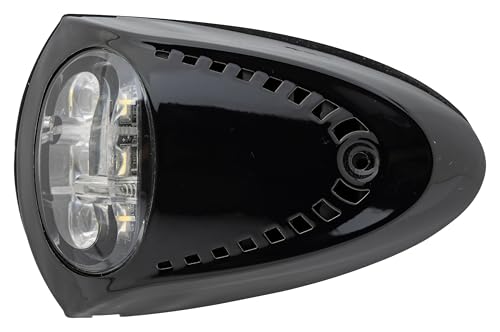
The 6523BK7 is the black powder-coat bezel version of the same general surface-mount design. Both emit white light; black describes the housing finish. Choose between them primarily for fit and appearance, not an assumed difference in beam reach.
Check before buying: verify the mounting footprint, cable access and three-screw pattern against your pontoon. Attwood lists the required #8 stainless screws as not included. A pair of lights is not a complete switch-and-wiring kit, and “universal” does not guarantee that existing holes will line up.
2. ITC 69389E-SS: for a matching left/right side-mount installation

ITC’s side-mount pair deserves a look when replacing similar lights or planning an installation along the sides of the bow. The manufacturer’s product page specifies a 304 stainless housing, sealed IP66 construction and a 10–14 V DC operating range. The exact linked configuration is polished stainless and contains the left and right lights.
Its published light specification is 300 lumens. Treat that as a manufacturer specification rather than proof it will outperform the other products here: aiming, beam spread and mounting position can matter more at the dock. The product page also identifies fiberglass-hull mounting, so an aluminum pontoon installation deserves a specific check of the mounting surface, fasteners and isolation requirements.
Check before buying: ITC’s 69389 installation sheet calls for a half-inch wiring hole and tells installers to disconnect power first. This is a 12-volt-class fixture, not a light to connect directly to a 24-volt supply. Confirm the orientation and dimensions before using it as a replacement.
3. Five Oceans FO4600-M2: for forward and side coverage

This two-light set is an option when you want both a focused forward beam and wider illumination alongside the docking area. The Five Oceans product page describes three forward LEDs with a 20-degree beam and eight top-array LEDs with a 90-degree beam. It specifies 12 V operation, an IP66 rating, a polished stainless housing and a polycarbonate lens.
The design may suit a layout where light needs to cover more than the area directly ahead. However, two beam directions do not establish that you can switch those arrays independently; confirm the wiring if separate control is important.
Check before buying: the manufacturer’s listed height does not agree between inches and millimeters. Get a confirmed dimension or mounting drawing before ordering for a tight space or drilling. Do not rely on the listing’s “flush mount” wording to assume it will fit an existing recessed opening. This is a conditional choice when you can resolve the fit first.
What matters most on a pontoon?
Useful coverage instead of maximum brightness
Think about what you need to see during the last few feet of an approach: the dock face, a cleat, a piling or the trailer. A broad beam can help show the immediate area, while a focused beam can create a bright patch and leave the sides dark. Also consider reflections from polished rails, pale upholstery and the water.
There is no defensible single brightness winner here. The manufacturers do not provide a common comparison measured at the same distance and angle. Compare the mounting location and beam pattern first, and confirm whether any quoted output or current applies to one fixture or the complete pair.
Mounting, corrosion and access
Measure the housing footprint, cable hole, fastener spacing and space behind the panel. Check gate movement, fenders, rub rails and boarding areas. The light should not become a snag point or require drilling into a structural member without the boat builder’s approval.
IP66 is a water-ingress protection rating, not permission for indefinite submersion or proof of unlimited saltwater durability. The housing, fasteners, wiring connections and installation all need to suit the boat’s environment. A marine installer can advise on corrosion protection where dissimilar metals meet.
Electrical compatibility
Check supply voltage, total fixture load, wiring condition, cable-run length and circuit protection before replacing halogens or adding a new pair. Use suitable marine wiring and sealed connections, protect cable penetrations and follow the light and boat manufacturers’ instructions. Have a qualified marine electrician size or modify the circuit if those details are uncertain.
A separate docking-light control makes it easier to keep local illumination off while retaining the required navigation lighting. After installation, check the view from the helm and from outside the boat at dusk, safely secured at the dock. Look for glare, obscured navigation lights and shadows before relying on the setup during an approach.
Bottom line
Start with the Attwood pair for broad surface-mounted light, investigate ITC for a compatible left/right replacement, and consider Five Oceans when its mixed beam pattern fits your needs and its dimensions are confirmed. Correct installation and restrained use matter more than adding the brightest lights you can find.
Image note: AI-generated generic editorial illustration; not a photograph of a named or tested product.