


A good stainless steel snap shackle starts with the right release mechanism, attachment geometry and manufacturer-published load rating. For a sailboat sheet or halyard, a similar-looking key clip or general-purpose spring hook is not enough information to make a safe substitution.
Two models worth comparing are the Wichard 2673, a compact lanyard-operated quick-release shackle, and the Ronstan RF6120, a large-bail swivel snap shackle with a plunger release. Their published specifications make the differences clear. Neither should be chosen from a breaking-load number alone.
Safety first: this guide covers marine hardware selection. Use a shackle only in a configuration and application approved by its manufacturer. Do not substitute these products for certified climbing, fall-arrest, rescue or overhead-lifting equipment.
Two stainless steel snap shackles to compare
- Wichard 2673: 70 mm overall length, swivel eye, lanyard-operated quick release; manufacturer specifies spinnaker sheets and halyards.
- Ronstan RF6120: 73 mm overall length, swiveling large bail, plunger-pin release; compare its dimensions with the intended marine attachment.
These choices illustrate different mechanisms rather than a universal first-place and second-place ranking. The better purchase is the one that fits the approved rigging arrangement and meets its load requirements.
1. Wichard 2673: compact quick release for specified sailing uses
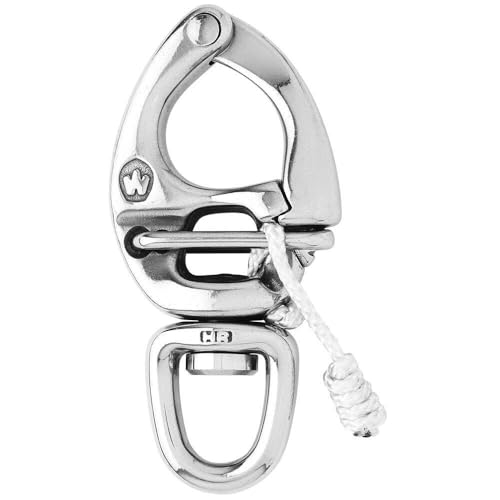
Wichard 2673 HR Quick-Release Snap Shackle, 70 mm Swivel Eye Stainless Steel, 1 Shackle
As an Amazon Associate we earn from qualifying purchases.
The Wichard 2673 specification describes a forged 17-4 PH stainless steel quick-release shackle with a swivel eye. Wichard identifies spinnaker operations, specifically sheets and halyards, as its applications. The mechanism opens by pulling its lanyard.
Its published dimensions and ratings are:
- Overall length: 70 mm, sold in the selected listing as 2-3/4 inches
- Weight: 59 g
- Nautical working load: 880 kg
- Breaking load: 1,500 kg
- Drawing dimensions A and B: 14 mm and 11 mm
This is a focused option when a compact swivel-eye quick-release arrangement is specified. Check the drawing against the actual attachment points, not just the advertised overall length.
Important model distinction: 2673 and 2473 are different Wichard products. The 2473 has a captive plunger-pin mechanism and different published ratings. Both are 70 mm long, so size alone will not catch a mistaken order. The buying card above is for one 2673 shackle.
2. Ronstan RF6120: large-bail swivel alternative
The Ronstan RF6120 is a 73 mm swiveling large-bail snap shackle. Ronstan specifies an investment-cast 15-5 PH stainless steel body and hasp, with a 316 stainless steel plunger pin and spring.
The manufacturer’s U.S. page lists a maximum working load of 1,655 lb and a breaking load of 3,310 lb. Its metric page gives the corresponding published figures as 750 kg and 1,500 kg. Weight is listed as 57 g, or 2.0 ounces. Keep the manufacturer’s unit system visible when comparing these numbers.
The large bail is the main reason to investigate this model: its attachment geometry differs from a compact small-eye shackle. Ronstan lists drawing dimensions A, B and C as 5/8 inch, 1/2 inch and 2-7/8 inches. The plunger’s split ring is spot-welded, and a lanyard can be attached to that ring.
Check before ordering: match RF6120 and the large-bail drawing. Do not confuse it with Ronstan’s fixed-bail, small-bail or fork-swivel models. Use the manufacturer’s product page to locate the correct part through a supplier and confirm the quantity offered.
Working load and breaking load are different numbers
Breaking load describes a failure threshold under stated test conditions. It is not a recommended operating load. Ronstan’s definitions explain that maximum working load relates to continued function without excessive friction, distortion, wear or permanent deformation, while breaking load concerns major structural failure when the product is new.
Actual selection also depends on load direction, fatigue, shock loading, environment and the consequences of failure. A line that jerks tight does not create the same situation as an uncomplicated static weight. If you cannot establish the required load and margin for the complete rigging arrangement, ask the manufacturer or a qualified rigger before choosing hardware.
Do not apply a universal conversion between breaking load and usable capacity. Follow the selected manufacturer’s definitions and instructions for the specific application. In particular, Wichard labels the 2673 figure as a nautical working load; it should not be relabeled as an industrial lifting working-load limit.
Check geometry as carefully as strength
A shackle can have an adequate published rating and still be the wrong shape for the job. Before buying, compare:
- Eye or bail opening: will the specified line, ring or fitting fit in the intended orientation?
- Overall length: will the connector interfere with nearby hardware or change the planned arrangement?
- Swivel requirement: does the application call for rotation, or is a fixed attachment specified?
- Release access: can the mechanism be reached as intended without another fitting obstructing it?
- Complete assembly: are the connected line, splice and other fittings also appropriate?
Check that no adjacent component forces the shackle sideways or presses on its release mechanism. A product photo rarely provides enough information to establish that fit. Use the dimension drawing and the instructions for the complete system.
Quick release does not mean every snap opens the same way
A plunger-pin snap shackle, a trigger-release shackle and a general spring-gate clip have different mechanisms. The fact that one manufacturer describes a specific model as releasable under load does not establish that behavior for every item advertised as a snap shackle.
For a planned under-load release, obtain the exact manufacturer’s operating instructions and approval for the application. Do not improvise a release procedure or test it with a person, suspended weight or uncontrolled loaded line attached. Accessible release controls also need protection from unintended contact in the installed arrangement.
Inspection and care belong in the buying decision
Stainless steel still needs inspection. Wichard’s public maintenance guidance calls for checking marine hardware for deformation, wear, cracks and corrosion and recommends fresh-water rinsing after use. Also check for an unreliable closing or release mechanism. If the history is unknown or the hardware has been overloaded, get qualified advice before returning it to service. A polished surface alone does not establish its condition.
Wichard also advises against using its 17-4 PH hardware in submerged conditions such as moorings. Do not interpret “marine” as approval for permanent underwater use. Follow the maker’s cleaning, lubrication and inspection instructions for the exact product. Avoid modifying the body, substituting an improvised pin or forcing a sticking mechanism back into service. Availability of the correct documentation and manufacturer support is a useful buying criterion, particularly when replacing existing rigging hardware.
The bottom line
Choose the Wichard 2673 for an approved compact, swivel-eye quick-release arrangement in its specified sailing applications. Compare the Ronstan RF6120 when a large-bail plunger-release design better matches the installation. In both cases, confirm the exact model, geometry, working-load requirements and operating instructions before purchase.
Image note: AI-generated editorial illustration; not a photograph of the named product.