


Marine tower lights are usually work lights mounted on a wakeboard tower, T-top, arch or hardtop to illuminate the deck. Choose them by mounting method, beam coverage, electrical demand and glare control. A powerful forward-facing light can make nighttime visibility worse if it reflects off the bow or shines into another operator’s eyes.
For a bracket-mounted deck light, the Lumitec Caprera3 101713 is a straightforward white-only option. For a compatible recessed installation, the Lumitec Capri2 101099 provides dimmable white and blue output. These are auxiliary floodlights, and neither replaces the navigation or anchor lights required for your vessel.
Start with the mounting job
- Bracket installation: compare the Caprera3 101713 if you have a suitable mounting point and want to aim a flood beam toward a work area.
- Flush installation: compare the Capri2 101099 if you have a suitable panel, the correct cutout and sufficient clearance behind it.
- Clamp-on tower installation: check the tower’s outside diameter and an approved mount separately. Neither “marine” nor “tower light” means a universal tube clamp is included.
This guide compares documented specifications and installation requirements. It does not claim on-water testing, measured beam coverage or a universal fit for a particular boat.
Lumitec Caprera3 101713: white-only bracket-mounted floodlight
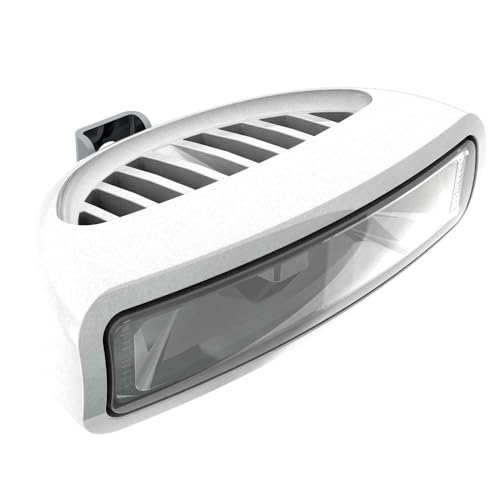
Lumitec Caprera3 101713, White Housing and White Non-Dimming Output, Single Spreader Light
As an Amazon Associate we earn from qualifying purchases.
The Caprera3 is a bracket-mount floodlight with a powder-coated die-cast aluminum housing. The exact 101713 variant has a white housing and white, non-dimming output. Lumitec’s model-by-model product guide lists 1,200 lumens, a 10–30 V DC operating range, 1 amp at 12 volts and 0.5 amp at 24 volts. The family is IP67 rated.
That makes it a sensible candidate for an owner who wants simple deck illumination from a suitable bracket mounting point. The flood pattern is intended to spread light across an area rather than concentrate it into a long-distance search beam. Mounting height and angle determine where that light actually lands.
The important variant check: 101713 does not dim or change color. Other Caprera3 part numbers offer dimming, dual-color or RGBW output, so their control features should not be copied onto this listing. The Capri3/Caprera3 operating instructions explicitly identify white-only non-dimming lights as simple on/off products.
Main limitation: the bracket still needs a structurally suitable mounting location. It is not evidence that the light includes a clamp matched to your tower tubing. Check hardware, cable routing and the boat or tower manufacturer’s mounting guidance before drilling.
Lumitec Capri2 101099: recessed white/blue deck lighting

The Capri2 101099 is a flush-mount option with white housing and two selectable light colors: dimmable white and dimmable blue. Lumitec’s exact-model page lists 1,000 lumens, 10–30 V DC operation, 1.3 amps at 12 volts, 600 mA at 24 volts and an IP67 rating. The white-output specification is not a separate lumen guarantee for the blue mode.
This is worth comparing when replacing a compatible existing recessed fixture or planning a panel installation where a protruding bracket is undesirable. Its timed-toggle control uses brief power-switch interruptions to select dimming and change color. Check the supplied instructions so the behavior suits the switches already on the boat.
Main limitation: flush mounting requires a correctly sized opening, fastening points and space behind the panel. An existing hole is not automatically compatible because an older fixture was also called Capri. The Capri2 installation sheet calls for qualified installation and at least 1 inch of clearance around the sides and back for airflow.
Blue output is an optional appearance feature, not proof of better night vision or permission to run decorative lighting underway. Consider the effect on other vessels and the visibility of the boat’s required navigation lights.
What makes a useful tower or deck light?
A beam that lands where you work
For rigging tackle, handling lines or cleaning a cockpit, broad coverage is usually more useful than a tightly concentrated spot. Look at a manufacturer’s beam diagram when available, then consider the actual mounting height and obstructions. A bright patch on the deck with dark steps beside it can be less useful than a lower-output, more evenly placed light.
Temporarily check the intended aim before final mounting. Watch for light reflected from white gelcoat, polished rails, windows and the underside of the hardtop. Aim deck floods down toward the task rather than treating them like road-vehicle headlights.
Sealing plus a sound installation
Both choices carry an IP67 rating. That addresses specified dust and water-ingress protection; it does not make an installation immune to corrosion, damaged seals or water entering an unprotected splice. Keep cable joints protected, support the wiring and follow the fixture’s installation instructions. A sealed light still depends on properly prepared mounting holes and connections.
Exact controls and color output
Decide whether you need simple on/off light or genuinely need dimming. White-only, dual-color and full-color models can share a housing while having different part numbers and controls. If you have a boat lighting controller, verify compatibility with the exact light rather than assuming every model in a product family supports it.
Plan power, switching and wire length
Check whether the boat uses a nominal 12- or 24-volt DC system. Add the current draw of every light on the circuit, then account for the complete cable route. Two Caprera3 101713 lights have a combined listed draw of 2 amps at 12 volts; that arithmetic is a running-load estimate, not a fuse or wire-size recommendation.
Lumitec’s wire-gauge guidance uses the out-and-back cable length, system voltage, total load and allowable voltage drop. Its fuse-selection guidance also considers the smallest wire’s current capacity and circuit protection near the power source. Have a qualified marine installer resolve the circuit design if those details are uncertain.
Give auxiliary deck lights their own appropriate switching arrangement so you can extinguish them without losing required navigation lighting. Include the cost of mounts, wire, connectors, switching, protection and labor when comparing installations; the fixture is only part of the job.
Navigation lights, glare and radio interference
The U.S. Coast Guard’s navigation-rules guidance warns that additional high-intensity or decorative lights can obscure navigation lights, confuse another operator or interfere with a proper lookout. View the completed installation from outside the boat and from the helm. Adjust or turn off auxiliary lighting if it creates those problems, and check the rules applying to your vessel and waters.
A white deck flood does not become an approved all-round anchor light simply because it is bright. Required navigation fixtures have defined color, visibility and sector requirements. Keep them unobstructed by tower lights, speakers, canvas and other accessories.
The Coast Guard also notes that some LED lighting can interfere with AIS and VHF reception. Check radio performance with the new lights switched off and on, especially when wiring or fixtures are close to antennas. Investigate any added noise or reception loss before relying on the installation.
Questions about marine tower lights
Will these fit a wakeboard tower?
That depends on the available mounting surface or approved adapter, not just the tower’s name. Measure tubing if you need a clamp, check load and clearance, and confirm that the light can be aimed without obstructing required lights or equipment.
Can I use them as navigation lights?
No. These two products are auxiliary deck floodlights. Choose separately specified navigation fixtures for the vessel’s required lighting arrangement.
Which is the better starting point?
For a new bracket-mounted white work light, start by checking the Caprera3 101713’s mounting fit. For an existing compatible flush installation where white/blue dimming is wanted, compare the Capri2 101099. In either case, a well-aimed, properly wired installation matters more than chasing the largest lumen number.
Image note: AI-generated editorial illustration; not a photograph of the named product or a compatibility/installation diagram.