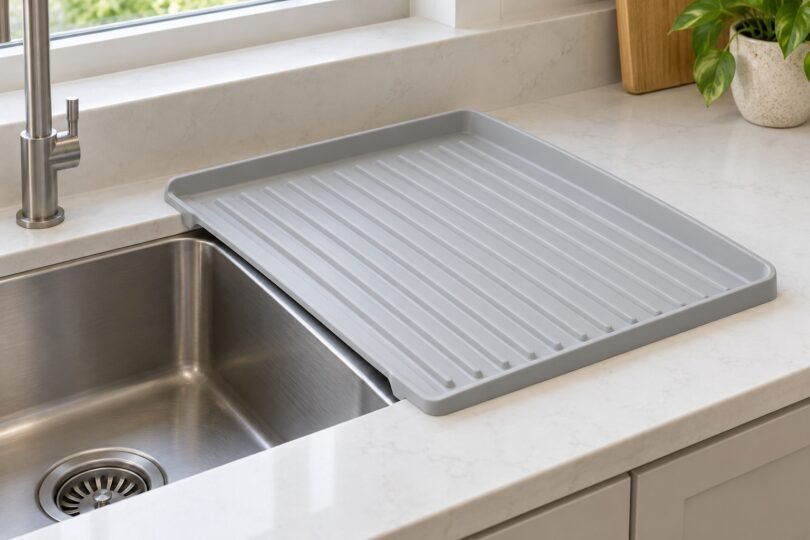

A dish rack drain board needs to do two jobs: catch the drips from your rack and send them somewhere useful. The right choice depends on your rack’s footprint, the height of your sink rim, and whether you want water to drain automatically or collect for emptying later.
If your existing rack works well, start with a standalone board. For occasional cups and pans, a drying mat may be enough. Replace the whole rack only when you also need different plate supports, more capacity, or an integrated drainage system. The options below are compared using manufacturer specifications and care instructions, rather than hands-on testing.
Drain board, drip tray, or complete rack?
- Standalone drain board: a separate base used beneath a rack or directly beneath dishes. A draining version needs a slope and an outlet positioned over the sink.
- Collecting tray: catches water until you empty it. Raised edges alone do not mean a tray drains automatically.
- Drying mat: provides a resting surface for dishes. Do not assume a ribbed silicone mat absorbs water or has a route into the sink.
- Complete dish rack: combines dish supports with a tray and, sometimes, a movable spout. Its tray may be a model-specific component rather than a universal replacement.
Measure these four things before buying
- The rack’s feet and drip area. Measure between the outermost feet, then include utensil baskets and cup holders that hang outside the frame. All feet need stable support, and drips from overhanging items must land on the board. The board’s outside dimensions are not necessarily its usable inside dimensions.
- The counter footprint. Mark the proposed length and width with removable tape. Check access to the faucet and soap dispenser, and leave enough room to lift the tray out for cleaning. For an expanding rack, measure its open position too.
- The sink rim. Measure how far a drop-in sink’s rim rises above the counter. The outlet must reach over that rim without forcing the board to tilt backward. Overall product height does not tell you the clearance beneath the outlet.
- The outlet’s reach and direction. Measure from the intended board position to the inside edge of the sink bowl. Check which side drains. A swiveling spout changes direction; an extendable spout changes reach. Those are different features.
If a listing omits usable tray dimensions or outlet clearance, ask the seller for those measurements. A photograph beside an undermount sink does not establish compatibility with a raised sink rim. Avoid balancing a loaded rack on makeshift blocks to overcome a poor fit.
Standalone boards and compact alternatives
IKEA RINNIG: a reversible draining or collecting board
The white RINNIG, article 606.013.48, measures 15¾ inches long by 12¼ inches wide by 1¼ inches high. IKEA specifies a polypropylene tray, synthetic-rubber feet, and handwashing only. Its two-sided design lets you choose between directing water into the sink and collecting it to pour away later. The plate holder shown as an add-on is separate. See IKEA’s RINNIG specifications.
This is a useful starting point for a modest drying area or a compatible existing rack. Its flexibility is the attraction, but check the feet against the usable board surface. The published overall height is not a sink-rim clearance rating.
Better Houseware Drain Board: a larger replacement footprint
Better Houseware’s standard Drain Board measures 19½ by 15½ by 1¼ inches high and is made from polyethylene. The manufacturer describes it as accommodating large dish racks. That makes it worth checking when compact boards are too small for your existing rack. Use the standard Drain Board specification, since the separately named Junior model is smaller.
Do not treat “large” as a compatibility guarantee. The maker does not publish usable interior measurements, sink-edge clearance, or dishwasher approval on this page. Confirm the outlet arrangement and care label for the exact color and item you order. Choose it for its documented footprint, not an assumed fit with every rack.
Joseph Joseph Flip-Up: a board with its own folding plate support
The gray Flip-Up, model 85139, combines a draining board with a plate support that folds down for storage. Joseph Joseph lists capacity for up to six dinner plates, non-slip feet, and an integrated spout. Published dimensions are 40 by 31.9 by 2.4 centimeters, approximately 15¾ by 12½ by 1 inch. It must be washed and dried by hand. See the Flip-Up product details.
Consider it for smaller loads when you want some upright plate storage without leaving a tall rack on the counter. It is a board-and-support combination, so buying it solely as a base for another rack may waste its main feature. Confirm that its fixed outlet reaches your sink.

Joseph Joseph Flip-Up Drain Board, Gray, Model 85139
As an Amazon Associate we earn from qualifying purchases.
Alternatives when a replacement board is not enough
OXO Large Silicone Drying Mat: for a separate drying area
OXO’s Large Silicone Drying Mat, SKU 1410880, measures 16.9 by 12.5 by 0.25 inches. The silicone surface has raised ribs, and the mat can be rolled or hung for storage. OXO labels it dishwasher-safe and heat-resistant up to 425°F for trivet use. These specifications apply to this particular mat. See OXO’s dimensions and care details.
This suits cups, pans, or platters that need a temporary resting area. It is not a self-draining replacement board with a sink spout. Plan to empty residual water and dry the mat and counter beneath it. Do not transfer its heat rating to another silicone product.
Joseph Joseph Extend Steel: replace the entire rack
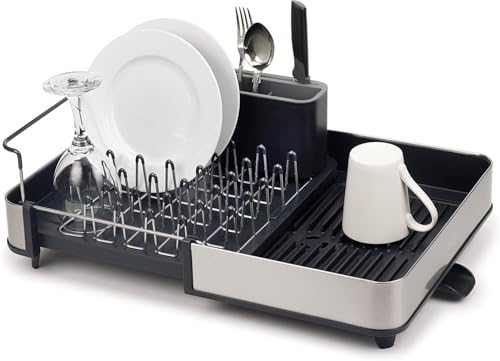
The gray Extend Steel, model 85153, is a complete rack with a movable cutlery holder, coated draining prongs, and a spout with three positions. Joseph Joseph currently lists dimensions of 35.3 centimeters wide by 31 centimeters deep by 16.7 centimeters high when closed; depth increases to 51.5 centimeters when expanded. See the current Extend Steel specifications. Some retailer listings show different measurements, so confirm the supplied unit if clearance is tight.
This is relevant when you need variable drying capacity as well as drainage. The expanding tray and repositionable spout serve different purposes; neither specification establishes clearance over your particular sink rim. The rack dismantles for cleaning and requires handwashing and drying. The maker advises against abrasive cloths and strong chemical cleaners on its stainless-steel parts.
Material and cleaning checks that matter
Choose by the exact care instructions rather than material alone. RINNIG’s plastic tray is handwash-only, while the OXO silicone mat is dishwasher-safe. Stainless-steel trim does not make every component of a complete rack dishwasher-safe, and a dishwasher-safe label does not automatically authorize placing hot cookware on a board.
Keep the drainage channel accessible. Empty collected water, clean the grooves and underside, and let both the board and counter dry before putting everything back. Follow the product’s instructions for detergents and descaling; avoid assuming a strong cleaner is suitable for every coating or plastic.
No board should be chosen on an unsupported promise that it prevents mold, disinfects dishes, or eliminates cleaning. Good drainage is useful, but it does not make a drying surface maintenance-free.
Quick questions before checkout
Can I buy just a replacement tray?
Sometimes. If your rack has a fitted drain fitting, clips, or molded feet, look for a replacement identified for that exact model. A generic board is more promising under an independently supported rack, provided the feet and drip area fit.
Why does a sloped board still hold water?
Check its orientation, whether the outlet is obstructed, and whether the sink rim is pushing the front upward. Inspect the setup empty before loading dishes. Small residual droplets do not establish that a product is defective, but persistent pooling deserves a fit and cleaning check.
Which style should I choose?
Choose a standalone board to keep a serviceable rack, a reversible tray when you sometimes need to collect water, or a mat for occasional overflow. Choose a complete draining rack when dish support and capacity also need changing. In every case, buy the drainage arrangement that fits your measured sink and counter.