
Choose a dust suit by the material you will encounter and the protection your work requires. A hooded white coverall can mean anything from washable work clothing to limited-use protective apparel. Appearance, a “hazmat” label and a low price cannot establish suitability for an unknown exposure.
For a useful comparison, this guide looks at two specific DuPont Tyvek 400 designs and a reusable SAS Safety Moonsuit. The Tyvek models differ mainly in their foot openings: TY127S has elastic ankles; TY122S has attached boots. The Moonsuit provides a washable clothing option, but the reviewed manufacturer specification does not establish equivalent hazardous-particle protection.
Identify the job before choosing a suit
Start by naming the dust or substance. Ordinary dirt on work clothes, demolition debris, chemical spray and a suspected asbestos-containing material need different decisions. If you cannot identify the exposure, pause the job and get qualified advice instead of buying whichever coverall has the broadest claims.
For workplace use, OSHA’s PPE requirements address hazard assessment, appropriate equipment, fit and training. A supervisor or safety professional should establish the complete protection plan. Home projects involving suspected lead, asbestos or other hazardous contamination also deserve specialist assessment before disturbing the material.
- Clothing cleanliness: consider whether washable workwear or a limited-use garment is more practical for a known, non-hazardous task.
- Hazardous particles or liquids: match the exact garment’s manufacturer data to the substance, exposure and work procedure.
- Breathing hazards: evaluate respiratory protection separately. A hood leaves an opening at the face and does not filter the air you breathe.
- Heat, sparks or flame: these ordinary Tyvek 400 models are not flame-resistant workwear.
DuPont Tyvek 400 TY127S: hood and elastic ankles

DuPont Tyvek 400 TY127S Hooded Coverall, White 2XL with Elastic Ankles, One Coverall
As an Amazon Associate we earn from qualifying purchases.
TY127S is the option to examine when the approved clothing arrangement calls for a hooded coverall with elastic wrists and ankles. Its front zipper has a storm flap, and the garment uses serged seams. Footwear and any required boot covers must be selected separately.
DuPont’s TY127S specification identifies the fabric as Tyvek 400 and provides model-specific design, sizing and barrier information. The ankle opening is the practical distinction from TY122S; choosing it is a question of the complete protective arrangement, rather than an upgrade in fabric protection.
- Consider it when: an elastic-ankle design fits the assessed task and compatible footwear plan.
- Check carefully: the interface between trouser legs, footwear and any other PPE during movement.
- Exact linked package: one white 2XL coverall. That size is an example of a verified retail variant, not a suggested size for every wearer.
DuPont Tyvek 400 TY122S: hood and attached boots
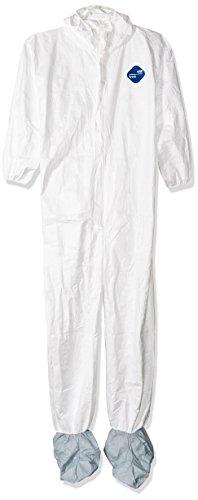
TY122S combines a hooded Tyvek 400 coverall with elastic wrists and attached skid-resistant boots. It is worth comparing when the work procedure calls for that integrated configuration. A complete garment still needs checking for fit, damage and compatibility with the rest of the equipment.
The manufacturer’s TY122S page documents its booted design, serged seams, zipper and storm flap. Attached fabric boots should not be mistaken for protective work footwear. Required impact, puncture, chemical or other foot protection must come from equipment specified for the actual hazard.
- Consider it when: the selected PPE procedure calls for attached boot coverage.
- Check carefully: fit around footwear and the suitability of the whole arrangement for the walking surface. “Skid-resistant” does not mean slip-proof.
- Exact linked package: one white Large coverall. DuPont’s manufacturer case quantity and a retailer’s single-garment listing are different purchasing units.
SAS Safety 6938 Moonsuit: a washable work-clothing option

The 6938 Moonsuit has a rip-stop nylon front and a cotton back, plus a hood, front zipper, elastic waist and adjustable hook-and-loop wrist and ankle closures. SAS describes it as washable and reusable. That can be convenient when your purpose is keeping clothes cleaner during a known non-hazardous job.
The SAS manufacturer specification identifies 6938 as Large and the retail unit as one coverall. It does not provide a Type 5/6 particle or liquid protection rating for this garment. Do not treat the Moonsuit as interchangeable with a hazard-selected chemical-protective coverall.
- Consider it when: washable work clothing meets the task’s requirements.
- Check carefully: the current garment label and cleaning instructions, plus any contaminant-specific restrictions.
- Important limit: a list of possible industries in a product description does not establish protection against every hazard in those industries.
Understand what the protection wording means
A fabric data point and a complete protective system answer different questions. Seams, the zipper, face opening, cuffs and ankle interfaces all matter. Look for documentation for the exact model and revision you are buying; a familiar brand name or similar photograph is insufficient.
“Dust suit” also says nothing about breathing protection. OSHA’s respirator-selection guidance starts with identifying the type and amount of exposure. A particulate respirator is not automatically suitable for a gas or vapor, and an ordinary coverall supplies neither function. Respiratory protection must be chosen and used under the applicable instructions and workplace program.
Neither an inexpensive suit nor a more substantial-looking one makes an asbestos, lead, mold or chemical-remediation project safe by itself. Such work can require exposure controls, specialized equipment, training and contamination-management procedures. Use the relevant professional guidance before beginning.
Fit the garment to the person and the equipment
- Use the manufacturer’s size chart. Start with the stated body measurements and account for clothing and required equipment underneath. Do not assume your ordinary shirt size will transfer.
- Check movement in a clean area. Bend, reach and squat as the job requires. Look for excessive tension at the shoulders, seat and crotch, or loose fabric that interferes with safe movement.
- Check the interfaces. The hood, sleeves and legs must work with the separately selected respiratory, eye, hand and foot protection.
- Inspect before use. Check fabric, seams, fasteners and attached foot coverings. Replace damaged equipment rather than improvising a repair that has no manufacturer approval.
Keep the verified package sizes in this guide separate from your own sizing decision. For example, the linked TY127S is 2XL and the linked TY122S is Large; those listings are not a fit-matched comparison for one person.
Know when to replace or clean the suit
DuPont describes Tyvek 400 as limited-use and does not recommend laundering it for reuse. Stop using a garment that is damaged, altered or contaminated. Its ordinary Tyvek 400 fabric can burn and melt, so keep these models away from heat, sparks, flames and potentially flammable or explosive environments. The manufacturer’s use limitations also explain that liquid exposure must be assessed for the particular substance and conditions.
For the washable Moonsuit, follow the garment’s actual care instructions. Washability alone does not establish that a contaminated garment can safely go into a home washing machine. Arrange appropriate handling and disposal before the task, particularly when hazardous contamination is possible.
Protective clothing can add heat burden. Plan the work around conditions and the equipment required, with appropriate breaks and access to a clean changing area. Use the task’s removal procedure to avoid transferring contamination to skin, ordinary clothes or clean surfaces; do not shake dust off a used suit.
Frequently asked questions
Are all white disposable coveralls made from Tyvek?
No. Confirm the manufacturer and fabric on the garment label. Color and the general coverall shape do not identify the material or its protection.
Which is better: attached boots or elastic ankles?
Choose the configuration that works with the selected footwear and contamination-control procedure. TY122S has attached boots; TY127S has elastic ankles. Neither configuration automatically makes the garment appropriate for a different hazard.
Can I reuse a dust suit if it looks clean?
Appearance alone cannot establish that it is uncontaminated. Follow the manufacturer’s limits and the assessment for the substance involved. Keep limited-use Tyvek care requirements separate from the Moonsuit’s washable construction.
What should I check at checkout?
Match the exact model, size, closure configuration and quantity. Then confirm that the garment’s documentation meets the established requirements for your task. If those requirements are still unknown, resolve that question before buying.
Image note: AI-generated editorial illustration; not a photograph of the named product.