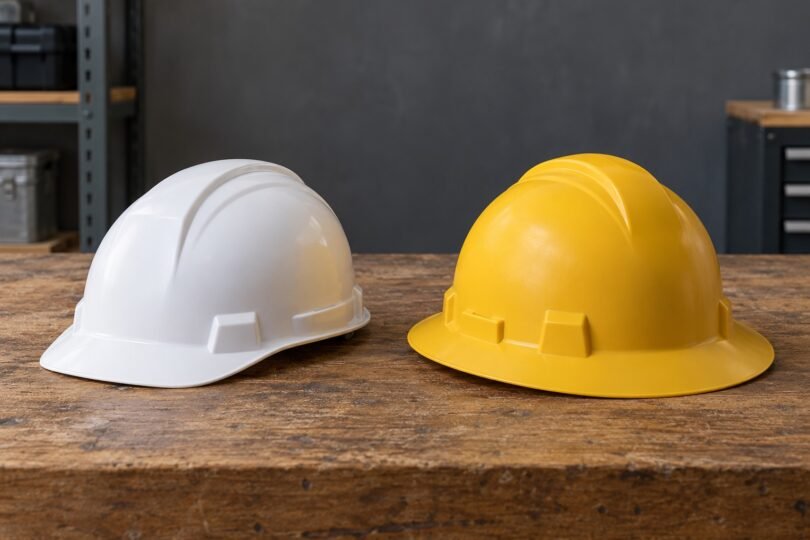

A low-profile hard hat should fit securely without feeling unnecessarily tall or top-heavy. But “low profile” describes its shape and fit, not its level of protection. Choose the impact type and electrical class required by your workplace first, then compare the fit of models that meet those requirements.
A bump cap is not a substitute for a required hard hat. A Class C hard hat provides no electrical protection. If either distinction is unclear on a listing, stop and check the manufacturer’s label and instructions before ordering.
Start with the protection your job requires
For construction work, OSHA’s head-protection rule requires protective helmets where there is a possible danger from impact, falling or flying objects, or electrical shock and burns. Your employer’s hazard assessment and site requirements determine the appropriate equipment; a seller’s “construction approved” headline is not enough to make that decision.
- Type I: protection designed for impacts to the top of the head.
- Type II: protection designed for top and side impacts.
- Class G and Class E: electrical-protection classifications with different test requirements. They do not make all electrical work safe or replace other required precautions.
- Class C: no protection against contact with electrical hazards.
OSHA’s head-protection bulletin explains these distinctions and states that vented hard hats or safety helmets cannot be used for electrical work. It also recommends considering retention, including chin straps, for the hazards involved. A chin strap or a helmet-like appearance does not by itself establish Type II protection.
Three models worth comparing after the safety requirements are settled
These examples illustrate different fit and equipment choices. All three are listed below as Type I models. If your job requires Type II protection, use that requirement to build a different shortlist. The specifications come from the manufacturers; they are not results of a hands-on comfort or impact test.
Pyramex Ridgeline Full Brim HP54110: an adjustable non-vented option
The white Pyramex Ridgeline HP54110 is the non-vented full-brim version with a four-point ratchet suspension. Pyramex lists the non-vented family as Type I, Class E, with ANSI/ISEA Z89.1-2014 (R2019) and CSA Z94.1-2015 (R2024) claims on its current product page. Its swinging ratchet suspension and size range of 6½–8 make it a useful model to try when a stable, lower-seated fit is the priority.
Check the suffix: HP54110V is a vented version, rated Class C. HP56110 is a six-point non-vented configuration. These are different selections, not interchangeable names for one package. Pyramex also warns of mixed inventory during a product transition, so confirm the actual label, suspension and accessory slots on the unit supplied.
LIFT DAX Full Brim HDF-15NG: a fiber-resin alternative
The natural-color LIFT DAX HDF-15NG uses a fiber-reinforced resin shell and a six-point suspension. LIFT identifies this model family as ANSI Z89.1-2014 Type I, Class G, with a head-size range of 6½–8. Its large adjustment dial is a practical feature to compare if you often adjust your hat while wearing gloves.
Do not transfer those ratings to a carbon-fiber DAX, a Mips version or the newer DAX T2 simply because the names look similar. LIFT also sells separate CSA-certified products; verify the exact model’s label if Canadian certification is required. This is a fit comparison candidate, not a claim that it is the lowest, lightest or most comfortable hat for every wearer.
Klein 60407RL: a vented option with an included light
The white Klein 60407RL is a full-brim, four-point ratchet hard hat with adjustable vents and a rechargeable 56062 headlamp. Klein lists it as Type I, Class C, meeting ANSI Z89.1-2014 and CSA Z94.1-15. The listed package includes the hard hat, rechargeable headlamp, charging cable, user guide and reflective stickers; its stated hat-size range is 6½–8.
The older 60407 is no longer in production and used an alkaline headlamp. Check the complete model number when comparing listings. Closing the 60407RL’s vents does not turn it into a Class E hat. Although Klein lists additional European test clauses, its instructions explicitly say this is not an ANSI/CSA Type II hard hat.
How to judge whether a low-profile hard hat actually fits
Start with your head measurement and the manufacturer’s sizing instructions. A shared size range does not mean two suspension systems will feel the same on your head. Try the hat with the eye, hearing and face protection you will actually use, including only approved liners and attachments.
For example, Klein’s instructions for the 60407RL family call for a snug, level fit that stays in place during gentle normal head movement. They provide designated height-adjustment positions and require matching left and right settings. That is a useful distinction: use the adjustments designed into the suspension, rather than trying to force the shell closer to your scalp.
- Stability: the hat should stay properly positioned when you look up, down and sideways.
- Pressure: check the forehead, temples and rear adjustment band for uncomfortable contact.
- Visibility: check your working sight lines with the brim and any approved shield in place.
- Other PPE: make sure glasses, earmuffs and attachments do not dislodge the hat or interfere with each other.
- Adjustment: if the approved settings cannot produce a secure fit, try a different size or model.
Never cut or shorten suspension straps, remove protective padding, drill ventilation holes or substitute an unapproved suspension to make a hat sit lower. The shell and suspension are a protective system. Do not store objects in the space between them.
Vents, accessories and finishes need their own checks
Decide whether ventilation is permitted before treating it as a comfort feature. A vented Class C model is not an electrical-protection alternative. Similarly, a carbon-fiber pattern does not tell you the actual shell material, impact type or electrical class.
Match every replacement suspension, chin strap, headlamp bracket, face shield and earmuff to the helmet maker’s approved combinations. Accessory slots are not proof that every attachment will fit or preserve protection. A welding shield or headlamp by itself is not a hard hat.
Pyramex’s current Ridgeline instructions prohibit altering the shell or suspension and warn against paint, chemicals and gasoline. They allow decals only where these do not affect protection or conceal damage. Check the instructions for your exact model before applying any coating, adhesive, sticker or aftermarket decoration.
Inspect it and follow its own replacement schedule
Check the shell, suspension, anchors and any chin strap before use. Cracks, damaged straps, deterioration or an impact are reasons to remove equipment from service according to its instructions. An undamaged-looking exterior does not prove that a helmet remains protective after an incident.
There is no single replacement interval that should be copied across all brands. Pyramex’s current Ridgeline sheet specifies a maximum of five years from first use for the shell and one year for the suspension, with earlier replacement when necessary. Klein’s instructions for the listed hard-hat family give a different schedule: the entire hat after two years of use or five years from manufacture, whichever comes first; the suspension and optional chin strap after no more than 12 months of use. Those are model-specific guidance limits, not promises of safe life under all conditions.
Record both the manufacturing date and when the hat enters service. Follow the maker’s cleaning and storage directions, and keep inspection and replacement records. Heat, sunlight, chemicals and rough treatment can make an earlier replacement necessary.
Before you order
- Get the required impact type, electrical class, retention features and applicable standards from your workplace.
- Match the exact manufacturer model, including suffixes, to its current technical sheet.
- Confirm size, suspension, venting, included accessories and whether the listing supplies a complete hat or only a replacement part.
- Check the return conditions so you can assess fit without modifying the equipment.
- On delivery, compare the model and internal labels with the order, then inspect and fit it before use.
Common questions
Is a bump cap a cheaper low-profile hard hat?
No. Pyramex describes its Ridgeline Bump Cap as non-rated equipment for minor bumps and scalp lacerations in applications where hard hats are not required. It is not designed to meet industrial head-protection standards. A similar outline or the same brand name does not make it a replacement for a protective helmet required by the job.
Does a full brim mean better impact protection?
Brim shape is a design choice, not the Type I/Type II classification. Compare the actual label and the protection required. A full-brim Type I hat does not become Type II because it has more brim coverage.
Can I wear it backward to improve visibility?
Only if the exact model is approved and marked for reverse wearing, its suspension is installed as directed, and your workplace permits it. Do not assume that reversing a hat preserves its rating.
Which is the best low-profile hard hat?
The useful shortlist is the one that meets your workplace requirements and fits securely with your other PPE. Compare approved models in person when possible. Appearance, shell height, reviews and price are secondary to the protection, fit and condition of the exact hat you will wear.