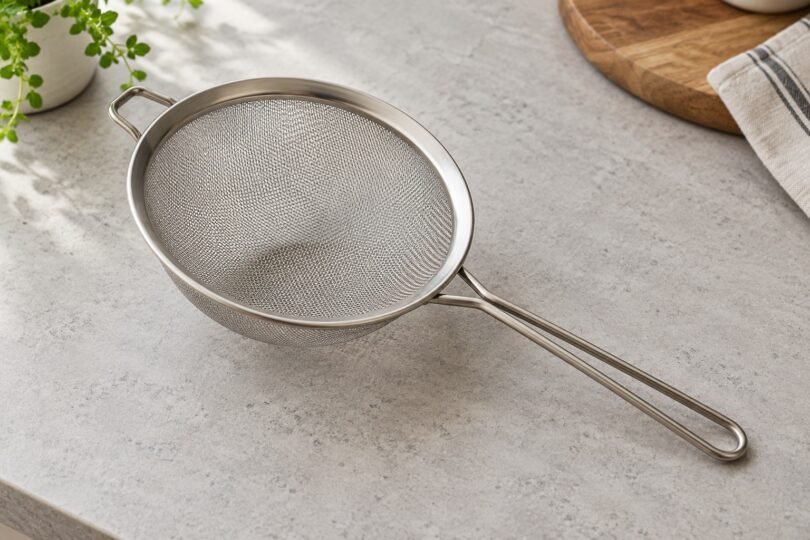

A large fine mesh strainer should suit both your ingredients and the bowl underneath it. An approximately 8-inch sieve is a sensible starting point for everyday kitchen work; a wider basket helps when you need more room, but also takes more space to store and support. Before choosing, compare the basket diameter, overall dimensions, mesh information and cleaning instructions.
Three useful options are the OXO Good Grips 8-inch Strainer for its cushioned grip, the RÖSLE 24 cm Round Handle Kitchen Strainer for a larger basket with a stated capacity, and the Cuisinart CTG-00-3MS set if you also need smaller strainers. Their specifications answer different questions, so start with the job you do most often.
Three options at a glance
| Model | Published size | Useful distinction | Missing measurement to check |
|---|---|---|---|
| OXO Good Grips 8-inch Strainer, SKU 38991 | 8-inch size; overall dimensions 15.2 × 8 × 3.5 inches | Soft grip and an opposing rest loop | Internal basket depth and usable support span |
| RÖSLE Round Handle Kitchen Strainer, 161264 | 24 cm diameter; 50 × 24 × 15 cm overall; 2-liter filling quantity | Published 0.5 mm mesh width | Internal basket depth and separate handle/rest dimensions |
| Cuisinart Mesh Strainers, CTG-00-3MS | Three sizes: 3⅛, 5½ and 7⅞ inches | One package covers several scales of preparation | Basket depth, capacity and overall/support dimensions |
Overall height is not necessarily usable basket depth. None of these product pages gives every measurement needed to guarantee a fit over a particular pot.
Which strainer makes sense for your kitchen?
OXO Good Grips 8-inch Strainer: prioritize the grip
OXO identifies this as a stainless-steel fine mesh strainer with double-rod construction. Its small loop provides a resting point on a bowl or pot, while the soft handle is designed for a nonslip grip. The manufacturer names vegetables, berries and pasta among its uses and labels it dishwasher safe. See the OXO 8-inch Strainer specifications.
This is the straightforward choice to consider if you want one handled sieve for routine preparation. The listed overall size is useful for checking drawer space. However, the page does not publish a liter capacity, an internal depth or an aperture measurement. Do not interpret its fine mesh description as a guarantee that every tiny grain or coffee particle will stay in the basket.

OXO Good Grips 8-inch Strainer, 38991
As an Amazon Associate we earn from qualifying purchases.
RÖSLE 24 cm Round Handle Strainer: prioritize basket size
The RÖSLE 24 cm strainer, article 161264 and former number 95264, has a 2-liter stated filling quantity. Its 24 cm diameter is approximately 9.5 inches, and its overall length is 50 cm. RÖSLE specifies 18/10 stainless steel, dishwasher suitability and a mesh width of 0.05 cm, equivalent to 0.5 mm.
It is worth considering when an 8-inch basket feels cramped and you have room for a longer utensil. The maker lists straining, passing, blanching and sifting flour among its uses, but marks it unsuitable for stove and oven use. Those distinctions matter: a metal kitchen tool is not automatically cookware. The stated 15 cm overall height should not be presented as a measured internal bowl depth.
Cuisinart CTG-00-3MS: prioritize having several sizes
The Cuisinart three-piece mesh strainer set includes 3⅛-, 5½- and 7⅞-inch strainers. Cuisinart specifies stainless-steel mesh and dishwasher cleaning. The largest member is close to an 8-inch sieve, so this set makes sense when smaller tools would also earn their place in your kitchen.
Choose it for the range of sizes rather than expecting an especially large single basket. The current product specification does not provide mesh opening dimensions, capacity or separate handle lengths. If your main job requires retaining very small particles, ask about that exact requirement before buying. Its manufacturer care sheet confirms dishwasher suitability but does not establish an oven or frying temperature limit.

Measure the bowl, the supports and the storage space
Basket diameter tells you the width of the strainer, not the size of vessel it can bridge. A handle and opposite resting loop may extend well beyond that diameter, yet only part of each may actually contact the receiving bowl. A rolled rim, sloping side or pouring spout can also change where it sits.
- Measure the receiving opening. Note its inside width and the shape of the rim. If the fit is essential, request the distance between the strainer’s usable resting points.
- Check the clearance below. The basket needs room beneath it, and collected liquid should not rise back into the food. Ask for internal basket depth when the published height is ambiguous.
- Check storage with the handle included. A wide basket may fit your cabinet while a long handle obstructs the door. Overall length matters just as much as diameter.
- Check stability before filling. Place the empty strainer on the intended vessel. If it rocks, slips or sits at an angle, choose a better-fitting container rather than relying on the loop alone.
For larger batches, think about both food and liquid. A filling quantity is not a promise that you can pour that volume into the basket all at once, and it is not a rated load limit. Work in portions with enough receiving capacity below.
Match the mesh to what needs to stay behind
Fine mesh is a description, not a universal micron rating. RÖSLE provides an opening measurement for the model above; OXO and Cuisinart do not provide one on the cited product pages. Even a published mesh width should not be recast as a tested filtration efficiency or a guarantee of perfectly clear liquid.
For berries and larger food pieces, support and basket size may drive the decision. For flour, choose a utensil the maker describes as suitable for sifting and make sure it is dry before use. For tiny grains, ask specifically about retaining the grain you cook, including broken pieces. For very fine sediment or a recipe calling for cloth filtration, follow that recipe’s specified filter rather than assuming a kitchen sieve is interchangeable.
A wire spider, a perforated colander and a cloth straining bag serve different purposes. Check the construction in the product description instead of selecting everything sold under the word strainer. Pool skimmers and sink-debris catchers do not belong on a food-preparation shortlist.
Cleaning and handling checks that matter
All three manufacturers permit dishwasher cleaning for these exact products. Check the instructions supplied with the item you receive, particularly if a listing offers several versions. Dishwasher suitability does not establish resistance to direct flame, an oven or deep-frying temperatures.
As a practical routine, empty trapped food promptly, rinse away loose residue and inspect both sides of the mesh and the rim after washing. Let the utensil dry before storing it. Avoid forcing stuck food through with a sharp object or piling heavy cookware on a mesh basket. If wires loosen or the rim separates, stop using it for food preparation.
The best purchase is the one that fits your receiving bowl, stores comfortably and retains the ingredients you actually use. Choose the OXO for its grip, the larger RÖSLE for its specified basket capacity, or the Cuisinart set when several sizes are more useful than one wider sieve.