

Choose a Venetian plaster trowel for its blade size, edge finish and suitability for your plaster system. A smooth, clean blade with rounded corners helps with thin decorative coats, but the right tool for spreading a wall may be different from the one you prefer for detailed burnishing.
Two useful options are the Meoded 240 × 120 mm medium trapezoid trowel for a broader working face and the Kraft Tool PL627PF 8 × 3-inch trowel for a compact, firm polishing blade. Their specifications are verified below. We have not tested them side by side, so the recommendations reflect their documented designs and practical size differences.
Venetian plaster trowels at a glance
| Tool | Verified blade size | Material and handle | Why consider it? |
|---|---|---|---|
| Meoded Medium Trapezoid | 240 × 120 mm; 0.6 mm thick | Stainless steel; rubber and plastic handle | A broader blade for application and smoothing on accessible wall areas |
| Kraft Tool PL627PF | 8 × 3 in. / approximately 203 × 76 mm | Polished stainless steel; ProForm soft-grip handle | A compact, hard blade designed for finishing and polishing decorative plaster |
Meoded 240 × 120 mm: a broader everyday application tool
Meoded specifies a stainless-steel trapezoid blade with rounded edges, 0.6 mm thickness and a rubber/plastic handle. The dimensions convert to approximately 9.4 × 4.7 inches. It is intended for Venetian, Marmorino and stucco plasters.
The broader face makes this a sensible starting point for an open feature wall when you want room to carry and spread material. That is a size-based recommendation, not a measured productivity claim. A larger blade also gives you more edge to manage, so a sample board is valuable before committing to a visible wall.
Select the 240 × 120 mm variant carefully. The listing also discusses other sizes, and the 240 × 100 mm version is narrower. A product-family photo or pooled review does not establish that you have chosen the same tool. This standard steel model is also not Meoded’s separate WhiteOut finishing trowel.

Stainless Steel Plaster Trowel, (9.4x4.7inch) Venetian Plaster Trowel, Plaster Tool, Finishing Tool, Trapezoid 240x120mm, Meoded Paint & Plaster
As an Amazon Associate we earn from qualifying purchases.
Kraft Tool PL627PF: compact, firm and polished
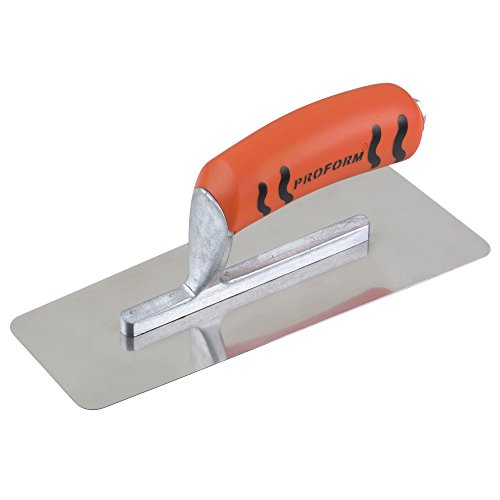
The Kraft PL627PF has an 8 × 3-inch stainless-steel blade, a trapezoid shape, rounded corners and a machined, polished edge. Kraft describes it as a hard-blade tool for finishing and polishing decorative plaster and stucco. An aluminum mounting supports the blade, and the ProForm handle provides a contoured soft grip.
Consider it when you want a smaller working face for controlled finishing, small sections or projects where a broad trowel feels awkward. Compared with the Meoded option, both its length and width are smaller. It may require more passes across a large wall, but that tradeoff can be worthwhile if it gives you better control.
Buy by the exact PL627PF model number. Kraft offers related sizes and handle versions; PL627 without the PF suffix uses a different handle. The listed blade is intended to be firm, so do not choose it expecting an ultra-flexible skim-coat tool. Its polished steel still needs a clean, undamaged edge.
Pick the plaster system before the trowel
“Venetian plaster” covers products with different binders, textures and application schedules. A lime-based polished plaster, a coarser Marmorino and an acrylic decorative finish do not necessarily use the same tools or timing. Read the finish manufacturer’s technical sheet before choosing a blade.
For example, Meoded Stucco Lamundo calls for a rounded-edge stainless-steel trowel or spatula and burnishing the final coat while it is still moist. In contrast, Modern Masters’ Venetian Plaster instructions describe sanding the dried finish and then burnishing for a higher sheen, with cautions for light colors. Those are product-specific procedures, not interchangeable recipes.
A trowel can be suitable for application without being the preferred final-polishing tool. Decide whether you are spreading base coats, compressing a finish coat or polishing a cured decorative product, then match the manufacturer’s method.
What size and blade feel should you choose?
- Small blades: prioritize control and access. A compact trowel is useful for practice panels and smaller wall sections, though very narrow recesses may still need a separate spatula.
- Medium blades: offer more working area for an open wall. Check whether the listed width is 100 or 120 mm; equal length does not mean equal handling.
- Firm blades: can suit compression and polishing when specified by the plaster maker.
- Flexible blades: may suit particular application techniques, but extra flex is not an automatic upgrade for every finish.
- Comfortable handles: matter because you need repeatable pressure and a relaxed grip. Material preference alone cannot establish how a handle fits your hand.
Thickness is only part of blade feel. The alloy, blade dimensions and mounting also matter. Neither the smallest trowel nor the most flexible one is universally easiest for beginners.
Prevent scratches and dark burnishing marks
Inspect the blade before touching the finish. Dried fragments, nicks and damaged corners can spoil an otherwise smooth coat. Keep a clean cloth and the product-approved cleaning setup nearby, and avoid dragging hardened material from the bucket rim into fresh plaster.
Meoded’s application guide warns that ordinary stainless tools can leave dark marks on light-colored finishes and recommends its WhiteOut tool for that situation. Treat claims that any steel blade “never marks” as product-specific marketing, not a guarantee across all plasters. If you are making a pale or white polished finish, ask the finish manufacturer which low-marking tool it approves and test that combination.
Do not aggressively grind a new blade into a different profile without the tool maker’s guidance. A purpose-finished edge should not need improvised reshaping before the first trial.
A sensible first-project kit
Start with one appropriate trowel, a compatible loading tool or hawk, a small detail spatula, clean containers and a sample board prepared like the actual wall. Practice the complete system, including primer and any approved sealer, rather than testing a smear of plaster on an unrelated surface.
Follow the plaster’s safety data sheet. For example, Stucco Lamundo’s SDS calls for protective gloves, clothing and eye/face protection. Use the specified dust controls and respiratory protection when sanding. Keep sharp tool edges away from unprotected hands, and clean and dry the trowel according to the tool and coating instructions before storing it where its edge is protected.
Bottom line
Choose the Meoded 240 × 120 mm for a broader application blade or the Kraft PL627PF for a compact, firm finishing tool. Confirm the exact size, try it on a sample board and follow your plaster’s instructions. Edge condition, clean technique and correct burnishing timing will matter more than buying the largest tool set.
Image note: Examples of plaster-finishing trowels; pictured sizes and models may differ from the selected options.