A weatherproof outdoor wall clock should match the place where you will hang it. A shaded porch, an open garden wall and a poolside splash zone expose a clock to very different conditions. Start with the manufacturer’s placement instructions, then compare dial size, lighting and battery requirements.
For an 18-inch illuminated metal clock, compare the Bulova C4813 Weather Master. For a larger illuminated dial, the AcuRite 75133M measures 24 inches. The La Crosse 404-4450 is a conditional alternative because its outdoor-placement documentation conflicts. None should be treated as an immersion-rated clock merely because a listing uses the word waterproof.
This comparison is based on current manufacturer product pages, instructions and verified model listings. We have not exposed these clocks to rain, tested their timekeeping or measured their nighttime readability.
Outdoor clocks worth comparing
| Model | Diameter | Lighting and gauges | Important placement point |
|---|---|---|---|
| La Crosse 404-4450 | 19.7 inches | Temperature and humidity gauges; no dial lighting specified | Older FAQ permits an overhang; current guide says indoor |
| Bulova C4813 Weather Master | 18 inches | Light-responsive LEDs; thermometer and hygrometer | Gasketed glass and movement cover; avoid direct desert sun |
| AcuRite 75133M | 24 inches | Light-sensor illumination; temperature and humidity gauges | Keep away from direct sun, heat and moisture sources for accurate readings |
La Crosse 404-4450: clarify outdoor suitability first
The La Crosse 404-4450 has a bronze-finish plastic case, glass lens, metal hands and raised Arabic numerals. It uses one AA alkaline battery and has a silent sweeping quartz movement. Its actual stated diameter is 19.7 inches, although the feature list rounds the case size to 20 inches.
The key qualification is placement. La Crosse’s model-specific FAQ instructs outdoor users to choose an overhang that protects the clock from overhead sun and accumulated snow or rain. However, the linked 2024 setup guide lists placement as indoor, despite its indoor/outdoor title. Ask La Crosse to resolve that conflict for your intended location before buying it for outdoor use.
Its large conventional dial and simple battery setup may suit an indoor sunroom. No dial lighting is specified. Verify the model and placement permission before ordering rather than assuming another La Crosse clock has the same limits.
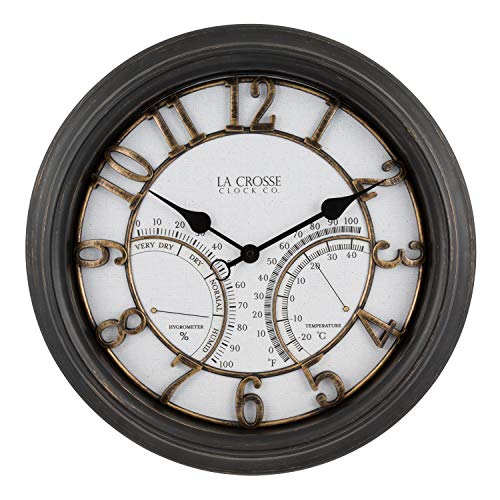
La Crosse 404-4450 Courtyard Clock - Bronze, 19.7 Inches
As an Amazon Associate we earn from qualifying purchases.
Bulova C4813 Weather Master: an illuminated metal option
The Bulova C4813 Weather Master has an 18-inch burnished-bronze metal case, gasketed glass lens and gasketed movement cover. Its light-responsive LEDs illuminate the dial at dusk, with a selectable five-hour timer to reduce lighting use. It takes one AA battery for timekeeping and four D batteries for the lights.
Bulova says the movement was upgraded in 2024 for higher summer temperatures, but specifically advises against direct sun in desert conditions. Confirm which production version the seller is offering if that upgrade matters. An older model-number match alone does not prove the current movement is inside.
This is worth comparing when you want nighttime visibility in a smaller footprint than the 24-inch AcuRite. The gasketed construction is a useful documented feature, but it does not establish an immersion or pressure-washing rating. For a wall exposed to severe weather, confirm the intended exposure with the manufacturer.

AcuRite 75133M: a larger dial with automatic illumination
The AcuRite 75133M is the 24-inch version of the maker’s illuminated outdoor clock. It has quartz timekeeping, bold numerals and temperature and humidity gauges. Its light sensor supports a four-hour illumination mode, lighting throughout darkness, or lighting switched off. Timekeeping uses one AA battery; illumination uses four D batteries.
The size is its main distinguishing feature here. Make a 24-inch paper circle before buying to see how much wall it occupies and whether the surrounding trim leaves room to lift the clock off its hanger.
AcuRite describes the construction as weather-resistant. Its instructions require replacing the protective battery covers after setup and recommend shade for accurate readings. They also advise keeping the clock away from heat sources and bodies of water that can distort humidity readings. A poolside location needs careful positioning even if the clock is visible from the pool.
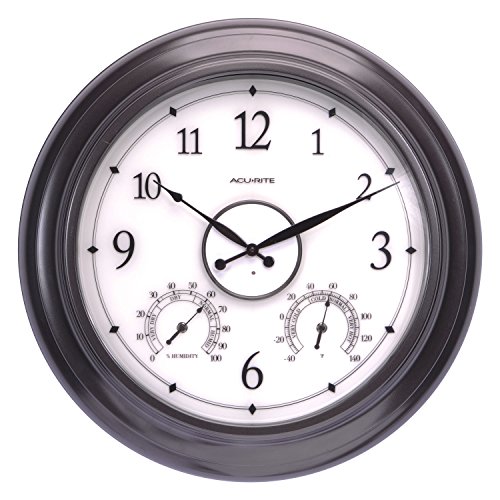
Weather-resistant does not tell the whole story
Read the instructions for the exact model before deciding that an outdoor label covers your wall. A product can tolerate outdoor humidity while still needing protection from direct rain. Conversely, a gasketed outdoor product may have stronger protection without specifying an immersion rating. The wording and the permitted mounting conditions both matter.
Separate these questions when shopping:
- Can it be installed outdoors at all?
- Must it sit beneath an overhang?
- Does the manufacturer allow direct rainfall on the front and back?
- Are there limits for direct sun, freezing weather or coastal exposure?
- Does the warranty exclude the conditions at the proposed location?
For a fully exposed garden wall, do not fill an information gap with a retailer’s waterproof headline. Ask the manufacturer about that placement using the exact model number. If the answer remains unclear, choose a sheltered position or a different product whose instructions explicitly cover the exposure.
Keep garden hoses, pressure washers and sprinklers away from the clock. A decorative wall clock is also a poor choice for a location where it may fall into water. None of the documentation checked for this shortlist establishes that kind of use.
Pick the dial for your viewing distance
Stand where you usually sit or work and look toward the intended wall. Consider whether you will read the time from a dining chair, the far end of the patio or while gardening. The distance and angle may matter more than another two inches of outer case diameter.
Look for a strong contrast between hands and face, distinct hour markings and a minute hand you can distinguish from the hour hand. Decorative frames can occupy a large share of the stated diameter. Compare the usable face area rather than assuming equally sized clocks will be equally legible.
Glare can obscure an otherwise clear dial. Check where the morning and afternoon sun strike the wall and whether nearby windows reflect bright light toward it. A slightly different mounting position may solve a readability problem more effectively than buying a larger clock.
Night lighting changes maintenance
Illuminated clocks have a separate power demand beyond the movement. In this shortlist, the Bulova and AcuRite use D batteries for the LEDs and an AA battery for timekeeping. If the lights stop while the hands keep moving, check the lighting batteries and mode switch before assuming the whole clock has failed.
Choose a timer setting that matches your evening use instead of leaving illumination active longer than necessary. Actual battery life depends on use and conditions, so avoid treating a general lifespan claim as a promise for your patio.
Think about access before mounting the clock high. You will need to remove it safely, support its weight and open the covers without losing small parts. A location that requires a ladder over outdoor furniture every time batteries need changing may be unnecessarily awkward.
Temperature and humidity readings need the right location
A clock mounted in direct sunlight may report the conditions around its heated case rather than representative shaded outdoor air. Nearby exhausts, masonry and other heat sources can also affect a local reading. Decide whether attractive placement or useful environmental measurements is your priority.
Follow the exact model’s calibration procedure. AcuRite’s instructions advise allowing at least three hours for the gauges to settle in a new location before judging their readings. They describe adjustment from the back when needed. Do not apply that procedure to every clock: La Crosse’s 404-4450 instructions state that its gauges are pre-calibrated and not adjustable.
For decisions that need precise temperature or humidity information, compare the clock’s stated accuracy with that need. Decorative analog gauges are most useful when you understand their limitations. A familiar-looking scale alone does not establish measurement accuracy.
Mount and maintain it carefully
Use hardware suitable for the wall material, the clock’s weight and outdoor conditions. Follow the hanging instructions and check that the mounting point captures the hanger fully. Avoid positioning the clock where opening a door, moving a chair or handling garden tools could knock it loose.
After changing batteries, check that covers and seals are seated as intended. Do not add sealant to an unspecified opening: you could obstruct a sensor or make servicing difficult. If moisture appears inside the face or battery compartment, remove the clock from that exposure and follow the manufacturer’s support advice.
Clean gently using the model’s care directions. Avoid abrasive treatment of a clear lens and remove batteries before long-term storage when the instructions require it. Inspect the hanger and surrounding wall periodically, especially after severe weather.
Which should you choose?
Compare the Bulova C4813 when you want an illuminated metal clock with documented gaskets, and the AcuRite 75133M when a larger illuminated face suits the wall. Hold off on the La Crosse 404-4450 for outdoor use until its conflicting instructions are clarified. For any fully exposed installation, settle the weather-compatibility question before choosing the style.
Image note: Existing category illustration retained from the original article.