
For visible wood grain, compare white oak, walnut and hard maple; for a painted shelf, compare poplar; for a thicker-looking built-up shelf, consider furniture-grade veneer-core plywood with a suitable design. The best choice depends on the look, dimensions, construction and mounting hardware, not simply which species is called the strongest.
A floating shelf is a system: the wood, bracket, fasteners, wall structure and installation work together. Buying a dense hardwood does not make an unsuitable bracket or wall fixing safe. Choose the support system and intended load before ordering or cutting the wood.
Research checked October 4, 2026 using wood-product manufacturers, bracket suppliers and the USDA Forest Products Laboratory. We have not load-tested shelves or verified an installation in your wall. Recommendations are material-selection comparisons, not structural ratings or a universal construction plan.
Wood choices at a glance
| Material | Why choose it? | Main tradeoff |
|---|---|---|
| White oak | A visible, open-grain natural-wood look | Board quality, movement and mounting design still matter |
| Walnut | A naturally darker brown appearance | Compare actual boards and total cost rather than paying for the name alone |
| Hard maple | A lighter appearance with tighter-looking grain | Confirm the exact maple species and finish sample |
| Poplar | A practical comparison for a painted finish | Natural color variation may not suit a clear-finished look |
| Veneer-core plywood | A candidate for a properly designed built-up shelf | Core quality, edging and internal support must suit the construction |
Oak, walnut and maple for exposed grain
Walnut Wood Works’ solid-shelf range offers white oak, black walnut and hard maple, among other species. Its descriptions illustrate the main visual differences: open-grained light-brown oak, darker walnut and lighter, tighter-grained maple.
Our recommendation is to choose among these primarily by the appearance you want and the suitability of the actual stock for the design. A photograph is only a starting point: grain, sapwood, knots and color vary from board to board. Ask to see a sample with the intended finish if matching other furniture matters.
Tradeoff: a thick solid slab can be substantial to handle and support. Its own weight is part of the load, before any books or dishes are added. Do not transfer a manufacturer’s complete-shelf rating to a different DIY board and bracket combination.
Poplar for a painted shelf
Windsor Plywood’s poplar guidance identifies yellow poplar as a paint-grade material used for interior millwork and shelf edging. It also notes natural green or purple color variation and that poplar dents more readily than maple or oak.
We would compare poplar when paint is the intended finish and you do not need to pay for a decorative wood species that will be covered. Confirm the grade, actual dimensions and straightness with the supplier. “Paint grade” does not mean cracks, loose knots or poor support details become acceptable.
Tradeoff: if you want a clear or lightly stained finish, inspect a sample first. Do not assume the natural color will resemble a pale maple shelf after applying a transparent coating. The linked supplier is a material-information example, not a guarantee of local stock or price.
Veneer-core plywood for a built-up design
Columbia Forest Products explains that veneer-core plywood uses alternating layers arranged for stability and strength. It distinguishes those panels from MDF and particleboard cores, so a decorative face veneer alone does not tell you what is inside the board.
This is our comparison for a designed box-style shelf where you want the appearance of thickness without using a single thick slab throughout. Choose the panel, internal structure and bracket as a matched design. A hollow shell with unsupported thin faces is not automatically a strong shelf.
Tradeoff: exposed edges need a deliberate treatment, and the internal construction must provide proper support and attachment. Inspect panel flatness, face quality and core quality. If you are buying a completed shelf, ask whether it is solid wood, veneer-core plywood, MDF or another composite rather than relying on the word “wood.”
Choose the bracket before finalizing thickness
Hidden brackets impose real dimensional limits. For example, Rockler’s Floating Shelf Bracket Supports specify a minimum shelf thickness of 1-1/8 inches to conceal that particular hardware and a maximum shelf depth of 8 inches. These numbers apply to that product, not to every floating bracket.
Sheppard Brackets’ selection guide likewise relates the bracket’s backplate and rods to the shelf dimensions. The practical lesson is to obtain the exact hardware instructions first. Do not buy a thin board and assume every concealed support can be made to fit it.
Ask the bracket maker about compatible shelf construction, wall type, fastening requirements, support spacing and the intended load. If those answers are unclear, change the design or use a qualified installer before making irreversible cuts.
Wood condition matters as much as species
The USDA Wood Handbook’s moisture chapter explains that wood exchanges moisture with its surroundings and that this affects its properties and performance. For an indoor shelf, obtain appropriately dried material and follow the supplier’s acclimation and finishing guidance.
The mechanical-properties chapter also emphasizes natural variation, including the effects of knots and grain. A species name or hardness score is not a shelf-capacity calculation.
- Inspect for bow, twist, cupping, checks and defects where the support will engage.
- Confirm actual finished dimensions, not only a nominal lumber size.
- Choose material and finish appropriate to the room’s moisture exposure.
- Allow for the mounting details required by the wood and hardware suppliers.
- Do not assume a coating eliminates wood movement or makes every board waterproof.
Think about the complete load and location
List what you plan to store and include the shelf’s own weight. Books, stacks of dishes and large planters are different from a few light decorative objects. Load distribution and shelf depth also affect the support system.
Follow the exact bracket’s wall-attachment instructions. A rating based on attachment to sound wood studs is not a rating for an arbitrary drywall anchor, masonry fixing or unknown wall. Avoid drilling until utilities and the wall construction have been checked.
For heavy, long or unusually deep shelves, or installations above beds and seating, get competent design and installation advice. A floating shelf should not be treated as a seat, step or climbing surface. If the clean appearance requires compromising support, choose visible brackets or another storage design.
Buying checklist
- Choose clear-finished wood, paint or a veneered appearance.
- Confirm the shelf’s length, depth, finished thickness and intended contents.
- Select a support system approved for those dimensions and the actual wall.
- Check the material’s grade, construction, dryness and visible defects.
- Include milling, edging, finishing, hardware, delivery and installation in the budget.
- For custom orders, confirm the drawing, finish sample and cancellation or return terms before paying.
Frequently asked questions
Is solid wood always better than plywood?
No. They suit different constructions and appearances. A well-designed plywood shelf can be a sensible choice, while a poorly supported solid board can still fail.
Can I choose by a Janka hardness number?
Not alone. Surface hardness is not the same as bending performance, bracket strength or wall attachment. Treat capacity as a complete-system question.
How thick should floating-shelf wood be?
Use the requirements of the exact bracket and shelf design. There is no universal thickness that makes every length, depth and load safe.
Bottom line: compare oak, walnut or maple for visible grain, poplar for paint, and suitable veneer-core plywood for a built-up design. Finalize the bracket, wall attachment and load requirements before buying the wood.
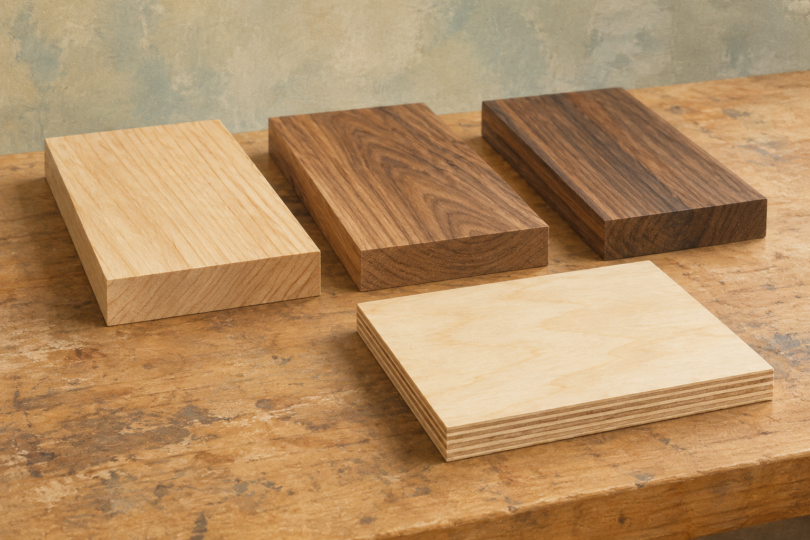
Image note: AI-generated generic editorial illustration; it does not certify species, grade, dimensions or the load capacity of a shelf.