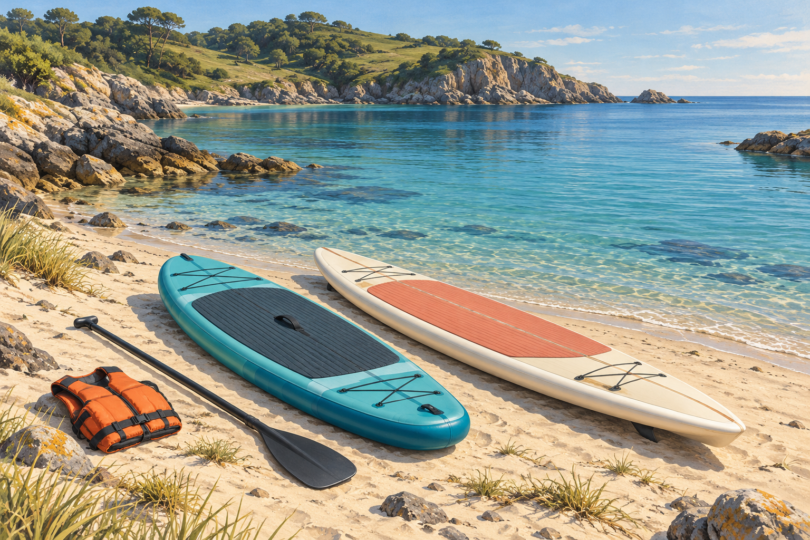

The best paddleboard for ocean use depends on the kind of coast you paddle. For sheltered coastal touring, start with the Red Paddle Co 12’6" Sport MSL if you already have confident board skills, the SIC Okeanos Expedition Air if packing and carrying equipment matter, or the BOTE HD 12′ Gatorshell if you prefer a rigid board and can manage its bulk. These are conditional buying choices; none makes an exposed route suitable for an inexperienced paddler.
This shortlist compares manufacturer specifications and package details, with safety guidance from the RNLI and U.S. Coast Guard. We have not tested these boards side by side. The focus is recreational paddling in suitable coastal conditions, not specialist surf, offshore expeditions or competitive downwinding.
Three paddleboards to compare
| Board and construction | Published dimensions | Maker’s load wording | Our suggested fit and main tradeoff |
|---|---|---|---|
| Red Paddle Co 12’6" Sport MSL; inflatable MSL drop-stitch with RSS battens | 12’6" long × 30" wide | 330 lb listed maximum weight | Confident touring paddlers; narrowest board here |
| SIC Okeanos Expedition Air 108913; Fusion Skin inflatable | 12’6" × 31" × 6" | 255 lb / 115 kg maximum rider weight | Packable touring with equipment; paddle not listed in the package |
| BOTE HD 12′ Gatorshell; rigid ABS/composite construction | 12′ × 32" × 5" | 315 lb capacity; maker advises sizing up within 50 lb of capacity | Rigid recreational or fishing platform; approximately 45 lb to carry |
The load column preserves each manufacturer’s terminology. Treat those numbers as model-specific guidance rather than interchangeable performance scores. Confirm your planned rider-plus-equipment load with the maker, and leave room for comfortable control instead of shopping only by the largest advertised number.
1. Red Paddle Co 12’6" Sport MSL: for confident touring paddlers
The Sport is our pick to investigate for longer paddles when you want a touring shape that packs away. Red describes this model as a touring design for confident paddlers. Its MSL drop-stitch construction uses removable RSS stiffening battens, and the deck has an adjustable cargo system.
Its 30-inch width deserves a demo if balance in coastal chop is your concern. Although the page also displays a beginner label, we would follow the more specific confident-paddler description. A high stated load is not evidence that it will feel comfortable for every rider.
Check the 12’6" Sport MSL package carefully: the captured Navy selection is “No Paddle.” Red lists a Titan II pump, touring fin, leash and backpack, but paddle inclusion depends on the package selected.
2. SIC Okeanos Expedition Air: for touring with a packable board
The 12’6" × 31" Okeanos Expedition Air, code 108913, is our packing-focused choice. SIC specifies Fusion Skin construction, a board weight of 26.9 lb and fore-and-aft bungee storage. Its dry-bag-style backpack is a practical reason to consider it for trips where the board needs to travel in a bag.
The 255 lb figure is explicitly a maximum rider weight; do not reinterpret it as a guaranteed combined equipment allowance. SIC also markets recreational downwinding, but its safety guidance requires appropriate training and flatwater mastery before using the board in waves. We would keep an unfamiliar board’s first outings sheltered.
The Okeanos Expedition Air 108913 listing includes one board, a pump, repair kit, dry-bag backpack and leash. A paddle is absent from that package list, so allow for one separately. Confirm fin contents before ordering: the page’s package list and supplied-fin specification do not agree.
3. BOTE HD 12′ Gatorshell: for a rigid recreational platform
The HD is our rigid-board option for recreational coastal paddling or a fishing setup. BOTE specifies Gatorshell construction using ABS plastic and composites, plus a hybrid displacement hull. Select the 12-foot version when using the measurements above; the same page also contains specifications for a smaller board.
The practical penalty is its approximately 45 lb weight and full-length storage requirement. Plan the carry from your vehicle before buying. BOTE recommends a higher-capacity board when the rider is within 50 lb of its listed capacity; do not treat 315 lb as a comfortable target load.
The HD Gatorshell package lists one board, a two-piece adjustable SUP paddle and a removable 10-inch center fin. Racks are sold separately. Budget for the complete outing rather than assuming a fishing accessory or personal safety equipment comes with the board.
How to narrow the choice
- Start with transport. Choose an inflatable if a full-length board cannot fit your storage and travel arrangements. Choose the rigid HD only after working out how you will lift, secure and store it.
- Try the loaded setup. A local lesson or demo is more useful than assuming a width or capacity figure predicts your balance. Ask to practise getting back aboard, turning and returning to the launch with the equipment you intend to carry.
- Compare complete costs. Include the paddle, pump where needed, suitable PFD, correct leash, communication equipment and transport solution. Confirm the exact model, size, package and returns terms at checkout; this guide does not quote live prices or stock.
Coastal conditions and safety equipment
Check wind direction and strength, tides, currents and the return route before launching. Avoid offshore winds: the RNLI warns that calm-looking water can still leave paddlers being blown away from shore. Have a lesson, paddle with company and tell someone your route and expected return. Cancel when conditions exceed your skills.
Wear a properly fitted PFD suited to the activity and your ability. The U.S. Coast Guard’s FAQ says a SUP used beyond the narrow limits of a swimming, surfing or bathing area is considered a vessel and must carry an appropriate U.S. Coast Guard-approved wearable life jacket; the Coast Guard recommends wearing it. This is a U.S. federal baseline, not a complete statement of every local rule. Check the boating authority and launch restrictions where you paddle.
Match the leash to the water. The RNLI distinguishes relatively still open water, where a leg leash can be suitable, from flowing tidal water such as estuaries, where a quick-release waist system is needed to address entrapment risk. Get instruction in choosing and operating that system. A supplied ankle leash should not be assumed suitable for every coastal launch.
Dress for immersion as well as the weather, and keep a means of calling for help on your body in a waterproof pouch. Red’s cold-water guidance highlights cold shock even for experienced swimmers. Practise recovery in appropriate supervised conditions before planning longer trips.
Questions before buying an ocean paddleboard
Can a beginner use one of these boards at the coast?
Begin with instruction and calm, protected water, such as a sheltered bay. The RNLI’s beginner guidance recommends a lifeguarded beach and avoiding solo paddling. A beginner label on a product page does not establish that today’s sea conditions are suitable.
Is an inflatable automatically unsuitable for salt water?
This shortlist includes inflatable touring options, but material alone does not decide whether a coastal trip is appropriate. Follow the board’s instructions and inspect it before use. Red tells owners to rinse equipment with fresh water and dry it fully before storage; follow the care instructions for your own model.
Are these the right boards for learning to surf?
This comparison is aimed at recreational coastal touring. For wave riding, seek a surf-specific board recommendation and lessons for your size and ability. SIC specifically requires flatwater mastery and appropriate instruction before waves; a touring recommendation is not a surfing endorsement.
Which one should I choose first?
For a confident touring paddler, start by comparing the Sport’s shape and package with the Okeanos’s packing arrangement. Choose the HD if a rigid board is a priority and its carrying weight is manageable. If none fits your load, balance or launch conditions, keep looking with a local instructor instead of forcing a choice from the shortlist.