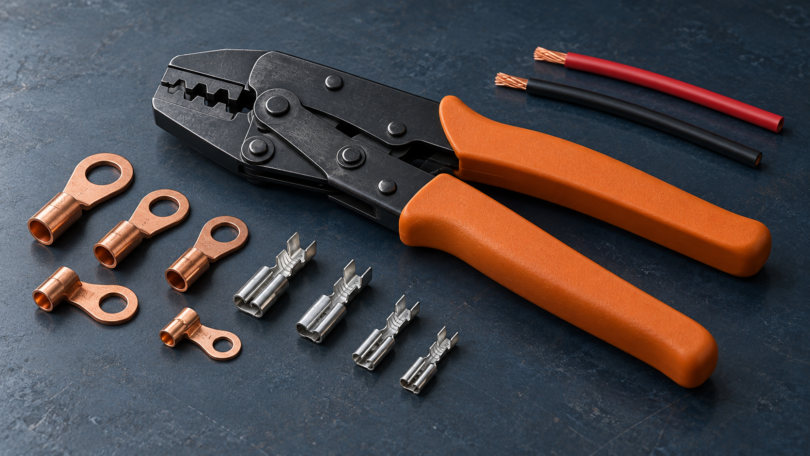

The best crimper for non-insulated terminals depends on the terminal’s barrel, wire size and required crimp profile. A tool for small open-barrel contacts is a different purchase from a tool for battery cable lugs, even though both work on bare metal terminals.
For general solderless terminals, start with the Klein Tools 1005. For tiny open-barrel contacts, consider the ENGINEER PA-09 after checking its compatibility chart. For large battery lugs in six specific AWG sizes, consider the iCrimp HX-50BI. These are documentation-based recommendations; we have not performed comparative crimp-strength or durability testing.
Compare the three picks
| Tool | Best reason to choose it | Manufacturer’s stated scope | Main limitation |
|---|---|---|---|
| Klein Tools 1005 | General terminal work with a simple crimper/cutter | 10–22 AWG insulated and non-insulated solderless terminals; separately marked dies | Manual squeeze; the rating does not establish compatibility with every terminal in that wire range |
| ENGINEER PA-09 | Small open-barrel connector contacts | 32–20 AWG reference range; 1.0, 1.4, 1.6 and 1.9 mm die widths | Exact contact must match the chart; conductor and insulation barrels are crimped separately |
| iCrimp HX-50BI | Battery cable lugs requiring a hex crimp | Six rotary positions: 8, 6, 4, 2, 1 and 1/0 AWG | Large two-handed tool; no intermediate sizes or small-terminal coverage implied |
1. Klein Tools 1005: best starting point for general terminal work
The 1005 is the straightforward choice when you already know that your solderless terminals suit its jaw. Klein specifies 10–22 AWG insulated and non-insulated terminals, with markings that distinguish the two crimping sections. A cutter in the tapered nose adds useful wire-cutting capability without a separate tool.
Why choose it: the uncomplicated plier layout makes sense for occasional terminal jobs and a general tool bag. It is also a useful option when you handle both insulated and bare solderless terminals, provided each terminal is appropriate for the designated die.
Tradeoff: it is a manual crimper without a full-cycle ratchet. The user controls closure, and a secure-looking connection is not evidence that it meets a connector manufacturer’s crimp specification. Do not interpret the broad AWG range as approval for micro open-barrel pins, ferrules or large cable lugs.
The red plastic-dipped handles are comfort grips. Klein explicitly states that this tool is not electrically insulated.

Klein Tools 1005 Crimping and Cutting Tool, Single Tool
As an Amazon Associate we earn from qualifying purchases.
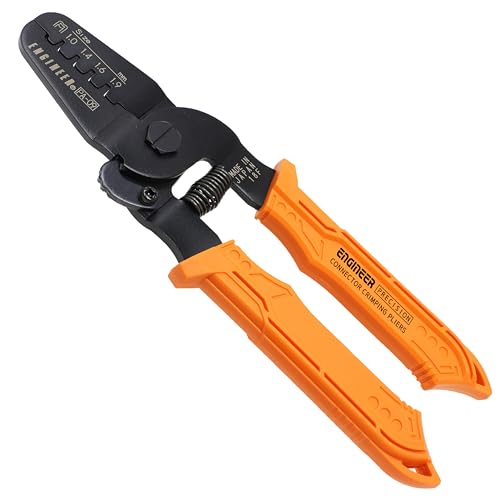
2. ENGINEER PA-09: best for chart-listed micro open-barrel contacts
The PA-09 is the specialist pick for small connector contacts with separate conductor and insulation wings. Its four die widths are 1.0, 1.4, 1.6 and 1.9 mm. ENGINEER describes a 32–20 AWG reference range and suitability for certain micro connector and D-sub contacts. That range is a starting point for selection, not a promise that every contact using those wires will fit.
Why choose it: the narrow cavities address small contacts that a general terminal crimper cannot properly accommodate. The 175 mm tool has a spring and storage latch. Its separate conductor-barrel and insulation-barrel operations allow different cavities to be chosen for those two parts of an appropriate contact.
Tradeoff: this takes more selection and inspection than a dedicated, connector-specific production tool. Check the exact contact part number in ENGINEER’s compatibility tables, then follow that contact manufacturer’s requirements. A connector brand or housing pitch alone is insufficient. The charts include both supported and unsupported contacts from the same manufacturer.
Choose it for compatible small open-barrel contacts, rather than battery lugs or ordinary large terminal barrels. The PA-09 product page provides the exact model details.
3. iCrimp HX-50BI: best for the listed battery-lug sizes
The HX-50BI serves a much heavier job: hexagonal crimps on compatible cable lugs. Its rotary die set has six discrete AWG settings: 8, 6, 4, 2, 1 and 1/0. The manufacturer’s HX-50BI page distinguishes these AWG dies from metric versions.
Why choose it: the built-in rotary dies keep those six settings on the tool, and the hex profile suits lug-and-cable combinations whose manufacturer specifies that kind of crimp. It is a more relevant purchase for these large lugs than either of the compact tools above.
Tradeoff: the model-specific manual table identifies the HX-50BI as the crimper alone; cutter bundles and the metric KIT-50B have different contents. It is intended for two-handed use. Check the exact model and die markings, and do not treat metric markings as automatic AWG equivalents.
Although the maker lists copper and aluminum lugs, the lug, conductor material and required tooling must all be compatible. The six settings do not establish approval for every lug brand, a different crimp profile or intermediate wire sizes. This tool is not electrically insulated.

How to choose a crimper that matches your terminals
Identify the barrel before comparing features. A bare ring terminal, a micro open-barrel contact, a ferrule and a heavy battery lug need different tooling decisions. “Non-insulated” describes the absence of an insulating cover; it does not define one shared die shape. Obtain the terminal’s part number and tooling requirements before buying.
Match more than AWG. Check the permitted conductor size and material, barrel dimensions, crimp profile and any specified die or tool. A tool’s wire range does not expand the terminal’s own range. For the PA-09, use the exact contact listing and cavity dimensions. For the HX-50BI, confirm one of its six AWG settings and a compatible hex-crimp lug.
Decide whether your work needs a dedicated ratchet tool. A full-cycle ratchet can control completion of a squeeze, but it cannot correct a mismatched die. For repetitive assembly or a connection with specified acceptance criteria, the connector maker’s prescribed tooling and inspection method take priority over this general shortlist. None of these recommendations guarantees a particular pull strength or electrical resistance.
Budget for the complete job. Include appropriate wire preparation, terminals and any specified insulation or environmental sealing. A bag of heat-shrink tubing or connectors is an accessory purchase, not a substitute for a suitable crimper. Count the tools and accessories in the exact package rather than assuming every listing includes a cutter or terminals.
Use these hand tools only on safely de-energized work, and follow the tool and equipment instructions. Ordinary coated handles do not provide shock protection. If you cannot establish the correct terminal, die or safe isolation procedure, have a qualified professional select the tooling and perform the work.
Which should you buy?
Choose the Klein 1005 for general solderless-terminal work when its marked jaw matches your terminals. Choose the PA-09 for an exact small open-barrel contact supported by ENGINEER’s chart. Choose the HX-50BI for compatible battery lugs in its six listed AWG sizes. For a connector that specifies another tool, follow that specification instead of forcing a match to this list.
Frequently asked questions
Can one crimper handle every non-insulated terminal?
No. Small open-barrel contacts, solderless terminals, ferrules and battery lugs can require different die shapes and crimp profiles. Match the exact terminal and conductor to the tool specification.
Can the Klein 1005 crimp insulated terminals too?
Yes. Klein rates the 1005 for 10–22 AWG insulated and non-insulated solderless terminals, using the appropriately marked die. That does not make its handles electrically insulated.
Does the PA-09 work with every JST or Molex connector?
No. Check the exact contact part number in ENGINEER’s compatibility tables and the connector manufacturer’s requirements. Brand name, housing pitch and the tool’s 32–20 AWG reference range do not establish universal compatibility.
Which wire sizes does the HX-50BI support?
Its six rotary die settings are 8, 6, 4, 2, 1 and 1/0 AWG for compatible cable lugs. They are discrete settings, and the HX-50BI should not be confused with metric-die kits or other model variants.
Does a ratcheting mechanism guarantee a good crimp?
No. The terminal, conductor, die profile and tool must still match. Use the connector manufacturer’s inspection and acceptance criteria; completing a ratchet cycle alone does not certify the connection.