
The right 2001 Acura Integra coilovers depend on the car’s body, trim and rear suspension mounts. A Type R kit is not interchangeable with a rear-fork kit, and a listing that says “1994–2001 Integra” may leave out a crucial body or mounting restriction. Identify the car and its existing hardware before choosing spring rates or a lowering range.
Start with the correct 2001 Integra
For the U.S. model, Acura’s 2001 vehicle identification filing separates the following configurations. The hatchback is described as a two-door in that document and commonly called a three-door when the hatch is counted.
| Body | Trim | Chassis | What to check |
|---|---|---|---|
| Hatchback | LS / GS | DC4 | Exact trim coverage and rear lower mount |
| Hatchback | GS-R | DC2 | Non-Type R application and rear lower mount |
| Hatchback | Type R | DC2 | Type R kit and rear eye/loop mount |
| Sedan | LS / GS | DB7 | Explicit four-door coverage |
| Sedan | GS-R | DB8 | Explicit four-door coverage |
A DC2 code alone does not distinguish a GS-R from a Type R. Also inspect the actual rear arms and mounts: a previous owner’s suspension conversion can make the original trim an incomplete guide.
Keep market and generation separate. The U.S. car has double-wishbone suspension front and rear. Honda’s July 2001 Japanese Integra release describes a newer 2.0-liter model with front struts. “2001 Honda Integra” search results can therefore lead to parts for a different car.
Coilover options and the fitment limits that matter
These manufacturer-listed parts are useful starting points for a fitment discussion. They are not a universal fit list or a ranking based on road testing.
| Kit | Manufacturer application | Front / rear spring rates | Important limit |
|---|---|---|---|
| TEIN FLEX Z VSA00-CUSA1-C | U.S. 1994–2001 DC2 and DC4 catalog rows; three-door, rear fork | 10 / 7 kgf/mm | DC4 row is labeled RS; confirm 2001 LS/GS coverage directly |
| TEIN FLEX Z VSH48-CUSA1-C | U.S. 1997–2001 DC2 Type R; rear eye | 10 / 7 kgf/mm | Verify the car retains compatible Type R rear mounts |
| Progress CS2 77.1003.3525 | 1994–2001 standard Integra series | 350 / 250 lb/in | Obtain body-specific confirmation; OEM-style steel top hats required |
| Progress CS2 77.1000.3525 | Type R series in the shared installation manual | 350 / 250 lb/in | Rear loop mount; competition-use qualification applies |
The TEIN U.S. application catalog supplies the two FLEX Z part numbers and mount restrictions. Its three-door note does not establish sedan fit. Its multi-year RS label also should not be silently treated as confirmation for every 2001 DC4 trim.
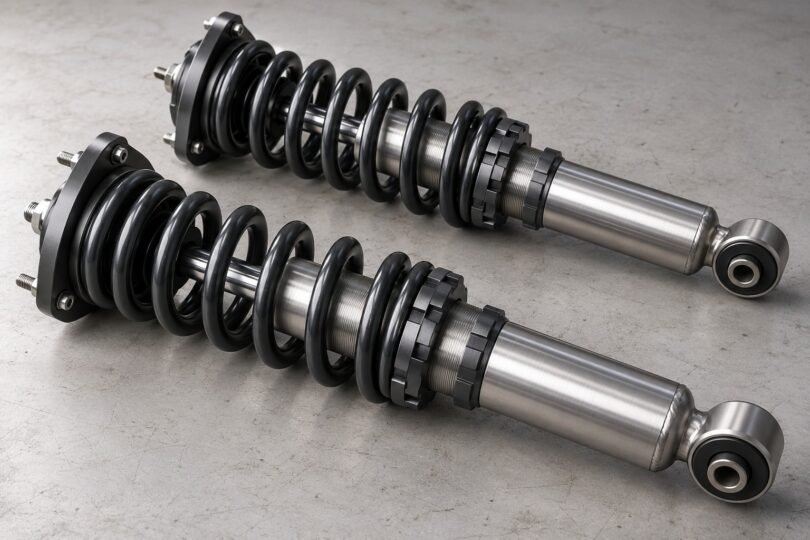
FLEX Z uses twin-tube dampers and 16 damping settings that change compression and rebound together. TEIN describes the family as four dampers and four springs; verify the exact seller’s contents, included mounts and current installation manual before ordering.
Progress CS2 offers different spring combinations, so the suffix matters. The .3525 examples above identify a particular rate pairing, not every CS2 kit. Its linked installation manual distinguishes the standard and Type R series, requires OEM-style top hats and prohibits extended hats. Although the product page discusses street-oriented setups, the manual describes these components as designed for competition use. Confirm suitability for your intended use before purchase.
How much should you lower it?
Choose a usable ride height before chasing the lowest setting. Wheel and tire clearance, damper travel, road conditions and alignment all matter. A kit’s maximum mechanical adjustment is not a promise that every setting is suitable on your car.
TEIN’s catalog gives different recommended lowering ranges for these kits: VSA00-CUSA1-C is 2.8–3.5 inches front and 2.0–2.8 inches rear below its OE reference; VSH48-CUSA1-C is 1.4–2.2 inches front and 1.6–2.4 inches rear. TEIN warns that exceeding its recommended range can cause interference and affect warranty coverage. These are catalog figures, not measurements on your vehicle.
If you want a smaller drop or original ride height, ask the manufacturer for an application designed around that goal. Do not assume a lowering kit can safely reach factory height, or that a large advertised adjustment range preserves clearance and travel everywhere.
Spring rates, damping and camber are different adjustments
A higher spring rate is not automatically better. The choice should reflect the car’s tires, load, intended use and the manufacturer’s damper calibration. Progress describes different compromises for front-heavy, equal-rate and rear-heavy combinations; a track-oriented pairing should not be chosen solely because its numbers are larger.
A damping knob changes damper behavior; it does not change the spring’s rated stiffness. Nor do pillowball top mounts make these Integra coilovers camber-adjustable. TEIN’s suspension explanation specifically distinguishes double-wishbone shock mounts from strut mounts: moving the shock’s upper mount does not provide camber or caster adjustment on this arrangement. Have an alignment specialist assess any additional correction the car needs.
What to confirm before paying
- Vehicle: U.S. model year, body, trim, chassis and any rear-arm, hub or brake changes.
- Kit: complete manufacturer part number, spring-rate suffix, rear mount shape and explicit body coverage.
- Package: whether it contains four dampers and springs, the required top mounts, hardware and adjustment tools. Spring sleeves or top hats alone are not complete replacement coilovers.
- Installation: the exact current instructions, required reused parts, brake-line retention and clearance checks. TEIN’s listed kits require the original front brake-line bracket; that detail must not be replaced with another brand’s procedure.
- Total cost: installation, alignment, worn mounting parts and any properly specified correction parts, as well as the kit itself.
Use a qualified suspension installer. Stored spring energy and incorrectly assembled mounts can cause injury. Progress requires an alignment check and adjustment after every ride-height change; arrange alignment as part of the work and follow the exact kit’s instructions. Inspect worn suspension components before expecting new coilovers to solve noise or poor handling.
Common buying questions
Will Civic coilovers fit a 2001 Integra?
Some manufacturers share an application across particular Civic and Integra models. A Civic title alone is insufficient: the exact kit must cover your Integra body, trim and rear mount. Do not substitute a kit for an earlier Integra generation.
Can a Type R use a standard Integra kit?
Do not assume it can. The TEIN and Progress references above distinguish the Type R rear eye/loop mounting arrangement from the standard rear-fork application. Any conversion needs its own verified component compatibility.
How do I choose for a four-door?
Ask for written fitment confirmation for DB7 or DB8, the specific trim and its current rear mounts. The three-door TEIN listing in this guide does not answer that question, and a shared “1994–2001” title should not decide it.