
The best playing cards for magic are the ones that suit the routines you want to learn and that you can comfortably replace. For a first purchase, the Bicycle Rider Back red-and-blue two-pack is the most straightforward choice here. Pick Bicycle Elite Edition in blue if you specifically want Penguin Magic’s thinner stock and included gaff cards. Choose theory11 Monarchs in original navy blue when presentation and a distinctive box matter as much as everyday practice.
These are three specific deck options for card magic. The useful differences are the paper and finish, the supplied extras, the back design and the number of decks in the package. An elaborate box does not make a difficult move easier, and a special finish does not replace practice.
Which deck should you buy?
| Deck and exact package | Best fit | Main advantage | Important limit |
|---|---|---|---|
| Bicycle Rider Back, standard index, red and blue, two decks | Starting out and keeping a spare | Poker-size paper cards with Air-Cushion Finish; one deck of each color | The two backs are different colors, so this is not a pair of matching-back decks |
| Bicycle Elite Edition, blue, one deck | Trying thinner stock and simple gaff routines | Thin-crush stock, embossed finish, two identical Jokers and two gaff cards | Remove the gaffs for ordinary-deck routines; thinner stock is a preference |
| theory11 Monarchs, original navy blue, one deck | A gift or a more decorative presentation | FSC-certified paper and a navy tuck box with gold foil | Its back design does not match Bicycle Rider Back accessories |
1. Bicycle Rider Back red-and-blue two-pack: the sensible starting point
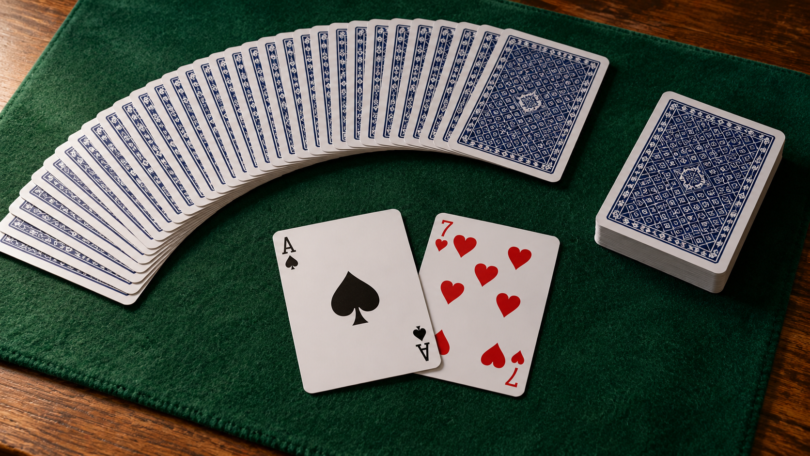
This recommendation is the standard-index, poker-size Rider Back two-pack, containing one red deck and one blue deck. It is a practical way to keep a fresh deck in reserve while you learn shuffles, controls and ordinary-deck tricks. The matching product is described by Bicycle’s official Cardtopia store as paper playing cards with Air-Cushion Finish.
Bicycle explains that the finish uses a textured surface with tiny embossed dimples to reduce friction between cards. That makes the finish relevant to fans and spreads, but it is not a promise that every new deck will feel identical or that a particular sleight will work immediately.
- Why buy it: you get two conventional decks, a familiar Rider Back design and an uncomplicated starting point for practice.
- What to watch: red and blue backs cannot be mixed unnoticed in a routine that requires a uniform back design. If you need duplicates from a second deck, buy the same back color and check the printing and wear.
- Choose carefully: standard index describes the size of the corner values. It is different from jumbo index, and poker size is different from the narrower bridge size.
A quantity of one for the linked product means one package containing two decks. Check that the selected listing still says red and blue, two-pack and standard poker size before ordering.
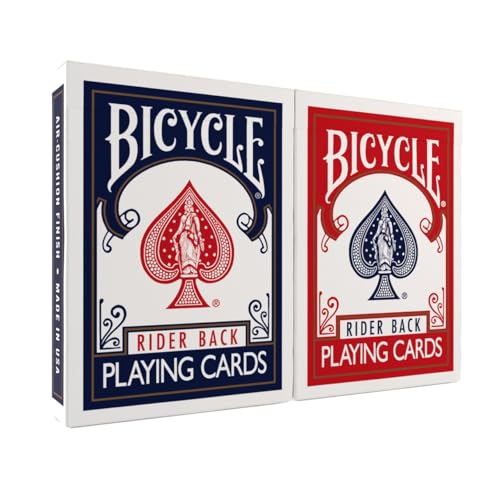
Bicycle Rider Back Playing Cards, Standard Index, Red and Blue, 2 Decks
As an Amazon Associate we earn from qualifying purchases.
2. Bicycle Elite Edition blue: for thinner stock and useful extras
Penguin Magic’s Bicycle Elite Edition, blue, one deck keeps the Rider Back look but changes the stock and supplied extras. Penguin lists thin-crush stock, an embossed finish and a traditional cut. It describes the intended feel as soft and flexible. Treat that as the maker’s description, since your grip and preferred resistance will determine whether the change suits you.
The clearly specified extras are two identical Jokers, a double-backer and a blank-facer. A double-backer has a card-back design on both sides; a blank-facer has a blank face. Those are useful starting materials for routines that deliberately require them. They also need to come out of the deck when you want an ordinary pack that spectators can inspect.
- Why buy it: it combines a familiar back design with a different stock specification and two named gaffs, rather than making you guess which extra cards are included.
- What to watch: softer, thinner cards are not automatically better for your technique. Try one deck before buying a brick.
- Compatibility limit: Rider Back artwork alone does not guarantee an invisible match to every existing gaff. Compare the color, borders, thickness and condition with the cards in your routine.
This is the blue single-deck Elite Edition, not a standard Bicycle two-pack or a different premium Bicycle edition. Buy it for the stated stock and extras; a traditional-cut claim should not be read as a guarantee of an effortless faro shuffle.
3. theory11 Monarchs in navy blue: the presentation pick
The original navy-blue Monarchs deck is the choice here for someone who wants the cards and tuck box to feel like part of the presentation. theory11 specifies FSC-certified paper, while the box uses navy coloring and gold foil. The gold decoration is a feature of the packaging; this recommendation is not for a gold-foil-backed collector edition.
The appeal is visual. A decorative deck can be a pleasing gift or suit a deliberately polished performance. It is less compelling if your routine regularly has spectators sign cards or if you mainly need inexpensive replacements. Compare the delivered cost per deck with your practice deck before committing to multiples.
- Why buy it: distinctive artwork and a decorative tuck box without needing to choose a rare or limited edition.
- What to watch: Monarch backs will not blend into a Bicycle Rider Back deck. Plan any matching special cards around the actual Monarch design.
- Edition limit: this is the original blue/navy model, one deck. Red, purple, silver and other Monarch releases are separate choices. Do not assume that all printings contain the same bonus cards.
The linked listing identifies model MONARCH, color Blue and one deck. There is no need to buy a collectible printing to learn card magic, and no named coating or special cutting direction is promised here.

How to choose cards for the tricks you want to perform
Start with the routine’s requirements. For a trick that calls for an ordinary deck, begin with a complete set of ordinary playing cards and remove advertising cards or gaffs. If a routine needs a marked, stripped, shortened or otherwise specially prepared deck, buy that exact type with its instructions. A normal deck and a trick deck are different tools.
Separate size from index. Bicycle’s card-size guide gives the common poker format as 2.5 by 3.5 inches and bridge format as 2.25 by 3.5 inches. Bridge cards are narrower. Jumbo index means larger printed values, not necessarily a larger physical card. Pick a size you can handle comfortably, then keep the size consistent when adding matching cards or props.
Paper, coating and plastic are separate questions. These picks use paper stock. A textured finish affects how surfaces slide against one another; it does not turn paper into a washable plastic card. Bicycle’s Air-Cushion explanation describes embossing and friction, not waterproofing. For a routine involving bending, signing or tearing a card, follow the routine’s material requirements instead of choosing solely by durability.
Match all visible details. For a deck switch or an added duplicate, compare the back pattern, color, border width, size and wear. Even two cards carrying the same brand name may come from different designs. A new extra card can also stand out in a heavily worn deck.
Buy a manageable quantity. A single deck lets you decide whether a stock suits you. A two-pack gives you a spare, but check its colors. Larger packs only make sense once you know the exact version you want. Compare the total delivered cost divided by the actual deck count, including any shipping charge.
Keeping a deck ready for performance
Return cards to their tuck box after use and keep them away from heat, damp storage and drinks. Bicycle’s storage advice warns that moisture, heat and dirt can cause cards to warp or stick. Use clean, dry hands and a clean surface; do not wash a paper deck as though it were plastic.
Before a performance, check that the needed cards are present and that none has an obvious bend, stain or damaged edge. Replace a deck when its condition interferes with your routine or makes an individual card recognizable. Keep a fresh spare if the performance depends on consistent handling.
The best choice for most buyers
Start with the Bicycle Rider Back red-and-blue two-pack if you want a straightforward practice purchase. Choose blue Bicycle Elite Edition when its thinner stock and included gaffs meet a specific need. Choose original navy Monarchs for their presentation. Spend on the feature your routine needs, then practice with that exact deck.
Frequently asked questions
Which playing cards are best for a beginner learning magic?
The Bicycle Rider Back standard-index red-and-blue two-pack is a practical starting point. It provides two ordinary poker-size decks with Air-Cushion Finish. Use one at a time, and remember that their different back colors are visible if you mix them.
Do I need a special trick deck to perform card magic?
Many routines use an ordinary deck. Buy a specially prepared deck only when the routine calls for it, and follow its instructions. Remove gaffs and advertising cards before a routine that needs a normal deck.
Are paper or plastic playing cards better for magic?
Choose the material required by your routine and the feel you prefer. These three picks use paper stock. A textured or coated paper card is not the same as a washable plastic card, and plastic is not automatically a suitable substitute for a routine involving signing, bending or tearing.
What is the difference between poker size, bridge size and jumbo index?
Common poker-size cards measure 2.5 by 3.5 inches; bridge-size cards are narrower at 2.25 by 3.5 inches. Jumbo index refers to larger printed corner values. Check physical size separately when matching a deck to extra cards or props.
When should I replace my playing cards?
Replace a deck when sticking, warping or damaged edges interfere with handling, or when a bend or stain makes a card identifiable. Store paper cards in their box in a cool, dry place, keep liquids away and carry a fresh spare for important performances.