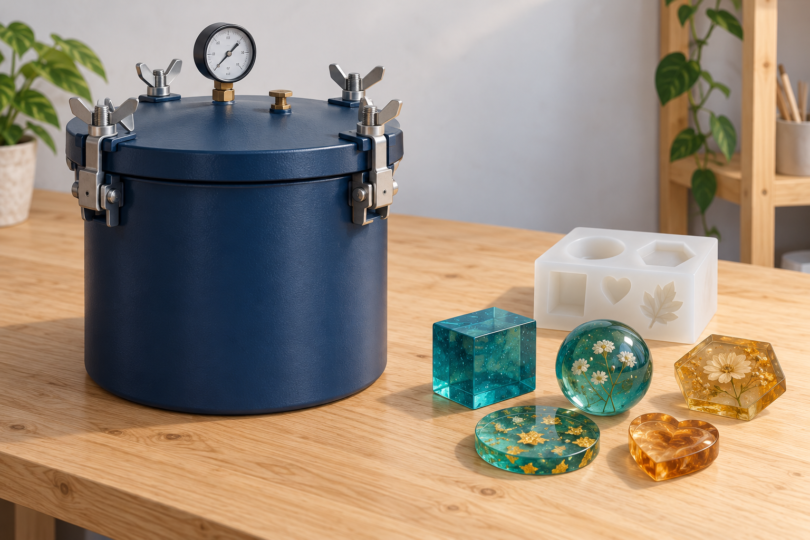

For compact resin molds, our pick is the California Air Tools 255C, 2.5 gallon. For a much wider mold, consider the California Air Tools 1810C, 10 gallon. The useful distinction is chamber shape: the larger model provides more width, but slightly less internal depth.
This focused shortlist compares two factory resin-casting pots using manufacturer specifications, linked manuals and exact retailer models. The recommendations reflect size and handling needs; we have not performed hands-on casting, pressure-retention or durability tests.
Best pressure pots for resin casting at a glance
| Model | Best fit | Inside with lid fitted | Weight | Main limitation |
|---|---|---|---|---|
| California Air Tools 255C, 2.5 gallon | Compact molds and a smaller work area | 9¼ inches wide × 10 inches deep | 22 lb | Narrow chamber; check the mold’s full outside dimensions |
| California Air Tools 1810C, 10 gallon | Wide, relatively shallow molds | 17¾ inches wide × 9⅝ inches deep | 64 lb | Heavy, and not a height upgrade over the 255C |
Both product pages list 60 PSI operating pressure and 80 PSI maximum pressure. Those are equipment specifications, not universal resin-curing settings. The 255C manual explicitly warns against using more than 60 PSI in the tank; the 1810C manual also gives 60 PSI as the working pressure and as the tank limit in its operation section. Do not treat the advertised 80 PSI maximum as an operating target.
California Air Tools 255C: best compact choice
The 255C is our choice when the complete mold fits comfortably inside its smaller chamber. California Air Tools specifies a coated steel tank, rubber feet and a carrying handle, plus a regulator, ball valve and pressure-relief valve.
- Pros: The lighter of these two pots; compact dimensions make it the easier one to accommodate in a small workspace.
- Cons: Limited width can rule out larger molds. The pot is only part of the equipment budget: its manual lists the compressor, filter, hose and operator safety equipment separately.
Choose the 255C / 2.5 Gallon Pot / 2.5 Gallon selection below. The linked listing is for one blue pressure pot.

California Air Tools 255C 2.5-Gallon Resin Casting Pressure Pot
As an Amazon Associate we earn from qualifying purchases.
California Air Tools 1810C: best for wider molds
The 1810C earns its place for chamber width. Its manufacturer specifications describe a coated steel tank with rubber feet and included caster wheels. At 64 lb, it is a substantial piece of equipment to place and move.
- Pros: Much more internal width than the 255C; useful when a broad mold cannot fit the smaller pot.
- Cons: The larger gallon capacity does not provide more headroom. Its 9⅝-inch internal depth can still exclude tall molds or a mold-and-support combination.
Choose CAT-1810C / 10 Gallon Pot / 10 Gallon. The linked listing identifies one black pressure pot; CAT-1810C is the retailer’s model designation for the manufacturer’s 1810C.

What to check before buying
Measure the mold’s outside width and height, including its base or support, then allow clearance for placing and removing it. Check the lid-on internal dimensions above. Nominal gallon capacity alone is a poor way to decide whether a particular mold will fit.
Budget for a compatible compressed-air setup and confirm the fittings and accessory ratings against the exact pot’s manual. Both pots are described by the manufacturer as non-ASME tanks; the product pages direct commercial users to check state and city requirements. Confirm suitability for your workplace before ordering.
Buy a factory casting model with intact safety equipment. Follow the model-specific manual and resin manufacturer’s instructions, and resolve any conflicting limits with the supplier before use. Never modify the vessel or defeat its relief valve, and never loosen the lid while pressure remains. The 1810C manual explains the explosion hazards from alterations and opening a pressurized tank.
Frequently asked questions
Which pot should I choose for dice or coaster molds?
Start with the complete mold’s measurements. The 255C is our compact pick when everything fits; choose the 1810C when you need its extra width. Neither recommendation guarantees that a particular mold, rack or batch arrangement will fit.
Is the 10-gallon pot deeper than the 2.5-gallon pot?
No. The manufacturer’s lid-on figures are 9⅝ inches deep for the 1810C and 10 inches for the 255C. The 1810C gains capacity through its wider chamber.
Does the maximum pressure tell me what curing setting to use?
No. A vessel’s maximum rating is not a resin process specification. Stay within the operating limits in the exact equipment instructions and use the resin supplier’s compatible process guidance. The 255C manual warns not to operate its tank above 60 PSI.
Do these listings include an air compressor?
The selected listings identify the included item as a pressure pot. Plan for a separate compatible compressor and air accessories; the 255C manual explicitly lists these supporting items separately.
Can I substitute a kitchen pressure cooker?
Our recommendation is to buy equipment expressly sold and documented for resin casting. A cooking appliance is outside this shortlist, and we do not recommend converting one or modifying a pressure vessel.