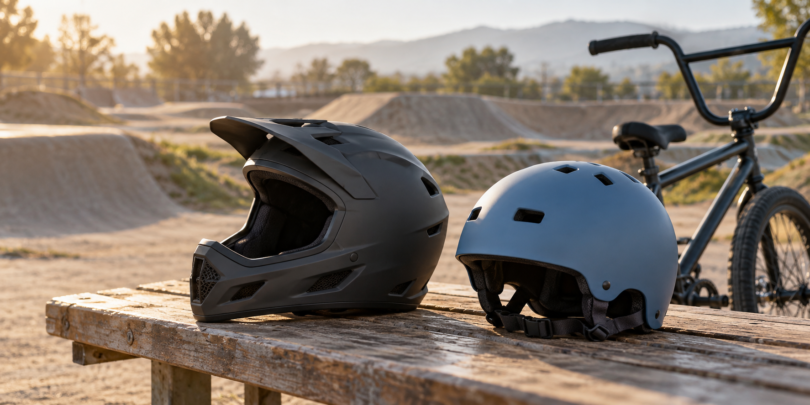

The Bell Sanction 2 is our starting point for a BMX full-face helmet, especially when its smaller XXS option is needed. Compare the Sanction 2 DLX Mips if you want Bell’s Mips-equipped version, or the Troy Lee Designs D4 Composite if its more closely spaced sizes fit you better. All three have manufacturer-documented BMX and downhill certification claims; the right choice still depends on fit and your riding requirements.
These are specification-based buying picks. We have not crash-tested these helmets or measured their comfort, ventilation or injury protection against one another. A feature list cannot establish which helmet will protect a particular rider best.
The three helmets at a glance
| Helmet | Documented US bicycle / BMX / downhill scope | Size range in this comparison | Reason to compare it |
|---|---|---|---|
| Bell Sanction 2 | CPSC, age 5+; ASTM F2032 BMX; ASTM F1952 downhill | XXS 48–51 cm in select colors; XS/S through XL 51–61 cm | First comparison for smaller heads and a straightforward full-face option |
| Bell Sanction 2 DLX Mips | CPSC, age 5+; ASTM F2032 BMX; ASTM F1952 downhill | XS/S through XL, 51–61 cm | Bell option with Mips Essential |
| Troy Lee Designs D4 Composite, Flush Black | CPSC, age 5+; ASTM F2032-15 BMX; ASTM F1952-15 downhill | XS through XXL, 53–63 cm, in specific size bands | Alternative fit with Mips C2 and removable cheek pads |
The ranges summarize each model’s chart; they are not interchangeable size labels. Check the individual size bands below and try the helmet on. A child’s age alone does not determine the correct size.
1. Bell Sanction 2: starting point for smaller head sizes
The Bell Sanction 2 lists 14 vents and removable cheek pads. Bell documents US CPSC bicycle compliance for riders age 5 and older, plus ASTM F2032 BMX and ASTM F1952 downhill certification. Its XXS option makes it worth checking first when a 51 cm starting size is too large.
Use Bell’s model-specific size chart: XXS 48–51 cm, XS/S 51–55 cm, M 55–57 cm, L 57–59 cm and XL 59–61 cm. XXS is offered only in select colors. Confirm the size on the actual color variant rather than assuming every Sanction 2 listing includes it.
The smaller range is a reason to try this model, not to buy a loose helmet for a child to grow into. If the shape creates pressure points or cannot stay secure with the straps correctly fastened, try another model.
2. Bell Sanction 2 DLX Mips: Bell option with a slip-plane system
The Sanction 2 DLX Mips adds Mips Essential, which Bell describes as a slip-plane system intended to reduce rotational forces in certain impacts. It also lists 14 vents and the same CPSC age-5-and-older, ASTM F2032 BMX and ASTM F1952 downhill scope. Those features do not establish a measured safety advantage over the other picks.
The current DLX chart is XS/S 51–55 cm, M 55–57 cm, L 57–59 cm and XL 59–61 cm. It does not list the base Sanction 2’s 48–51 cm XXS. Choose this model only if its fit works; adding a feature cannot compensate for the wrong size.
Before buying for a race, check the exact helmet’s retention system against the event’s rules and its supplied instructions. Select the full Sanction 2 DLX Mips model name when shopping; the Sanction 2 is a separate choice.
3. Troy Lee Designs D4 Composite: an alternative fit to try
The D4 Composite in Flush Black lists Mips C2, 20 intake and exhaust ports, quick-release contoured cheek pads and stainless-steel chinstrap D-rings. Troy Lee Designs documents CPSC bicycle compliance, ASTM F2032-15 BMX and ASTM F1952-15 downhill; its D4 manual specifies the CPSC age-5-and-older scope.
The US product chart gives XS 53–54 cm, SM 55–56 cm, MD 57–58 cm, LG 58–59 cm, XL 60–61 cm and XXL 62–63 cm. The selector calls the last size “2X.” These bands differ from Bell’s, so a Medium in one brand is not a direct substitute for a Medium in the other.
Consider it when those size bands offer a better starting fit. Follow the D4 manual’s fitting checks, including cheek-pad contact and resistance to rolling off with the strap fastened. Check vision with your goggles before riding. The D4 is a bicycle helmet; the manual excludes motorcycles and motorized vehicles.
Choose for the activity, including park riding
The CPSC activity guide identifies ASTM F2032 for BMX and ASTM F1952 for downhill mountain-bike racing. ASTM F1492 concerns skateboarding and aggressive skating. A helmet marketed as “skate/BMX,” or labeled only CPSC and F1492, does not establish F2032 compliance. Check the actual certification label.
For BMX riding at a skatepark, look for the BMX-specific standard when comparing helmets; the venue’s name does not turn cycling into skateboarding. If you also skateboard, check that separate activity’s standard rather than assuming these full-face models cover it.
Ask your track or event organizer about its equipment requirements before ordering. The USA BMX rulebook requires a permanent helmet strap and disallows snaps; it strongly recommends a full-face or ear-covering helmet. That wording is not a universal full-face requirement for every BMX event.
Fit and ownership checks before buying
- Measure, then try on. Wrap a flexible tape level around the head above the eyebrows. Use the exact model chart as a starting point, then follow its fit instructions. Do not select solely by age or a familiar S/M/L label.
- Check retention and visibility. With the chinstrap correctly secured, the helmet must fit snugly and resist rolling off. The D4 manual checks that the cheek pads contact the cheeks and that the helmet does not shift over the eyes. Follow the equivalent checks supplied with your chosen model.
- Buy for the fit now. NHTSA advises against a helmet bought for a child to grow into. A loose helmet needs a different size or shape, not an improvised layer of padding.
- Verify the exact unit. Match model, size, regional certification label and seller identity. Check current manufacturer notices, such as Bell’s recall page, and the CPSC recall database before purchasing. Search the specific model and production details; a brand name alone is insufficient.
- Plan for replacement. NHTSA says to replace a bicycle helmet after a crash even when damage is not visible. Follow the maker’s inspection, care and replacement instructions. Do not drill the shell or add unapproved camera mounts or other attachments.
Frequently asked questions
Is a CPSC bicycle label enough for BMX?
Check for the additional BMX-specific scope: CPSC’s activity guide points to ASTM F2032 for BMX cycling. All three choices here have an explicit manufacturer BMX certification claim. Confirm it on the exact helmet you receive.
Do I need a full-face helmet for a BMX race?
Check your event’s rulebook and track operator. USA BMX strongly recommends a full-face or ear-covering helmet and sets strap requirements. Other events may specify different equipment, so confirm before buying.
Does Mips guarantee concussion prevention?
No. Bell describes Mips as addressing rotational forces in some impacts, while CPSC states that no helmet design has been proven to prevent concussion. Do not treat a technology name or a higher price as a guarantee.
Can I size up for a growing child?
Buy a helmet that fits securely now. Start with head circumference and the exact size chart, then check the fit on the child. A size label or age recommendation cannot replace that check.
Can I keep a helmet after a crash if it looks fine?
Replace a bicycle helmet after a crash; damage can be hidden. If you are unsure whether a drop or another impact damaged a D4, its manual directs you to contact Troy Lee Designs before using it again.