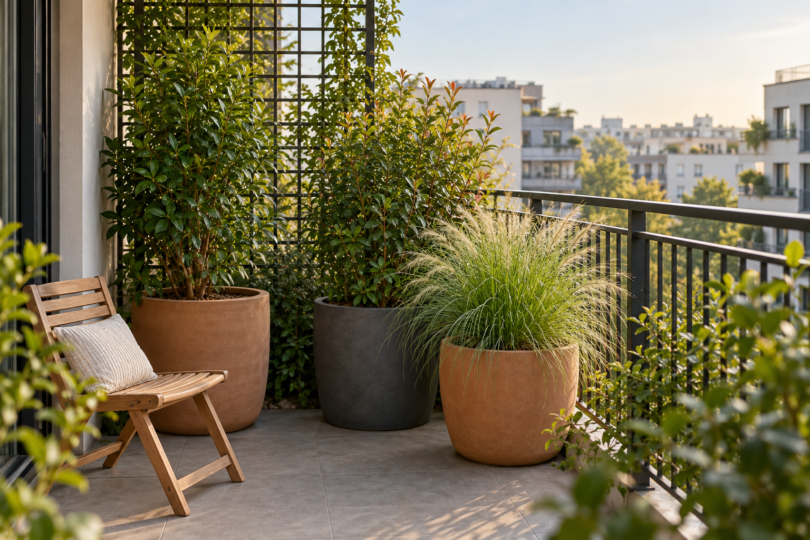

The best plants for balcony privacy depend on what you need to hide, how much sun reaches the pots, and whether you want foliage through winter. Sky Pencil holly suits a narrow evergreen planting; Northwind switchgrass suits a sunny, seasonal screen; star jasmine suits a supported screen in a mild climate. None is a universal choice for every U.S. balcony.
There is also a separate buying decision: living plants, seeds, or artificial greenery. This guide covers three live plants and two artificial screens. Faux ivy garlands, window film, and lights may decorate a balcony, but they are not interchangeable with an established planting or a fitted privacy panel.
Compare the five options
The hardiness zones below describe landscape suitability, not guaranteed survival in an exposed pot. Published mature sizes are landscape references. None of the selected sellers supplies a dependable mature height for every container size; pot volume, care, pruning, and climate change the result.
| Option | Best for | Sun and climate | Size and main limitation |
|---|---|---|---|
| Sky Pencil holly | Narrow evergreen columns | Sun to partial shade; zones 5–8 as a starting range | Landscape reference: 4–10 ft tall, 1–3 ft wide; container height varies |
| Northwind switchgrass | A sunny summer seating area | Full sun; zones 4–9 | About 4.5 ft foliage, 5.5 ft with flowers in nursery guidance; seasonal coverage |
| Star jasmine | A fragrant trellis screen | Sun to partial shade; sheltered zones 8–10 as a conservative starting range | Can climb 20 ft in the landscape; train and prune to the available support |
| DearHouse artificial ivy screen | Covering a long railing section | No growing requirements | One 118 × 39.4-inch screen; visible gaps between leaves |
| Sunnyglade artificial boxwood panels | A modular greenery backdrop | No growing requirements | Twelve 20 × 20-inch panels; needs a suitable supporting structure |
Live plants for balcony privacy
1. Sky Pencil holly: best for a narrow evergreen planting
Ilex crenata ‘Sky Pencil’ makes sense where a broad shrub would crowd the walkway. Its upright, densely branched habit provides vertical greenery without needing a trellis. NC State Extension identifies it as a container plant and gives a landscape range of 4–10 feet tall by 1–3 feet wide.
The tradeoff is patience and careful siting. This is a slow-growing shrub, and a small nursery plant will not immediately close a wide gap. It needs well-drained soil and protection from drying wind and cold. NC State also cautions about alkaline soil, drought, and high heat and humidity. A hot, exposed balcony is not automatically suitable just because its winter zone falls within a seller’s range.
Pros: evergreen leaves, narrow shape, no climbing framework. Cons: slow fill-in, limited width per plant, and continuing watering and winter-protection needs.
Perfect Plants offers Sky Pencil holly in a 1-gallon, single-plant option. Check that selection against the multipacks and larger pots. The decorative container and flowering underplanting shown in its photographs are display examples, not the stated single-plant purchase.
2. Northwind switchgrass: best for summer screening in sun
Panicum virgatum ‘Northwind’ offers a more relaxed look, with upright foliage and airy flowers. Hoffman Nursery lists sun, zones 4–9, approximately 4.5 feet of foliage, and 5.5 feet including bloom. Those measurements help distinguish the leafy screening portion from the taller, more transparent flower heads.
Choose it when privacy matters most during the growing season. It is a warm-season grass, so a pot does not provide a permanent green wall. Old stems can retain some visual interest, but cutting them back for the next season leaves a gap. Give the clump room rather than trying to fit a mature grass into a shallow railing box. In wildfire-prone settings, choose another screen: NC State rates switchgrass highly flammable and advises against it within a home’s defensible space.
Pros: upright habit, movement, and a softer backdrop. Cons: seasonal coverage, visible space between stems, and an annual cleanup period.
Rare Roots sells Northwind in a 1-quart pot and lists container use. That is a young plant, not a ready-made six-foot screen. Its listing also explains that plants may arrive dormant or trimmed for shipping, depending on the season.
3. Star jasmine: best for a supported screen in a mild climate
Star jasmine, Trachelospermum jasminoides, is the choice for a leafy trellis with fragrant flowers. NC State Extension lists zones 8–10, sun to partial shade, and patio-container use. In colder climates, it describes growing the plant seasonally or overwintering a container indoors.
This vine needs something to twine around. Train stems across the area you want covered and prune after flowering to keep growth within the available space. Its potential 20-foot landscape height is a reason to plan that maintenance, not a promise that a small pot will create that much screening.
The RHS recommends generous root space for balcony-grown star jasmine: around 16 inches deep and 16–24 inches wide. Treat that as planning guidance, then match the container to the purchased root ball and growing conditions.
Pros: evergreen foliage in suitable climates, flowers, adaptable trellis coverage. Cons: support and pruning required; cold-weather storage may be necessary.
Arbor Day’s listing offers one potted 1-gallon star jasmine, with a stated shipping height of ½–1 foot. It lists zones 7–11, broader than NC State’s range; confirm local suitability before buying for an exposed balcony near those limits.
Artificial greenery for immediate coverage
4. DearHouse ivy screen: best for a long, low panel
This is artificial foliage on a backing, not live ivy. The selected version measures 118 × 39.4 inches, approximately 9 feet 10 inches long by 3 feet 3 inches high. It can cover an existing railing section without pots or a growing season.
The product image shows gaps between leaves, so buy it for filtering a view rather than assuming complete concealment. Its low height also matters: railing coverage may hide a seated person’s lower body while leaving faces visible. Measure the sightline before ordering.
Pros: immediate greenery and a continuous strip. Cons: partial visibility, artificial appearance, and the need for secure mounting and cleaning. The seller describes outdoor use, but the listing is not proof of indefinite resistance to fading or storm damage.
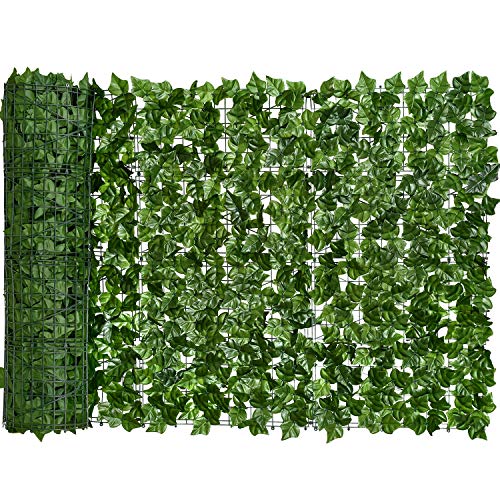
DearHouse Artificial Ivy Privacy Screen, 118 x 39.4 Inches
As an Amazon Associate we earn from qualifying purchases.
5. Sunnyglade boxwood panels: best for a modular backdrop
The selected Sunnyglade pack contains twelve artificial panels, each 20 × 20 inches. That is approximately 33.3 square feet before trimming or overlap. A four-across, three-high arrangement would measure 80 × 60 inches, which may suit a balcony end panel better than a long railing.
Pros: modular coverage, interlocking edges, and no watering. Cons: more joins and attachment points, a conspicuously uniform texture, and a separate support requirement. These panels are decorative cladding, not a freestanding barrier or a replacement for a safety railing. Check the selected size and twelve-panel quantity; other variants differ.
What to check before spending money
Measure the view, then the available space
Sit where you normally use the balcony and identify the gap you want to screen. Measure from the floor to that sightline, allowing for the planter’s height. Then measure the usable floor width after chairs, doors, and a walking route are accounted for. A narrow shrub can still require a substantial pot.
For a tall planting, choose a stable container and an approved way to secure supports. Illinois Extension highlights tipping risks on windy balconies and recommends checking structural weight limits before placing heavy pots. Include wet growing mix, plants, containers, and people in the discussion with building management or a qualified professional.
Budget for care and winter storage
The nursery pot is the shipping container, not necessarily the long-term planter. Include potting mix, drainage, watering access, and any trellis in the cost. Containers need drainage outlets; empty collected runoff so roots are not left standing in water. Maryland Extension’s container guidance also cautions that gravel in the bottom does not improve drainage.
A plant hardy in the ground can be damaged in a pot. UNH Extension explains that exposed roots face harsher cold and drying wind. Decide where the container will spend winter before choosing a large, difficult-to-move plant.
Living screens also need room for roots over time. RHS repotting advice explains that restricted root space and pruning affect plant size. Ask the nursery what height is realistic in your intended pot; do not substitute a landscape maximum for a container forecast.
Frequently asked questions
Which option provides privacy fastest?
A correctly sized artificial screen provides its coverage as soon as it is installed. For live greenery, buy a plant already close to the height and fullness you need. A quart grass or small shrub requires time to grow, and foliage may still have gaps.
Can I grow balcony privacy plants from seed?
You can grow a planting from suitable seed, but a seed packet contains no immediate screening. Germination, growth, and training come first. Check the species, local suitability, and growing season. Named cultivars should be bought as correctly identified plants when their particular size and habit matter.
Which plants keep their leaves in winter?
Sky Pencil holly and star jasmine are evergreen within suitable growing conditions. Northwind switchgrass is seasonal. Evergreen does not mean an exposed container needs no winter protection, or that a plant will thrive outside its appropriate climate.
How many plants do I need?
Start with the width you need to obscure, the plants’ current fullness, and room for their pots. Do not pack small plants together solely to close gaps on delivery day. Ask the nursery about spacing for the intended containers and allow for future growth.
Are artificial leaves completely private and maintenance-free?
No. Gaps, panel joints, viewing angle, and backlighting can affect concealment. Artificial greenery still needs cleaning and attachment checks. Inspect a sample against the actual view before covering a whole balcony, and confirm the building permits the proposed installation.