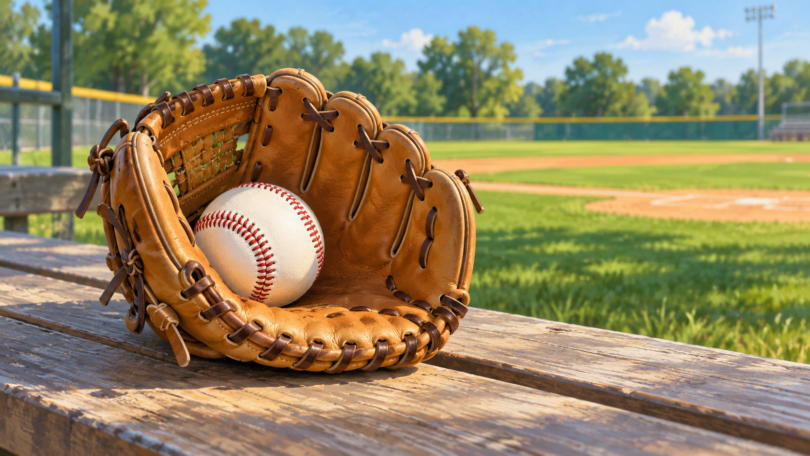

The best baseball glove for a 7-year-old is one the player can keep on their hand, open comfortably and close around the ball. A long glove with impressive leather is a poor choice if a beginner cannot control it. Start by trying a 10.5-inch youth glove, then compare smaller or larger options according to hand fit and the ball used by the team.
Our shortlist is the Rawlings Sure Catch 10.5-inch Kris Bryant glove for its adjustable youth fit, the Mizuno Prospect PowerClose 10.5-inch for its closure-focused design, and the Franklin Field Master 10.5-inch for a synthetic recreational option. These are three models to try, rather than a promise that one size fits every child.
Disclosure and method: This guide compares manufacturer specifications and published sizing guidance. We have not conducted hands-on testing or measured durability. Links lead to official manufacturer pages. Confirm the exact size, throwing-hand version, price and return conditions before ordering.
Baseball gloves for 7-year-olds compared
| Glove | Why consider it? | Verified construction or fit feature | Important limitation |
|---|---|---|---|
| Rawlings Sure Catch Kris Bryant, SC105KB-6/0 | Adjustable youth fit | Soft leather shell; Youth Pro Taper fit; heel cutout; adjustable wrist strap | This specific model is right-hand throw |
| Mizuno Prospect PowerClose, GPP1050Y3RY | Trying a closure-focused beginner glove | Full-grain pigskin leather; PowerClose; flexible AirMesh back | Closing assistance does not guarantee an individual fit |
| Franklin Field Master 10.5-inch, item 22606 | Casual catch and recreational play | Synthetic leather palm and shell; adjustable thumb fit | The linked tan/black model is right-hand throw; not a leather glove |
1. Rawlings Sure Catch 10.5-inch Kris Bryant: adjustable youth fit
This is the first model we would put on the try-on list for a right-handed thrower. Rawlings lists a soft leather shell, Youth Pro Taper fit and an adjustable Neo-Flex back with a hook-and-loop wrist strap. Its heel cutout is intended to make closing the glove easier. The manufacturer’s product page identifies the exact model as SC105KB-6/0, with a Pro H web and 10.5-inch size.
The practical appeal is the combination of a youth hand opening and adjustment at the wrist. Try it snug enough to stay put while still allowing free movement. The strap cannot compensate for finger stalls that are much too long.
Limitation: this particular Kris Bryant version is listed for right-hand throwing. A left-handed thrower needs a different, explicitly left-hand-throw model. Also, Rawlings’ game-ready description should not replace checking whether the actual player can squeeze it closed.
View this exact glove at Rawlings.
2. Mizuno Prospect PowerClose 10.5-inch: closure-focused design
Mizuno’s Prospect PowerClose is worth trying when a player struggles to close a stiffer glove. The official 10.5-inch listing specifies full-grain pigskin leather, an AirMesh back and PowerClose construction. Its Less 2 Lacing design removes two lace loops near the web to increase flexibility along the closing axis.
The palm liner is polyurethane, so “leather glove” does not mean every component is leather. Mizuno also lists palm padding and a moisture-managing lining. These are construction details, not proof that it will be more comfortable for every player.
Why consider it: the design directly addresses flexibility for developing hands. Limitation: a flexible glove can still be too loose at the wrist. The official page offers throwing-hand selections; choose the correct one and check the resulting variant before paying.
View the Mizuno Prospect PowerClose 10.5-inch glove.
3. Franklin Field Master 10.5-inch: synthetic recreational option
The tan/black Field Master, item 22606, is a straightforward alternative for casual catch and recreational baseball. Franklin’s exact product listing identifies both the palm and shell as synthetic leather and specifies a customizable thumb adjustment. The 10.5-inch version is a better starting point for this age discussion than treating every glove in the wide Field Master range as interchangeable.
Try this model alongside the youth-specific Rawlings and Mizuno options. A smaller printed size does not establish how closely the wrist and finger stalls will fit. Use the player’s ability to control the glove as the deciding factor.
Limitation: this is synthetic construction, and we have not tested its lifespan against the leather alternatives. The linked item is right-hand throw. If shopping another size or hand orientation, verify the full listing rather than relying on a shared family photograph.
View Franklin Field Master item 22606.
How to choose the right glove size
Age charts are starting points. Rawlings’ sizing chart gives a broad 10.25–11.5-inch range for infield gloves across ages 7–12. That covers children with very different hands and experience; it is not a reason to give every 7-year-old an 11.5-inch glove.
Our 10.5-inch starting point is a practical try-on suggestion within that range. A smaller beginner may control a 10-inch youth model better, while a larger or more experienced player may prefer 11 inches or more. Compare nearby sizes in youth patterns. Glove length and the size of the hand compartment are separate considerations.
Use a simple fit check
- Seat the hand fully. Check for uncomfortable pressure and excessive empty space.
- Adjust the wrist. The glove should remain secure when the player gently moves their hand.
- Open and close it repeatedly. The player should not need their other hand to force every closure.
- Try an easy catch with the team’s ball type. Check whether the player can hold the ball and remove it without fighting the pocket.
Avoid buying an oversized glove simply to grow into it. Cupertino Little League’s equipment guidance specifically warns that large gloves can be harder for young players to close and control. A useful glove today is more valuable than extra length that gets in the way.
Get throwing-hand terminology right
- Right-hand throw (RHT): throws with the right hand; wears the glove on the left.
- Left-hand throw (LHT): throws with the left hand; wears the glove on the right.
Franklin explains this distinction in its Field Master buying information. Choose by the hand used to throw, not the hand that will wear the glove.
Break-in and everyday use
Begin with easy catch and follow the care instructions for the specific material. Do not assume leather oils are suitable for a synthetic glove. Avoid drastic shortcuts such as heating or soaking; Rawlings’ leather glove guidance warns against these methods and against excessive oil.
Inspect the laces, lining and palm during the season. Little League advises regular equipment checks. Ask the coach about the division’s ball and positions before buying a specialized catcher’s or first-base mitt.
Frequently asked questions
Is 10.5 inches always the correct size for a 7-year-old?
No. It is a useful comparison size, not a universal prescription. Prioritize a secure youth fit and comfortable closure; try adjacent sizes when either is wrong.
Should a beginner use a baseball or softball glove?
Match the actual sport and ball. Softball gloves generally have a wider pocket for the larger ball, as Rawlings explains. Do not choose by the player’s gender or assume a baseball shortlist automatically fits softball.
Is an expensive glove easier to use?
Not necessarily. Premium leather may require substantial break-in. For a beginner, secure fit and manageable closure should come before a professional-style pattern or price tag.
What if the glove feels right to an adult but is difficult for the player?
Let the player perform the fit check. An adult squeezing the glove easily does not establish that a smaller hand can operate it. Compare another youth pattern or a more flexible model before trying to solve every problem through break-in.