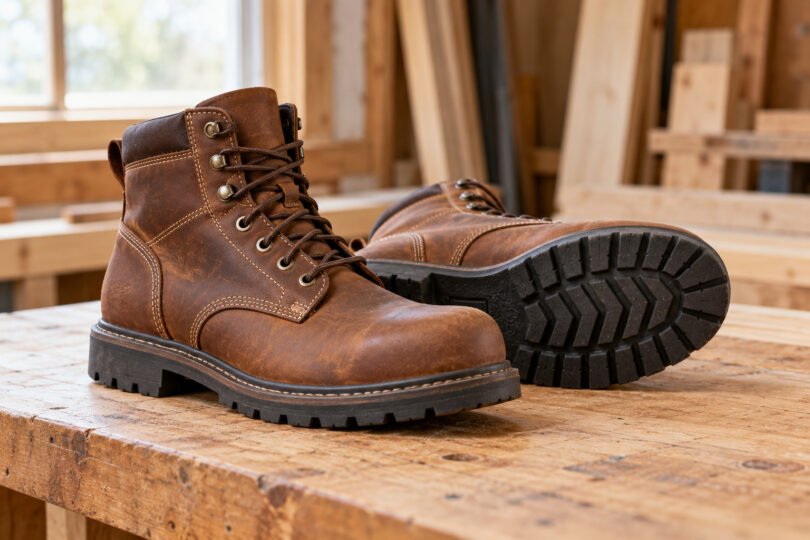

The right work shoes for construction workers start with the hazards on the job, then the fit of the footwear. A comfortable sneaker, a steel toe and a heavy leather boot solve different problems. Before buying, ask your employer which toe, sole, electrical, metatarsal and other protection your specific work requires.
For an athletic option, the Reebok Work RB4041 has an alloy toe and a published electrical-hazard specification, but its product page leaves some rating details to verify. For a six-inch leather boot with a clearly stated current standard, compare the Irish Setter Ashby 83606. For waterproof construction, consider the distinct Cat Second Shift USA steel-toe model P91875. None of these three should be assumed to provide puncture protection.
Start with the jobsite requirements
OSHA’s construction PPE rule makes employers responsible for selecting equipment appropriate to the work and ensuring it properly fits each affected employee. Its separate construction foot-protection standard still references ANSI Z41.1-1967. Do not mistake a retailer’s “OSHA approved” phrase for a jobsite assessment or assume the construction and general-industry standards have identical wording. Have your employer or safety professional confirm the accepted markings and additional protection for your work.
- Falling or rolling material: check the specific toe-impact and compression markings, and whether protection over the top of the foot is also required.
- Nails, sharp debris or demolition: ask for documented puncture resistance. A safety toe, thick outsole or ordinary steel shank does not establish a puncture rating.
- Wet floors, mud and ladders: discuss the actual surfaces, contaminants, tread and heel requirements. Slip resistance is conditional; no sole makes every surface safe.
- Electrical or static hazards: get the required classification in writing. Electrical-hazard, static-dissipative and conductive footwear are different categories.
- Hot work, chemicals or molten material: use the task’s specific PPE selection. Waterproof leather or a heat-resistant outsole alone does not establish protection from those exposures.
Three models to compare
These are comparisons of published specifications, with gaps identified so that a missing claim is not mistaken for protection. Check the label on the actual footwear supplied, including its standard edition and classifications.
| Exact model | Toe and electrical specification | Sole information | Decision point |
|---|---|---|---|
| Reebok Work Sublite Cushion Work RB4041, black | Alloy toe; maker lists ASTM F2413 and electrical-hazard protection. Edition and separate I/C markings are not stated on the reviewed page. | Slip-resistant claim; no named slip test or puncture-resistance rating shown. | Low-cut microfiber/mesh shoe. Confirm full label and site permission before choosing an athletic style. |
| Irish Setter Ashby 83606, brown | Aluminum toe; maker lists ASTM F2413-24, I/C, EH SR. | Rubber-EVA Traction Tred outsole; SR listed. No PR marking shown. | Six-inch leather boot. Distinguish it from soft-toe Ashby 83605. |
| Cat Second Shift USA 6-inch Waterproof Steel Toe, P91875 | Steel toe; maker lists ASTM F2413-24 I/C EH SR. | Rubber outsole; SR listed. No PR marking shown. | Waterproof leather and seam-sealed liners. This is a specific USA edition, not every Second Shift boot. |
Reebok Work RB4041: an athletic style when the site allows it
The RB4041 manufacturer page identifies a black microfiber-and-mesh upper, removable cushioning footbed and EVA midsole with rubber at the heel and forefoot. Its low-cut shape is worth considering when your employer permits a work shoe and the required protections match.
The limitations matter: the page’s “Best” slip category is an internal comparison, not a published numerical test result. It does not provide a puncture rating or identify a metatarsal guard. Do not transfer claims from a similar-looking Sublite model; the range includes different toe and electrical variants. Confirm the exact model, size and width when ordering.
Irish Setter Ashby 83606: check the style number
The Ashby 83606 combines an aluminum safety toe, a six-inch oiled leather upper, Goodyear welt construction and a removable polyurethane footbed. Its current specifications explicitly list ASTM F2413-24 I/C, EH and SR. The maker offers regular D and wide EE widths; the correct choice depends on your foot and work socks.
Ashby 83605 is a separate soft-toe style. The shared name and similar appearance do not make those two interchangeable. Also, the maker’s HRO description concerns the outsole’s resistance to melting, not a safe contact temperature for your feet. This model’s listed specifications do not establish puncture resistance, a metatarsal guard or waterproof construction.
Cat Second Shift USA P91875: a waterproof steel-toe option
The Second Shift USA six-inch waterproof steel-toe boot is a distinct model with waterproof leather, seam-sealed waterproof liners and a rubber outsole. Cat lists ASTM F2413-24 I/C EH SR and Goodyear welt construction.
Consider it when waterproof construction is part of the required specification. Confirm P91875 and the chosen size and width rather than shopping by “Second Shift” alone. Waterproofing does not make footwear appropriate for energized wet work or chemical immersion, and the reviewed page supplies no PR or metatarsal-protection claim. The boot still needs employer approval for the actual tasks.
Read safety markings without overextending them
I and C identify toe-impact and compression protection. EH identifies electrical-hazard footwear, while PR identifies puncture resistance when that protection is actually claimed. SR is a slip-resistance designation on the two current boot specifications above. A model described only as meeting ASTM F2413 should not be credited with every optional protection covered by that standard.
ASTM’s published scope explains that controlled laboratory compliance does not establish performance for every real-world exposure. It also warns that changing original components, including adding or replacing footbeds or resoling, can invalidate the marking. Ask the manufacturer and employer before adding an aftermarket insole to certified footwear; cushioning and protective construction are separate questions.
EH, SD and conductive footwear are different
As the Reebok Work safety-footwear guide explains, EH footwear addresses incidental electrical hazards; SD footwear dissipates static toward the walking surface; conductive footwear serves specific static-control environments. Toe-cap material by itself does not tell you which category a complete shoe meets.
EH footwear is secondary protection, not permission to work on live circuits. Wetness, wear and conductive contamination can compromise its insulating function. Conductive footwear must not be substituted for EH footwear around electric-shock hazards. SD footwear is also not an EH substitute. These distinctions are consistent with OSHA’s footwear safety guidance; have a qualified safety professional select the complete protection system for the task.
Fit and inspection before the first shift
Try both shoes with the socks you will wear at work. Walk and bend: toes should have room without contacting the protective cap, the heel should stay secure, and the upper should not pinch. Compare widths rather than simply buying a longer size. A boot that needs painful “breaking in” at the toe cap is a reason to reassess fit.
Before use, check the label, sole condition, stitching, closures and any exposed or embedded metal. Follow the maker’s cleaning and replacement instructions. Report a damaged toe area, puncture, separating sole or loss of grip to your employer; a shoe can need replacement even if it still looks usable from above.
Disposable shoe covers, socks and cushioning inserts are accessories, not substitutes for the specified protective footwear. Ordinary hiking boots and soft-toe work boots likewise need their own task-specific assessment. Choose the model whose documented protection and fit match your work, then keep it in serviceable condition.
Frequently asked questions
Are safety-toe sneakers suitable for construction?
Sometimes. The exact shoe must meet the employer’s requirements, and the task may demand additional sole, metatarsal, ankle-height or exposure protection. An athletic appearance does not prove suitability or disqualify a shoe by itself.
Does a steel toe mean the sole is puncture resistant?
No. Toe protection and sole puncture resistance are separate specifications. Look for the required puncture-resistance marking and supporting model documentation.
Can I use electrical-hazard shoes for static-control work?
Do not choose them by the word “electrical.” EH, SD and conductive footwear serve different purposes. Your employer’s safety assessment must determine the required category.