
A useful truck cab AC unit must match the truck’s electrical system, mounting structure, and overnight cooling demand. For engine-off cooling, start with a compressor-based parking air conditioner and a realistic battery plan. A household window unit, a small evaporative cooler, and a vehicle-mounted DC air conditioner solve different installation problems.
The three options below are actual vehicle-cooling systems: a Dometic rooftop parking cooler, a VEVOR rooftop unit, and a VEVOR split system. All three selected variants are 12 V DC. None is a universal fit, and a listing’s runtime claim does not establish how long it will run on your batteries.
This is a manufacturer-documentation buying guide. We have not installed these units or measured their cooling, noise, or overnight runtime against one another.
Truck cab air conditioners at a glance
| Exact option | Layout | Published cooling capacity | Main fit question |
|---|---|---|---|
| Dometic RTX 1000, US part 9600028489 | Self-contained rooftop parking cooler | 1,200 W, approximately 4,094 BTU/h | Does its capacity suit the cab, and is the correct roof installation approved? |
| VEVOR ZX-20, cooling-only | Self-contained rooftop | Manufacturer-listed 10,000 BTU/h | Can the roof, opening, and electrical supply accommodate it? |
| VEVOR DB23, cooling-only | Separate indoor and outdoor units | Manufacturer-listed 10,000 BTU/h | Are safe mounting locations and refrigerant/drain routes available? |
Cooling output is not electrical consumption. Also, these published figures are not the result of a common independent test, so the table cannot establish relative real-world efficiency or cooling speed. Cab insulation, glass area, sunlight, humidity, and air leakage all affect the result.
1. Dometic RTX 1000: a documented rooftop parking-cooler option
The selected RTX 1000 is the white US 12 V model, part 9600028489. Dometic’s US installation and operation manual lists 1,200 W cooling output and a 10–50 A current range. It gives an approximately 24 kg unit weight and 860 × 645 × 308 mm external dimensions.
This is an appropriate candidate when the installer confirms that its cooling capacity is sufficient. A relatively small sleeping area with controlled heat gain is a different assignment from a large, sun-soaked sleeper. Do not assume that the name “1000” is an electrical-input rating or that specifications for another regional RTX variant apply to this part.
The installation is a substantial part of the purchase. Obtain a parts list for the exact roof and confirm which mounting kit, trim, seals, battery cable, and circuit-protection components the seller includes. A product photograph is not a complete bill of materials.
Consider it when: you want this documented parking-cooler system and have confirmed roof fit, capacity, and support for the installation. Important limitation: Dometic’s manual excludes agricultural and construction vehicles. Broad marketplace descriptions should not override that restriction.
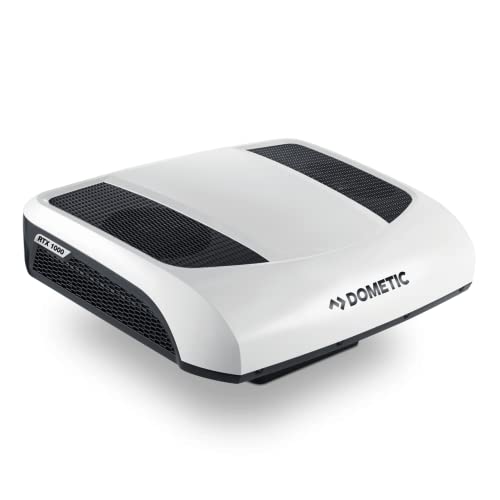
Dometic RTX 1000 9600028489, 12V Rooftop Parking Cooler, White, One Unit
As an Amazon Associate we earn from qualifying purchases.
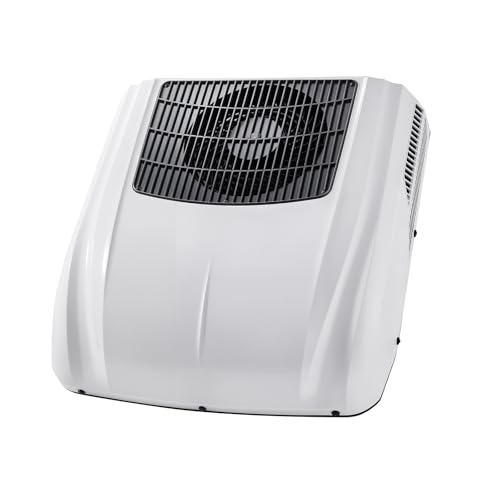
2. VEVOR ZX-20: a self-contained 12 V rooftop option
The ZX-20 manufacturer page identifies a cooling-only rooftop model with a listed 20–60 A current range. Its advertised airflow is 350 m³/h. VEVOR lists approximately 25.15 kg weight and 730 × 760 × 250 mm overall dimensions.
Keeping the refrigeration components together avoids the separate indoor-to-outdoor refrigerant-line installation of a split system. The roof work remains critical: the outer casing size does not tell you the required cutout, supported roof thickness, reinforcement, mounting orientation, or sealing method. Have the installer obtain the current template and manual before ordering.
The selected listing is the white ZX-20 cooling-only unit with an accessory kit. Do not substitute the ZX-20N heating-and-cooling variant without checking its specifications and package. Likewise, confirm that the accessory kit actually contains the items your truck needs.
Consider it when: you have a suitable roof and prefer a single rooftop assembly. Important limitation: we do not have comparative evidence confirming the advertised cooling speed, quietness, or battery runtime. Treat the published capacity as a manufacturer claim, not a guarantee for a particular cab.
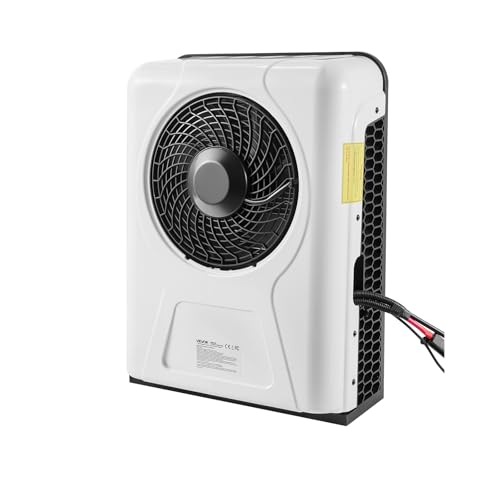
3. VEVOR DB23: a split layout for a different mounting plan
The DB23 manufacturer listing specifies separate indoor and outdoor units, cooling-only operation, a 20–60 A current range, and advertised 400 m³/h airflow. The indoor unit is listed as 500 × 380 × 165 mm; the outdoor unit is 650 × 540 × 240 mm.
This layout can be worth considering when a single roof-mounted assembly is unsuitable, but it introduces other demands. The outdoor assembly needs supported mounting and clear airflow. The cab needs room for the indoor assembly, and the connection route must accommodate refrigerant lines, wiring, and condensate drainage without chafing or interfering with cab movement.
VEVOR markets the system as pre-charged. That does not mean a split installation is ready to run as soon as the two units are bolted down. Have a qualified installer confirm the supplied refrigerant arrangement, required evacuation, leak checks, and commissioning procedure for the exact unit received. The manufacturer’s DZ23/DB23 manual describes piping, drainage, sealing, and refrigeration work.
Consider it when: a properly planned split installation suits the truck better than a rooftop unit. Important limitation: DB23 and DZ23 are different physical designs. Check the complete model, dimensions, mounting drawings, supplied pipes, and package contents rather than selecting by “10,000 BTU” alone.
Choose the power system before promising overnight cooling
A 12 V label does not mean the appliance can run from an ordinary accessory socket. The published current ranges above call for a designed high-current circuit. Cable size depends on current, cable length, installation conditions, and allowable voltage drop; circuit protection must match the manufacturer’s instructions and the wiring.
Ask the installer to check battery chemistry, usable capacity, discharge-current limits, charging capability, connections, and starting reserve. A battery-management-system current limit can matter even when the battery has enough stored energy. On a 24 V truck, choose a specifically approved voltage arrangement; never connect a 12 V model directly to a 24 V supply.
A simple planning example: if the AC averages 40 A, eight hours requires 320 Ah of usable capacity for the AC alone. That is arithmetic, not a measured result for these products. Fans, a refrigerator, lighting, electrical losses, and the battery reserve add to the requirement. The battery’s printed Ah figure is not automatically all usable.
Do not size the supply from an “Eco mode” number alone. The system still has to support higher-load operation, and a hot cab may spend more time there. Low-voltage protection is a final safeguard, not evidence that an overnight run will leave enough power to start the engine. Have its settings matched to the battery system.
Roof and cab fit checks that matter
Dometic’s RTX installation prerequisites explain why roof capacity means more than supporting the unit while parked: the structure must also tolerate loads while the vehicle moves. They also prohibit replacing an emergency-exit roof hatch with the cooler and require vehicle-manufacturer approval where a new cutout is needed.
- Roof shape and strength: confirm curvature, ribs, thickness, reinforcement, and a sealing surface that matches the approved installation.
- Clearances: account for the outside unit, inside trim or evaporator, antennas, fairings, racks, and maintenance access.
- Total vehicle height: update the measured height after installation and check the routes and facilities the truck uses.
- Cab movement: a tilting or suspended cab changes how brackets, hoses, and wiring must be routed and supported.
- Water management: confirm weather sealing and the intended condensate path. A leak into the headliner is not an acceptable trade-off for cooling.
Get vehicle-specific approval before drilling or cutting. A universal product description cannot confirm the roof structure of your truck. Model-specific tilt limits also matter; do not copy the permitted angle from a different cooler.
Size for the conditions you actually sleep in
Tell the installer the cab or sleeper dimensions, insulation, typical parking location, expected temperature and humidity, number of occupants, and required hours of cooling. Include whether a curtain isolates the bunk from the windshield area. That gives a more useful basis for selection than a residential square-foot claim.
Reducing heat gain can help the chosen system: park in shade when practical, use appropriate parked-vehicle window coverings, and address obvious air leaks. Keep required ventilation and emergency exits usable. Pre-cooling can reduce the initial load, but it does not eliminate the energy needed through the night.
Do not treat a parking cooler as a dependable life-safety system for anyone left unattended. A flat battery, protection shutdown, or equipment fault can stop cooling.
What does not belong on the same shortlist?
Personal evaporative coolers: a small water-fed cooler is not a substitute for a refrigerant-based cab AC. Direct evaporative cooling adds moisture and works best in dry conditions, as explained in the US Department of Energy’s HVAC guide. A “personal air conditioner” label does not establish whole-cab cooling.
Household window or portable AC units: these need their own power, mounting or exhaust, drainage, and transport assessment. Do not assume a residential window bracket is approved for road use. They are outside this vehicle-mounted shortlist.
Cabin filters and AC cleaners: maintenance products may be relevant to an existing HVAC system, but they do not provide engine-off cooling capacity. If the truck’s original AC has failed, get that fault diagnosed separately.
Frequently asked questions
Can a truck cab air conditioner run with the engine off?
A suitable DC parking cooler can, provided the battery and electrical system support it. The answer to “for how long?” depends on usable energy and actual load, not the appliance’s voltage alone.
Does a rooftop unit need a household-style exhaust hose?
A self-contained vehicle rooftop system rejects heat through its outdoor section. It does not use the same room-to-window hose arrangement as a household portable AC. Both indoor and outdoor airflow still need the clearances specified by the manufacturer.
Is a split unit easier to install?
Not automatically. It changes the mounting problem and adds connecting lines, drainage routing, and refrigeration commissioning. Choose the layout that can be installed correctly in the specific truck.
Which of these should I shortlist first?
Start with an installer-confirmed fit and cooling requirement. Evaluate the Dometic RTX 1000 where its documented US configuration and capacity fit the job; compare the ZX-20 for a self-contained rooftop layout and the DB23 for a supported split layout. Include batteries, wiring, mounting work, and service access in the decision before comparing unit prices.
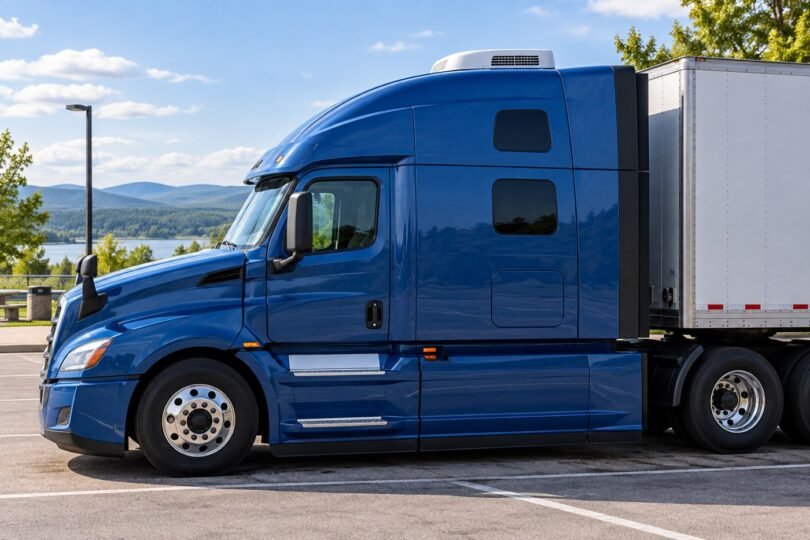
Image note: AI-generated editorial illustration; not a photograph of the named product.