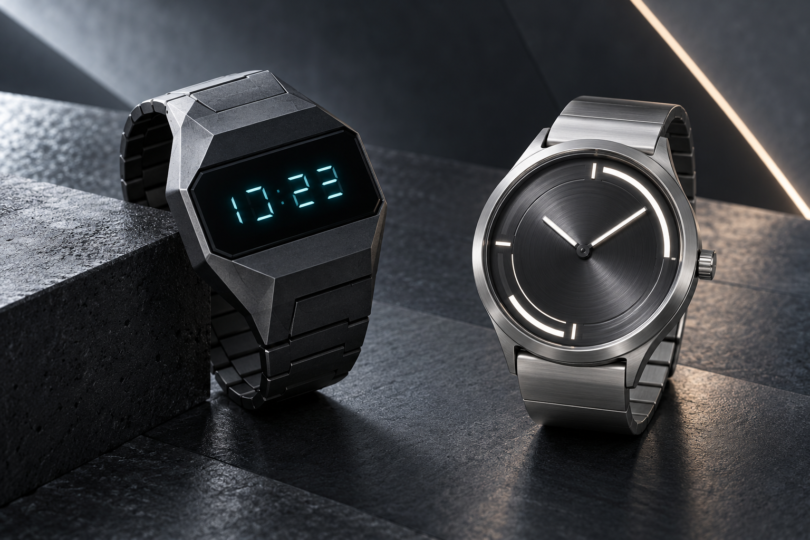

The Hamilton PSR H52414130, Bulova Computron 97C110 and ZIIIRO Eclipse Steel Black Red offer three different takes on a futuristic watch: a hybrid digital display, a button-activated LED display and a minimalist luminous dial. The best choice depends on how you want to read the time as much as how you want the watch to look.
For an everyday digital starting point, compare the Hamilton’s standard display with the Bulova’s screen-off behavior. For a more abstract face, look at the ZIIIRO, then decide whether its hour and minute markers suit your reading habits. These are style-led picks based on published specifications and instructions; fit and legibility still need checking on your own wrist.
Three futuristic watches for men at a glance
| Exact model | Display and power | Published fit information | Main tradeoff |
|---|---|---|---|
| Hamilton PSR H52414130 | LCD/OLED hybrid; battery-powered digital quartz | 41 × 35 mm case, 13.3 mm thick, 46 mm lug to lug | Distinctive steel case; check its thickness and bracelet fit |
| Bulova Computron 97C110 | Red LED; battery-powered quartz | 40 × 31 mm case on Bulova’s Ireland specification; steel bracelet | Press a button to read the time; screen turns off after inactivity |
| ZIIIRO Eclipse Steel Black Red | Analog hour/minute markers with luminous pigment; battery-powered quartz | 43 mm wide, 8.5 mm thick; listed wrist range 13–21 cm | Abstract dial takes interpretation; glow needs prior light exposure |
1. Hamilton PSR H52414130: for a digital display with a standard viewing mode

Hamilton PSR H52414130, Stainless Steel with Red Digital Display
As an Amazon Associate we earn from qualifying purchases.
The PSR H52414130 combines a rounded rectangular stainless-steel case and bracelet with red digital numerals. Hamilton identifies the display as an LCD/OLED hybrid. Its sapphire crystal has an anti-reflective treatment, and the manufacturer lists 10-bar water resistance.
Why shortlist it: the standard time display gives it a practical distinction from a screen that remains entirely off until pressed. Hamilton’s PSR instructions explain that a short button press illuminates the time, then returns to standard mode after four seconds. A second press while illuminated shows the seconds. Try both modes in the lighting where you will use the watch most often.
The ownership tradeoff: this is a substantial shape rather than a slim dress-watch case. Check the 13.3 mm thickness under a cuff and the 46 mm lug-to-lug span on your wrist. The listed 24 mm lug width does not tell you whether the bracelet will fit your wrist without sizing. Ask the seller about included links and adjustment before ordering.
Power and buying check: the PSR uses a replaceable battery. Its manual describes a blinking display and “bat” warning near the end of battery life and directs owners to Hamilton-approved service for replacement. Match H52414130 exactly if you want the steel case and red display; other PSR references have different finishes or display colors.
2. Bulova Computron 97C110: for a bold gold-tone LED design

The Computron 97C110 pairs a gold-tone stainless-steel case and bracelet with a red LED display. Its ribbed case and display placement give it a very different appearance from the Hamilton. Bulova lists a mineral crystal, a folding bracelet clasp and a 40 × 31 mm case on its Ireland product page.
Why shortlist it: you want the watch itself to be a prominent accessory, and you find a button-operated digital display appealing. The Computron manual includes 12/24-hour formats, date and day displays, and a second time zone. Those functions make it worth comparing if a simple time-only display feels too limited.
The reading tradeoff: pressing button B brings up the time. With no button operation for five seconds, it returns to screen-off mode. That extra action matters if you often need a quick glance while your other hand is occupied. Check the viewing angle and brightness for yourself; the striking red display does not prove readability in every lighting condition.
Power and buying check: Bulova specifies a CR2032 battery in the manual. Its battery-life calculation assumes only five three-second illuminations per day, so do not read the published life figure as a guarantee for frequent display use. The product page calls the watch splash resistant. Confirm bracelet sizing and the exact 97C110 gold-tone/red-display combination, since silver/blue and other Computron versions are separate choices.
3. ZIIIRO Eclipse Steel Black Red: for a minimalist luminous dial
The Eclipse Steel Black Red takes the most abstract approach here. ZIIIRO specifies a black hour marker, a colored minute marker and Super-LumiNova pigment, with a matte 316L stainless-steel case and steel mesh bracelet. The face replaces a conventional numbered dial with an eclipse-like arrangement.
Why shortlist it: you prefer a circular design and enjoy reading the relationship between markers. At a listed 8.5 mm thick, it is thinner on paper than the Hamilton, although its 43 mm width deserves attention. ZIIIRO gives a 13–21 cm wrist range for this exact Steel model. Use that as an initial sizing check, then confirm how its mesh clasp adjusts.
The reading tradeoff: learn which marker represents hours and which represents minutes before buying. The manufacturer’s Eclipse Steel catalog entry explains that its glow requires sufficient prior exposure to sunlight or artificial light. The luminous pigment does not make the quartz movement solar-powered, and it should not be treated as an always-bright electronic screen.
Power and buying check: this is a battery-powered quartz watch. Ask the seller to confirm the movement, replacement battery and service instructions supplied with the actual unit, particularly with older stock. ZIIIRO’s documents show different movement details across versions. Match “Steel Black Red” exactly: the silicone-strap Eclipse, smaller XS Eclipse and Rose Gold version are different choices, and the maker specifically excludes luminous pigment from Rose Gold.
View the ZIIIRO Eclipse Steel Black Red specifications and current purchase options.
How to choose between them
Start with the display behavior
The Hamilton suits a buyer who wants standard digital time plus button illumination. The Bulova suits someone happy to activate the screen for each reading. The ZIIIRO suits someone who prefers an unusual analog arrangement and accepts the need to interpret it. Look at a demonstration of the exact model, including its ordinary unlit state, before deciding.
Check dimensions and bracelet fit together
Case width alone does not describe fit. Compare thickness, case length, how the bracelet meets the case and the seller’s usable wrist range. Ask whether removed links are included with a used watch. For a gift, confirm adjustment and return options before a bracelet is sized.
Plan for service and the seller’s terms
All three use batteries; none should be chosen on the assumption that “futuristic” means solar charging. Ask about battery replacement, any required water-resistance checks and the service route for your country. Read the particular seller’s warranty and return terms, especially for imported or older stock. A manufacturer’s regional product page is a specification reference, not a promise of local stock or warranty coverage.
Which one is the best starting point?
Start with the Hamilton PSR H52414130 if you want a red digital face with a standard display mode. Choose the Bulova Computron 97C110 when the gold-tone design and extra digital functions matter more than instant, button-free viewing. Choose the ZIIIRO Eclipse Steel Black Red when its abstract luminous dial is the main attraction. The most useful final check is whether you can comfortably wear and read your chosen watch.