
The best Jameson pruner depends on what you already own. The FG-6PKG-1 is the most useful starting point if you need poles, a rope-operated pruner and a saw. The PH-14-PKG makes more sense if you already have a compatible Jameson pole. For a larger cutting opening, consider the JA-34DP-PKG. If your work calls for sawing rather than snipping, the LS-6PKG-6 is a separate saw-only choice.
These recommendations compare Jameson’s documented kit contents, cutting capacities and connection systems. A package name matters: a pruner head, a replacement blade and a complete pole kit solve different problems. None of the choices below is a substitute for professional tree work where branches, access or nearby utilities make the job unsafe.
Compare the four Jameson options
| Model | Best fit | What you get | Main limitation |
|---|---|---|---|
| FG-6PKG-1 | Starting with a complete saw-and-pruner system | Two 6-foot FG poles, JA-14 pruner, adapter, rope, saw head and 13-inch blade | Six-foot sections need storage space; 1.25-inch pruner capacity |
| PH-14-PKG | Adding a fixed-pulley pruner to compatible poles | JA-14 head, PHA-14 adapter and PR-20 rope | No pole or saw; 1.25-inch pruner capacity |
| JA-34DP-PKG | A larger opening with double-pulley assistance | 1.75-inch Big Mouth pruner, adapter and rope | No poles; larger capacity does not make every cut suitable |
| LS-6PKG-6 | Light-duty pole sawing | Three 6-foot LS sections, fixed saw head and 16-inch blade | No rope-operated pruner; more length to control |
Section lengths describe the supplied poles. They are not a promise that you can safely reach a branch at a particular height. The links below go to Jameson’s exact package pages; compare a retailer’s part number, contents and head version before ordering.
1. Jameson FG-6PKG-1: best complete starting kit
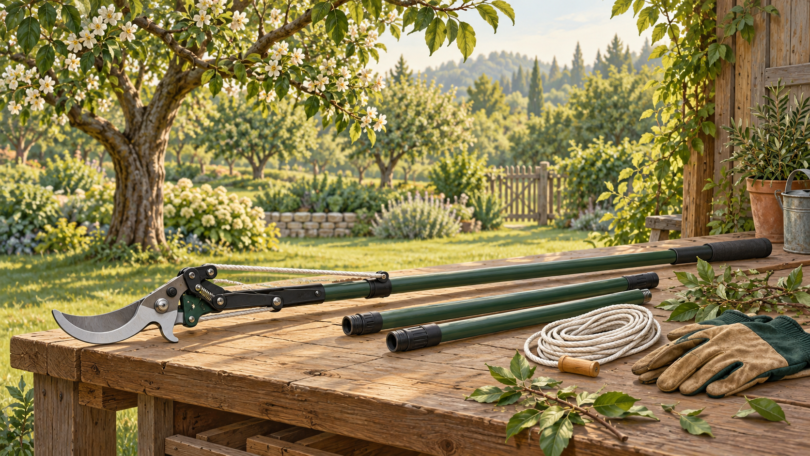
This is the practical choice when you do not already own a compatible system. Jameson includes an FG-6F base pole, an FG-6 extension, a JA-14 pruner with PHA-14 adapter and PR-20 rope, plus a PS-3FP saw head and SB-13TE blade. Each pole section is 6 feet long. The pruner is rated for a 1.25-inch cut; the saw is a separate tool head.
Why choose it: the package provides both cutting methods and the connecting parts, reducing the chance of buying a bare head and discovering that the pole or adapter is missing. It also leaves a clear parts list for future replacement purchases.
What to weigh: this is a sectional system, so it takes more transport and storage space than a compact telescoping tool. Buy it for the work you can control comfortably, not simply for the maximum assembled length. A saw in the box does not justify tackling a heavy overhead limb.
Check the FG-6PKG-1 kit and included parts at Jameson.
2. Jameson PH-14-PKG: best for existing compatible poles
The PH-14-PKG combines the fixed-pulley JA-14 head with a PHA-14 adapter and PR-20 rope. Jameson specifies a 1.25-inch cutting capacity. It does not include a pole or a saw blade, making it a focused purchase for someone whose existing Jameson base and extension poles are in serviceable condition.
Why choose it: you can replace or add a pruning head without paying for duplicate poles. The removable blade bolt and upper spring pin support blade servicing, rather than making the whole assembly disposable.
What to weigh: the bare JA-14 and PH-14-PKG are different purchases. The bare head’s adapter is sold separately. Confirm that the package really includes the adapter and rope, and match the connection to your pole before buying. A generic screw-threaded extension handle is not the same as Jameson’s ferrule system.
Check the PH-14-PKG head, adapter and rope package at Jameson.
3. Jameson JA-34DP-PKG: best larger-capacity pruner package
The Big Mouth JA-34DP-PKG increases the stated cutting capacity to 1.75 inches and uses a double-pulley arrangement. Jameson’s product page and pruner brochure identify the package with a pruning head, adapter and rope; poles remain a separate purchase. The double pulley is intended to reduce the pulling force required.
Why choose it: it is the relevant step up when a 1.25-inch opening is too small for suitable pruning work and you want to keep a compatible Jameson pole system.
What to weigh: a wider opening is not a guarantee of an easy cut through every species, condition or branch position. Choose a controllable job before choosing the largest head. Jameson describes the current head as Cut-Safe, referring to blade retraction. That name does not mean the entire tool is injury-proof or electrically insulated. Confirm the supplied head version when comparing older retailer photographs.
Check the JA-34DP-PKG package at Jameson.
4. Jameson LS-6PKG-6: best saw-only alternative
The LS-6PKG-6 belongs here as an alternative for sawing, not as another rope-operated pruner. It includes a 6-foot base, a 6-foot extension, a 6-foot saw-head section and a 16-inch Barracuda blade. The saw head is permanently mounted to its section; the blade can be replaced. Jameson describes LS poles as light-duty, hollow-core fiberglass.
Why choose it: it offers a straightforward saw package when you do not need a bypass-pruner mechanism. The three sections also make the contents easier to understand than a listing that gives only a headline reach figure.
What to weigh: the nominal section lengths total 18 feet, but usable working height depends on the setup and your ability to control it. This is not a telescoping kit. It also does not include the JA-14 head and pull rope supplied in some other LS packages. Do not buy it expecting a dual-purpose pruner.
Check the LS-6PKG-6 saw kit at Jameson.
How to choose the right kit and avoid mismatched parts
Start with the cutting method. A rope-operated pruner and a saw are different purchases. If you expect to use both, the FG kit is easier to compare as a complete system. If you already own suitable poles, price the appropriate head package against a whole kit. Include any missing adapter, rope, blade and safe storage accessories in that comparison.
Check the connection, not just the brand. Jameson’s tree-care manual calls for Jameson attachments on Jameson poles and for starting with a base pole. Its sectional connections use matching male and female ferrules with a leaf-spring locking button. Inspect the actual part numbers and connection, especially if you are replacing an older permanently mounted head. Do not assume that a universal-looking blade or threaded handle is compatible.
Separate pole length from working reach. Longer is not automatically better. Consider the angle, the weight you can manage and where the cut material will fall. Six-foot sections also need a suitable vehicle and storage location. If a shorter configuration will handle the work, there is little reason to buy extra length just because it appears in a listing.
Buy replacements by the head’s specification. The SB-16TE replacement blade is not a complete pruner. Jameson’s manual lists it among the blades supported by the PS-3FP saw head. The PS-3FPS1 is a head-and-13-inch-blade kit that also needs a pole. Either can be useful for an existing system, but neither should be mistaken for a complete tree-trimming kit.
Allow for upkeep. Follow the manual for assembly, inspection and care. Confirm that locks engage, fasteners are secure and parts are undamaged before use. Clean sap and moisture from the cutting parts and maintain them as instructed. Replace damaged components with the correct parts rather than improvising a connection.
Electrical and overhead-work limits matter more than reach
Do not use these tools near electrical lines. Jameson’s tree-care manual gives that warning explicitly. Its FG-series documentation also says the poles are not hot sticks and are not for energized lines. Fiberglass, a dielectric test claim, a rope accessory or the Cut-Safe name is not permission to work near electricity.
If a tree, branch, tool or falling material could contact a line, stop and contact the utility or a qualified line-clearance professional. OSHA’s tree-care guidance identifies overhead lines and falling branches among the hazards. A longer pole does not remove those hazards.
For appropriate work away from utilities, follow the manufacturer’s protection and footing requirements, keep people clear of falling material, and avoid positioning yourself beneath a limb. Heavy, storm-damaged, hung-up or awkwardly placed branches warrant a professional assessment. This buying guide cannot establish that a particular branch is safe to cut.
The verdict
Choose the FG-6PKG-1 for a complete starting system with both saw and pruner. Choose PH-14-PKG when compatible poles are already available and its opening suits the job. Choose JA-34DP-PKG for the larger pruner opening and double-pulley arrangement. Choose LS-6PKG-6 only when a saw-only kit is what you need. The best purchase is the smallest complete, compatible setup that fits work you can safely control.
Frequently asked questions
Which Jameson kit includes both a pruner and a saw?
The FG-6PKG-1 includes a JA-14 pruner, adapter and rope, a separate saw head with a 13-inch blade, a 6-foot FG base pole and a 6-foot FG extension. Check the exact package number because other FG kits have different contents.
Does the PH-14-PKG include a pole?
No. It includes the JA-14 fixed-pulley pruner, PHA-14 adapter and PR-20 rope. You need a compatible Jameson pole setup separately.
What is the difference between the JA-14 and JA-34 pruners?
Jameson specifies a 1.25-inch cutting capacity for the JA-14 and 1.75 inches for the JA-34 Big Mouth family. The JA-34DP-PKG adds the double-pulley arrangement. Those capacities do not guarantee that every branch fitting the opening is an appropriate cut.
Does an 18-foot kit guarantee 18 feet of working reach?
No. The LS-6PKG-6 supplies three 6-foot pole sections. Actual working reach depends on assembly, angle, position and safe control; the section total is not a guaranteed cutting height.
Are Jameson fiberglass pruning poles safe near power lines?
Do not use these pruning tools near electrical lines. Jameson’s tree-care manual warns against it, and the FG-series documentation says those poles are not hot sticks. Contact the utility or a qualified line-clearance professional when a tree or the proposed work could involve a line.