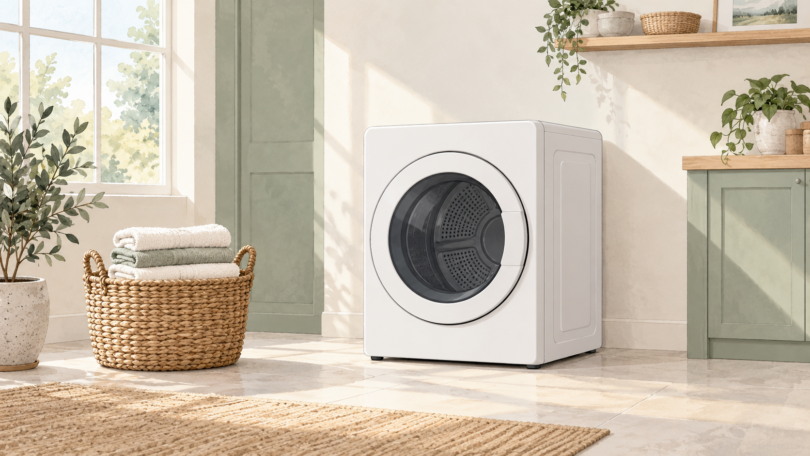

For an apartment with an approved outdoor dryer vent and a suitable 120-volt supply, the Magic Chef MCSDRY1S and MCSDRY35W1 are useful compact dryers to compare. If outdoor venting is unavailable and you have the required higher-voltage electrical connection, the Bosch WQB245B0UC is a ventless heat-pump alternative. The Bosch is a stationary appliance, so it belongs on a different shortlist from a dryer you expect to move regularly.
Our picks are based on current manufacturer specifications and installation manuals, not hands-on drying tests. We prioritize electrical compatibility, moisture disposal and usable space. We do not rank these machines by invented drying times, noise measurements or customer-review scores.
Before ordering: get the landlord’s approval and have the intended electrical supply, vent route or drainage arrangement checked against the exact model’s installation instructions. “Compact,” “portable” and “ventless” do not mean an appliance will work in any room.
Three apartment dryers worth comparing
| Exact model | Capacity and power | Best fit | Main limitation |
|---|---|---|---|
| Magic Chef MCSDRY1S | 2.6 cu. ft.; 120 V | Small loads where an outdoor exhaust route is available | Vented; requires installation space beyond its cabinet |
| Magic Chef MCSDRY35W1 | 3.5 cu. ft.; 120 V | More drum room within the same listed width and height | Deeper than the MCSDRY1S; also needs outdoor exhaust planning |
| Bosch 500 Series WQB245B0UC | 4.0 cu. ft.; 208–240 V | A fixed laundry space without an external exhaust duct | Stationary heat-pump dryer; electrical and condensate requirements still apply |
1. Magic Chef MCSDRY1S: for smaller loads and a shallower cabinet
The MCSDRY1S is a 2.6-cubic-foot vented electric dryer. Magic Chef lists a 23.6-inch width and 27.5-inch height, with up to 9 pounds of clothing in its product description. Its manual specifies a grounded 120-volt, 60-Hz supply and describes a draw of approximately 12 amps.
This is the first model we’d compare for a small household that washes modest batches and already has a suitable exhaust route. The controls include timed drying and a sensor selection. Plan the final location before buying: even the smaller model’s manual lists a 48.4-pound appliance weight.
- Pros: smaller drum for modest loads; 120-volt operation; a shallower listed cabinet than the 3.5-cubic-foot alternative.
- Cons: limited load room; vent installation is additional work; capacity is not a promise that bulky bedding will fit or dry well.
Check the exact MCSDRY1S and its linked manual. Confirm the current unit’s dimensions before committing to a tight space: the product page and manual differ slightly on cabinet depth.
2. Magic Chef MCSDRY35W1: for more capacity on 120 volts
The MCSDRY35W1 increases drum volume to 3.5 cubic feet. Its product page lists the same 23.6-inch width and 27.5-inch height as the smaller model, but a 21.5-inch depth. The page specifies a 120 VAC, 15-amp outlet and includes sensor drying and an ECO mode.
Choose it over the MCSDRY1S when the extra drum space matters more than minimizing depth. It remains a compact vented dryer. The “W1” suffix matters: Magic Chef also sells an MCSDRY35W with a different cabinet and controls, so compare the full model number rather than just “3.5 cu. ft.”
- Pros: more drum volume than the MCSDRY1S; the same listed width and height; sensor and timed options.
- Cons: a deeper cabinet; the same need to plan exhaust and clearances; no verified speed advantage in our comparison.
Check the MCSDRY35W1 specifications and manual.
3. Bosch WQB245B0UC: a ventless option for a permanent laundry space
Bosch’s WQB245B0UC is a 4.0-cubic-foot heat-pump dryer with no external exhaust duct. The current specification sheet lists 208/220–240-volt operation, 900 watts and a 15-amp minimum individual branch circuit. It is not a standard 120-volt plug-in alternative.
This is the stronger fit of these three when a building permits a dryer but cannot provide an outdoor exhaust path. It needs a planned installation and condensate handling. Bosch’s manual describes a connected water-drain hose and an alternative collection-container configuration; follow the instructions supplied with the exact unit.
- Pros: ventless heat-pump design; larger drum; reversible door and a self-cleaning condenser listed by Bosch.
- Cons: electrical compatibility can rule it out; it is a substantial stationary appliance; lint-screen care and installation ventilation remain necessary.
See the exact Bosch WQB245B0UC and installation documents. Confirm the receptacle and any manufacturer-supplied connection accessories with a qualified installer.
Vented, condenser or heat pump: what changes?
The two Magic Chef models exhaust moist air. Their shared manual recommends outdoor venting. We recommend choosing either only when a compliant outdoor exhaust installation is available; an indoor lint bucket is not the basis for these picks. Do not discharge a vented dryer’s exhaust into a closet or living space.
A ventless dryer collects moisture as water instead of requiring an external exhaust duct. A heat-pump dryer such as the Bosch uses that ventless approach, but “condenser” and “heat pump” are not interchangeable product specifications. Magic Chef’s separate MCSDRY24W1 is described as a ventless condensing model; it should not be confused with either 120-volt vented pick above.
Ventless still needs installation space and room airflow. Follow the model’s cabinet, door-opening and ventilation requirements. For the two selected Magic Chef vented units, the shared manual calls for at least 5 inches between the top, sides and rear and adjacent surfaces. Do not judge fit by cabinet width alone.
Checks that matter more than a “portable” label
- Power: match voltage, receptacle, grounding and circuit requirements. Plan a suitable direct connection; do not solve an incompatible outlet with a travel voltage converter, improvised wiring or a power strip. Get a qualified installer or electrician to resolve the mismatch.
- Load: use the selected program’s load limit, not only the advertised drum volume. The Magic Chef manual calls its load/time examples approximate. We would choose capacity around your usual clothing loads rather than assume a compact dryer can handle every comforter.
- Lint and airflow: clean the lint screen before or after each load and maintain the exhaust path where applicable. The CPSC’s dryer-fire alert explains how blocked airflow and accumulated lint can cause overheating and fire.
- Duct materials: follow the appliance’s approved installation details. CPSC recommends rigid or corrugated semi-rigid metal duct rather than plastic or foil accordion ducting. Keep the surrounding area clear.
- Exact unit: check the full model and serial number against CPSC recall notices and manufacturer support before buying a used appliance or installing one. A product recommendation is not proof that every production run is unaffected by recalls.
Frequently asked questions
Can a compact dryer use a normal apartment outlet?
Some can. The selected Magic Chef models use 120 volts; the selected Bosch needs 208–240 volts. Confirm the exact outlet and circuit requirements, including other loads on that circuit, before purchasing.
Can I put a vented dryer anywhere if I buy an indoor vent kit?
That is not our recommendation. Choose an approved outdoor exhaust installation for a vented model. If that is unavailable, evaluate a true ventless dryer and its electrical, drainage and ventilation needs.
Which is easiest to choose between the two Magic Chef models?
Choose the MCSDRY1S when smaller loads and cabinet depth drive the decision. Choose the MCSDRY35W1 when you can accommodate the deeper cabinet and want more drum room. Neither wins this comparison on independently measured drying speed.