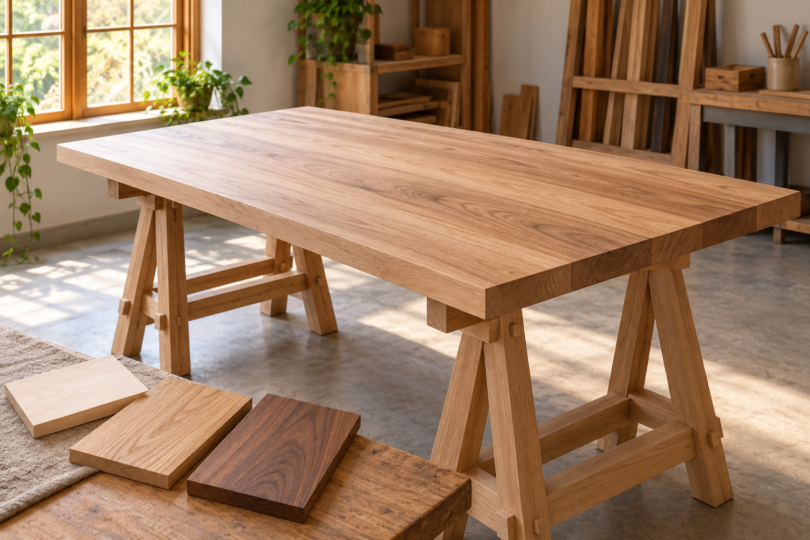

For an indoor tabletop, hard maple is a practical starting point when you want a dense hardwood, white oak suits a light tan look, and black walnut is the option to compare for natural brown color. The best purchase also depends on whether you can join boards yourself or need an assembled panel. Veneer and plywood offer different construction routes, with different repair and support considerations.
This guide compares five material choices and specific buying examples. A lumber pack still needs fabrication; a countertop still needs an appropriate table base. We have not performed wear tests or ranked these materials by an invented durability score.
Tabletop materials and buying examples
| Material and example | Choose it for | Main limitation |
|---|---|---|
| Hard maple: John Boos full-length edge-grain countertop, 48 × 30 × 1½ in option | An assembled hardwood panel rather than a board glue-up | Countertop product; base, attachment and support still need planning |
| White oak: Woodworkers Source ¾ in × 4–5 in board pack, 65 in length option, four boards | A custom top with light tan wood and individually arranged boards | One pack is too narrow for many dining-table plans; further fabrication required |
| Black walnut: Woodworkers Source 1¼ × 5½ × 36 in option, four-board pack | A smaller custom top with natural brown color | Nominal combined width is only 22 in before trimming and joint preparation |
| Walnut veneer: IKEA KARLBY 302.976.41, 74 × 42 × 1½ in | A large pre-made surface with a real walnut face | Particleboard core; follow its support and indoor-use limits |
| Hardwood-faced plywood: Columbia PureBond veneer-core panels | A sheet-based custom design | Specify face, core, thickness and size; PureBond alone does not identify them |
1. Hard maple: a practical assembled-panel starting point
John Boos’s Maple Full Length Edge Grain Countertop uses Northern Hard Rock Maple and is offered in a 48 × 30 × 1½ in size. This example makes sense if you want a joined hardwood surface without purchasing individual boards for the top. It is sold as a countertop, so a table base and suitable attachment remain your responsibility.
The current product specifies eased edges and a semi-gloss Varnique finish. It also says the countertop is not intended for direct cutting. Do not confuse this finished countertop with the brand’s cutting-board products or assume a finish is suitable for every food-preparation task.
Choose this route when a listed panel size works with your plan. If you want to control the board layout, build an unusual shape or select every grain transition, loose hardwood boards give you more fabrication decisions to make.
2. White oak: for a custom board-built top
The Woodworkers Source white-oak pack contains four boards listed at ¾ in thick and an assortment of 4–5 in widths. The selected length option here is 65 in. This is material for a woodworking project, not a finished tabletop.
Four boards at those listed widths add up to roughly 16–20 in before jointing, trimming or defect allowance. That can suit a narrow project, but it is not a promise of a dining-table-sized panel. Work from a cutting list and buy enough width for the actual design. The seller allows dimensional variation of about ⅛ in.
White oak’s beige-to-tan range is the visual reason to start here. Arrange boards for the appearance you want before glue-up, and budget for machining, adhesive, sanding, finishing and a base. Neither the wood species nor the pack’s straight-line rip service makes those jobs disappear.
3. Black walnut: for natural brown color
The Woodworkers Source walnut four-board pack, SKU HBWA64_4p, offers a 1¼ × 5½ × 36 in selection. The supplier identifies the species as Juglans nigra, or black walnut, and describes kiln-dried lumber with smooth faces and straight edges.
That chosen pack adds up to a nominal 22 in of width before preparation losses, making it a more plausible starting point for a small top than a large dining table. Confirm the dimensions you need and leave material for trimming. It is four loose boards, with listed size variation, rather than one finished 22 × 36 in panel.
Choose walnut for its brown color range when that is the look you want from the wood itself. Use the actual boards or a sample to judge color with your intended finish. Do not assume every piece will be uniformly dark or that a product called “walnut” is solid walnut throughout.
4. Walnut veneer: a large pre-made surface with a different core
IKEA KARLBY 302.976.41 is a 74 × 42 × 1½ in kitchen-island countertop with thick walnut veneer over particleboard and a laminate back. It is a useful comparison when you want a large walnut-faced surface and prefer to avoid joining a wide solid-wood panel. It is not a solid-walnut slab.
Treat use on a table frame as a design decision. IKEA requires supporting legs when an overhang exceeds 9⅞ in, with no more than 31½ in between those legs. Its specified support arrangement still needs to make sense with the chosen base; a heavy panel is not automatically self-supporting.
IKEA rules out outdoor use and damp rooms. Follow its edge, cutout and surface-care instructions if you alter the panel. A veneer face is a finite layer, so ask about the permitted repair method before aggressive sanding or edge reshaping.
5. Hardwood-faced plywood: for a fabricated sheet-based top
Columbia PureBond is a plywood product family, not a single species or panel size. For this approach, ask a supplier specifically for a veneer-core panel with the hardwood face, thickness and dimensions your design requires. Columbia also offers MDF and particleboard core constructions under the PureBond name.
The manufacturer describes veneer-core plywood as alternating inner wood plies with decorative faces. That construction is different from solid boards and from KARLBY’s particleboard core. Consider it for a broad custom surface, while planning the edge treatment and support as part of the build.
Inspect the face quality and actual thickness before purchasing. Columbia notes that veneer-core panels can vary in thickness and that the underlying core can show through thinner face veneers. Do not treat a decorative veneer as unlimited sanding stock or assume every plywood sheet has the same core quality.
The buying checks that prevent the expensive mistakes
- Allow wood movement: the USDA Wood Handbook explains that humidity changes affect wood dimensions and that coatings can slow that response without stopping it. Use a suitable attachment design for a solid top; rigidly trapping it is not a substitute for proper construction.
- Plan acclimation: follow the selected panel’s instructions in the room where it will be installed. John Boos specifies at least 72 hours for its butcher-block tops with the room’s heating or cooling controlling the environment. That product instruction is not a universal drying schedule for freshly sawn lumber.
- Design the base with the top: thickness alone does not establish a safe span or overhang. John Boos and IKEA publish different support requirements for their products. Give the installer the actual dimensions, base layout and intended loading.
- Match the finish to the use: verify application, curing and maintenance instructions for the exact coating. A dining surface and a direct-cutting surface are different uses; the selected John Boos countertop expressly prohibits direct cutting.
- Compare the completed project: include enough material, machining, edge work, finish, delivery and the base. The lowest-priced bag of offcuts or unrelated “wood” accessory is not evidence of a usable tabletop purchase.
Frequently asked questions
Which wood would you shortlist first?
Compare hard maple for a dense hardwood panel, white oak for a light tan board-built top and black walnut for brown color. Start with the form you can actually build: a finished-size panel and a four-board pack involve different work.
Is a veneer top fake wood?
The face can be real wood while the core is another material. KARLBY uses real walnut veneer over particleboard; veneer-core plywood uses layered wood internally. Read both the face and core specification.
Will a finish stop solid wood moving?
No. USDA guidance says protective coatings can slow dimensional changes but do not prevent them. The mounting method must still accommodate the selected wood and construction.
Can I build a dining top from one of the board packs?
Check the cutting list. Four 4–5 in oak boards give only about 16–20 in of combined width before losses; four 5½ in walnut boards give 22 in. Larger tops need a different quantity or panel size, plus proper support.
Are these outdoor tabletop recommendations?
No. This comparison is for indoor projects, and IKEA explicitly excludes outdoor use for the selected KARLBY. An outdoor table needs a separate choice of material, joinery, coating and exposure plan.