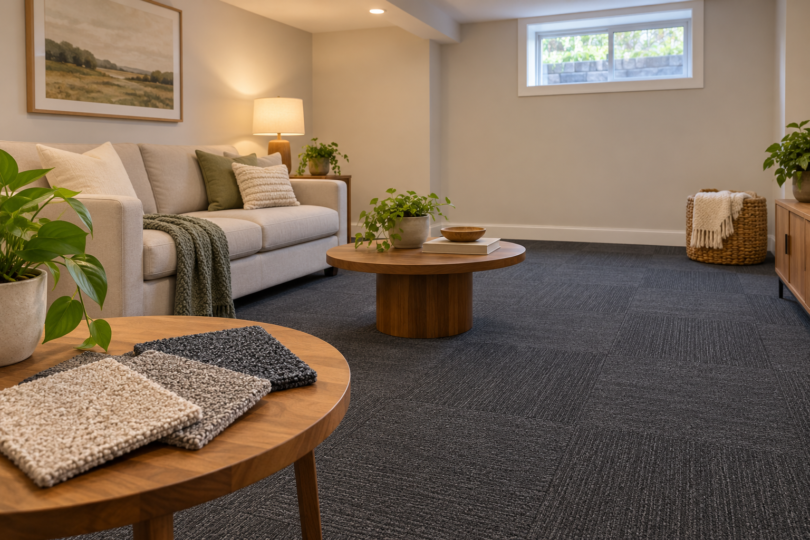

The best carpet for a basement starts with a dry, suitable floor. For a finished room with moisture under control, FLOR House Pet is worth considering for a modular rug, Mohawk Cabra CT for peel-and-stick squares, and Mohawk Canosa BL for a continuous broadloom layout. The right choice depends as much on the subfloor and installation method as on the carpet’s texture.
Do not cover unresolved leaks, damp concrete or mold with new carpet. The EPA’s moisture guidance says to fix water problems and notes that moldy porous materials such as carpet may need to be discarded. None of the choices here is presented as moldproof or as a solution to flooding.
This shortlist compares documented products and their manufacturers’ installation conditions. It does not claim a basement installation trial, a mold-resistance test, or that every basement is suitable for carpeting.
Three carpet options for a dry basement
| Carpet | Best fit | Format and installation | Important limit |
|---|---|---|---|
| FLOR House Pet, style 21-1031 | A modular rug or defined sitting area | Approximately 19.7-inch square tiles joined with FLORdots | Concrete needs the specified moisture-vapor-control sealer; no carpet padding or radiant heat for this style |
| Mohawk Cabra CT, style 3K92 | A ribbed peel-and-stick tile layout | 18 × 18-inch tiles with peel-and-stick backing | Clean, dry approved substrate; maker tile instructions require at least 50°F during installation |
| Mohawk Canosa BL, style 3K83 | Broadloom coverage with fewer tile seams | 12-foot-wide indoor/outdoor broadloom with Dura-Lock backing | Adhesive installation needs the correct substrate and working conditions; this is not loose-laid tile |
1. FLOR House Pet: best for a modular rug
House Pet is a textured needlepunch tile in the FLOR system. Its roughly 19.7-inch squares use FLORdots to join neighboring tiles, with the adhesive attaching to the tiles rather than the floor. This makes it a useful option when you want to define a seating area without choosing one fixed broadloom shape.
The tradeoff is subfloor preparation. FLOR specifies a smooth, clean, dry, level surface and says concrete must be fully cured for at least 90 days and sealed with a non-solvent-based moisture-vapor-control sealer. It does not permit installation over carpet or carpet padding. House Pet itself is not recommended over radiant heat, so check the basement’s heating system before ordering.
Choose this style if the wiry texture appeals and you value a modular layout. Order a sample to judge it underfoot; do not assume it feels like plush bedroom carpet. The maker recommends quarter-turned installation, and its product page warns that the random pattern will not align from tile to tile.
A removable square is convenient, but it does not make a damp floor acceptable. FLOR warns that prolonged excessive moisture can allow mildew or mold underneath. Follow its care guidance and let affected tiles and the surface below dry fully before reinstalling them.
2. Mohawk Cabra CT: best for peel-and-stick squares
Mohawk Cabra CT, style 3K92, is an indoor/outdoor carpet tile with a ribbed construction, EverStrand fiber branding and peel-and-stick backing. The manufacturer’s sheet specifies 18 × 18-inch squares. It is a practical candidate if you prefer an adhesive-backed tile layout to FLOR’s tile-to-tile connectors.
Mohawk’s tile installation instructions require a clean, dry floor and air temperature of at least 50°F. Its approved-substrate list includes concrete and properly prepared cement terrazzo. That list identifies compatible surface types; it does not establish that a particular basement slab is dry enough or that a failed coating is suitable.
Choose Cabra when you want a ribbed surface and a repeated square layout. Ask the supplier to confirm the current instructions for style 3K92 and how the adhesive backing should be handled on your slab. The adhesive-backed format deserves extra planning if you expect to lift sections regularly; do not assume it behaves like an unattached rug.
3. Mohawk Canosa BL: best for a broadloom layout
Canosa BL, style 3K83, is an indoor/outdoor broadloom product offered in a 12-foot width. Its sheet identifies Dilour construction, EverStrand fiber branding and Dura-Lock backing, and lists Nuboradlok VRT adhesive. A broadloom format is worth considering when you prefer coverage without a grid of tile joints.
This route needs more installation planning. Mohawk’s needlepunch installation instructions specify an ambient range of 65–95°F, a smooth prepared substrate and properly tacked adhesive. They also say to keep foot traffic off for at least 24 hours. Have an installer confirm the product, adhesive, moisture conditions and room layout together before committing.
Choose Canosa if the continuous look matters more than replacing one square at a time. A 12-foot roll still needs a measured seam plan for the room, and a local damaged area is less straightforward to swap than a separate tile. The indoor/outdoor label is not a guarantee against basement water or mold.
Check the basement before buying
Resolve the source of moisture before choosing a floor covering. EPA recommends keeping indoor relative humidity below 60%, ideally 30–50%, and drying water-damaged areas and items within 24–48 hours to help prevent mold growth. Room humidity alone does not establish that a concrete slab meets a carpet or adhesive specification.
Ask the supplier or installer which moisture evaluation, substrate preparation and adhesive or sealer requirements apply to the exact product. FLOR’s concrete sealer requirement must not be substituted for Mohawk’s installation system, or vice versa. A coating, a tile backing or a dehumidifier should never be treated as permission to cover an unresolved wet floor.
Measure the usable floor area and plan cuts, door clearances and transitions before ordering. For tiles, retain compatible spare pieces if future replacement matters; for broadloom, get a seam and roll-width plan. Compare the complete installed scope, including preparation, rather than assuming the carpet alone determines the cost.
Frequently asked questions
Can I install carpet directly on basement concrete?
Only when the exact flooring system permits it and the slab satisfies its conditions. FLOR requires smooth cured concrete with its specified type of moisture-vapor-control sealer. Mohawk lists concrete among approved substrates, but that does not remove its preparation, dry-floor and adhesive requirements.
Are carpet tiles moldproof?
No moldproof claim is supported here. Moisture can remain beneath floor coverings, and EPA notes that moldy carpet can be difficult or impossible to clean completely. Fix the water problem before replacing the flooring.
Should I add ordinary carpet padding under these tiles?
FLOR expressly excludes carpet padding. Cabra is an adhesive-backed tile, so follow its specified substrate instructions rather than adding an unapproved layer. Confirm any separate basement subfloor system with the carpet manufacturer before combining products.
Which option is the easiest starting point?
For a dry, properly prepared sitting area, start by comparing a House Pet sample with a Cabra sample. Choose between their texture and joining method. Consider Canosa when you prefer broadloom coverage and can arrange the required adhesive installation.