

The JLab Audio Block Party is a legacy wireless home speaker from the original Party Series, introduced in 2017. It can serve as a standalone Bluetooth speaker or join compatible original Block Party and House Party units. This archival model guide explains identification, pairing and what to check before considering an older unit.
It is not a list of current “best” speakers, and the original Block Party should not be confused with JLab’s newer GO Party, Pop Party, JBuds Party or Epic Party products. We have reviewed published documentation; we have not tested a sample, measured sound quality or assessed the battery in a seller’s unit.
Identify the original Block Party
The verified black model is BLOCKPARTY-BLK-BOX, with UPC 812887016001 and Amazon ASIN B01MTCXPX4. The Amazon product title, model and UPC agree, and the original model is also listed by Best Buy. Match the label and photographs before relying on instructions or buying accessories.

JLab Audio Block Party Series Wireless Multi-Room Bluetooth Speaker | Connect 8 Speakers | Wireless Connectivity | Phone Control | 50 Watts | Black
As an Amazon Associate we earn from qualifying purchases.
A historical listing is useful for identification, but it does not establish a current seller, service support, stock, warranty eligibility or battery condition. On a marketplace, read the actual condition and seller terms, not just the general product description. A used speaker with missing power equipment is a different purchase from a complete retail package.
Published specifications, in context
JLab’s January 2017 announcement described a 50-watt speaker with Bluetooth 4.0, auxiliary input and a 5.8 GHz speaker-to-speaker connection. It advertised up to eight original Party Series speakers, a nine-hour battery figure at medium volume and roughly 100 feet between speakers in open conditions. These are launch-era manufacturer figures, not results from a used unit today.
| Question | What the original design offers | Buying implication |
|---|---|---|
| Play from a phone? | Bluetooth connection to the main speaker | Test pairing with the device you actually use |
| Play across rooms? | Original Party Series sharing between compatible units | Confirm every speaker’s exact model |
| Use a wired source? | 3.5 mm auxiliary input | Check your source’s output and required cable |
| Portable use? | Built-in rechargeable battery | Ask for a meaningful unplugged playback demonstration |
| New-generation LabSync? | No verified compatibility with that newer family | Do not buy it as an assumed expansion for a current JLab system |
The launch sheet lists a roughly 5.5 × 6 × 5.5-inch cabinet and 5.6-pound weight. That puts it in a different practical category from a tiny clip-on travel speaker. Decide where it will sit, where its power adapter will go and whether moving it regularly is actually convenient.
Pair one Block Party with your phone
Use the original JLab Block Party manual for the button diagrams. The Bluetooth/Receive toggle and the central Share button have different roles.
- Turn the speaker on. A blue pulsing logo indicates Bluetooth mode; a rotating white ring indicates Receive mode.
- If necessary, briefly press the Bluetooth/Receive toggle to enter Bluetooth mode.
- Hold that toggle for about three seconds to enter pairing, then select “JLab Block Party” in the phone’s Bluetooth settings.
- After connection, check audio output and start at a modest level. Adjust both the source and speaker volume.
If it connects to an old phone instead, disconnect that device first. Test a single source and single speaker before troubleshooting an entire group. This avoids mistaking a source-device connection problem for a speaker-sharing failure.
Link original Party Series speakers
First connect the chosen main speaker to the phone. On each additional compatible speaker, select Receive mode and hold the central Share/Receive button for three seconds until its white ring blinks. Then hold the main speaker’s Share button for three seconds to search for those receivers. The distinction between a rotating white ring and a blinking white ring matters: selecting Receive mode alone does not complete the linking preparation.
Begin with the units near each other. Once the group works, move a receiving speaker to its intended room and play a familiar track long enough to notice interruptions. Walls, placement and the actual environment matter more than the advertised open-air distance. Keep the phone near the main speaker during this check so you can distinguish the two wireless links.
Block Party versus modern JLab LabSync
JLab’s current LabSync instructions identify GO Party, Pop Party, JBuds Party and Epic Party as compatible models. They describe optional app controls for channel assignment, lights and other settings. The original Block Party is not included in that compatibility list.
Consequently, treat the old and new product families as separate unless JLab confirms your exact combination. A shared brand, the word “Party” and ordinary Bluetooth support do not prove that two speakers can share synchronized audio. Buying a newer JLab speaker to expand an original Block Party arrangement needs a compatibility answer before a purchase, not an assumption afterward.
What to inspect before buying an older speaker
- Power equipment: obtain a clear photograph of the supplied adapter and the speaker’s input label. Have JLab confirm a replacement if the original is missing. Do not choose an adapter simply because its plug fits.
- Battery behavior: ask whether the speaker runs unplugged after charging and for how long under a described playback level. A brief power-on video is not a battery-capacity test.
- Controls and ports: check that the volume, pairing and sharing buttons respond, and that the auxiliary input and charging connection are undamaged.
- Multiple-speaker needs: request a demonstration with the exact second model if linking is the reason you are buying.
- Returns and condition: confirm whether weak battery life, missing accessories or failed linking would be covered by the seller’s return terms.
Stop using a unit that is swollen, leaking, damaged or becoming unusually hot, and seek manufacturer or qualified service guidance. Do not open or puncture its battery. Age and storage history matter even when the exterior looks tidy.
Water resistance and practical limits
JLab’s launch announcement describes IPX4 splash resistance, while a historical retailer description uses a different rating. Because those sources conflict, this guide does not upgrade the speaker’s protection. Follow the marking and manual for your exact unit, keep electrical connections dry and never assume it is safe to immerse.
Similarly, advertised music-service support refers to playing audio from a source device. It should not be read as proof of a current built-in streaming app, voice assistant or independent Wi-Fi music service. Choose the speaker around the connections you can demonstrate.
Is it worth seeking out?
The original Block Party is most relevant to an owner maintaining a working original Party Series setup or someone who finds a complete, demonstrably functional unit at a sensible total cost. For a new multi-speaker system, compare currently supported products before building around older hardware. Add the cost of a missing adapter, uncertain battery and return shipping to the decision.
If you already own one, start with correct mode selection and the manual’s pairing sequence. If you are shopping, prioritize verified condition and compatibility over the old marketing headline or an inflated claim that it is a current flagship.
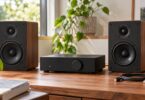
Image note: Original AI-generated editorial illustration; generic objects shown, not a branded product photograph.