The Kenwood KAC-M1804 is a compact four-channel amplifier rated at 45 watts RMS per channel into 4 ohms. It makes sense to evaluate it as a space-saving speaker amplifier, especially when replacing an existing M1804. Do not mistake its 400-watt maximum-power label for continuous output, and do not confuse it with the bridgeable KAC-M1814.
This guide keeps the KAC-M1804 at the center of the decision, then compares two closely related Kenwood alternatives. Specifications come from Kenwood’s product documentation; the recommendations are a comparison of documented capabilities, not a listening test or a bench-power test.
Kenwood KAC-M1804: the important specifications
| Item | Specification | Buying implication |
|---|---|---|
| Amplifier layout | Four-channel Class D | Suited to a four-speaker system with compatible loads |
| Continuous output | 45 W RMS × 4 at 4 ohms, at no more than 1% THD+N | Use this rating for speaker matching |
| Maximum output | 400 W | Not 400 W RMS and not 100 W RMS per channel |
| Body size, W × H × D | 140 × 34 × 90 mm | Allow additional room for wiring and mounting |
| Supply | 14.4 V nominal test specification; 11–16 V allowable | Designed for a suitable 12 V vehicle electrical system |
| Listed current consumption | 15 A | Electrical installation still needs properly protected wiring |
These figures are from Kenwood’s KAC-M1804 specification page. A speaker’s large peak-watt number does not establish a good match: check nominal impedance, continuous power handling, and the speaker manufacturer’s application guidance.
1. Kenwood KAC-M1804: the exact model
The M1804’s strongest reason for consideration is its small enclosure. If your installation already uses this model, obtaining the same amplifier can simplify planning, but inspect the connectors, harness condition, mounting arrangement, and complete part number before treating any replacement as a direct swap.
Kenwood documents speaker-level input and signal-sensing turn-on. Its instruction manual shows separate RCA-input and speaker-input connection arrangements. Use the arrangement for your source unit; the presence of speaker-level input does not by itself establish compatibility with every amplified factory audio system.
For this model, plan on separate speaker loads of at least 4 ohms and the manufacturer’s normal four-channel wiring. There is no approved bridged configuration in its installation instructions. Do not apply the M1814’s bridge wiring or 2-ohm capability to the M1804 because the names look similar.
Consider it when: you need this exact model or its particularly small footprint and your system fits its documented limits. Look elsewhere when: you require bridging, lower-impedance operation, or the additional tuning controls documented for the alternatives below. Before buying an older listing, verify item condition, supplied harnesses, return terms, and applicable warranty with the seller.

Kenwood KAC-M1804, Compact 4-Channel Class D Amplifier, One Amplifier
As an Amazon Associate we earn from qualifying purchases.
2. Kenwood KAC-M1814: more configuration flexibility
The KAC-M1814 is a different amplifier, not another spelling of M1804. Kenwood specifies 45 W RMS × 4 at 4 ohms, 45 W × 4 at 2 ohms, and 90 W × 2 bridged into 4 ohms. That makes its extra operating configurations the meaningful change; the four-channel 4-ohm rating is not higher than the M1804’s.
Its A/B channel groups have selectable high-pass, full-range, or low-pass operation, with variable 50–200 Hz filters and input-sensitivity adjustment. These controls can be useful when integrating smaller speakers or an appropriate bridged load. They still require correct setup for the speakers being used.
The body measures 145 × 45 × 99 mm, so it is taller and deeper than the M1804. Allow for brackets, connectors, and access to controls. The M1814 manual permits 2–8-ohm loads in its normal channel configuration and 4–8 ohms when bridged; follow its diagrams rather than improvising an output combination.
Consider it when: you want compact four-channel amplification with documented bridging and filter controls. Trade-off: it needs a fresh wiring and fit check, and its similar maximum-watt figure should not be interpreted as a performance upgrade in every system.
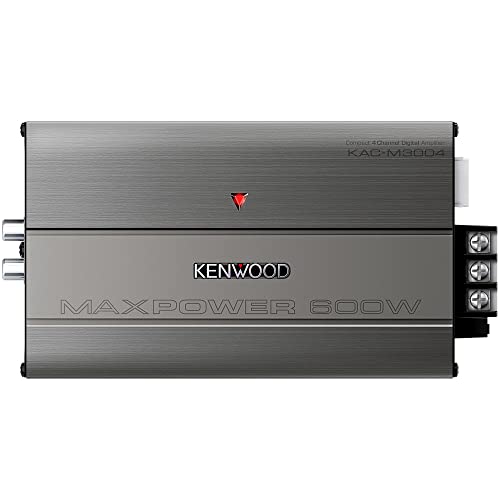
3. Kenwood KAC-M3004: a larger compact alternative
The KAC-M3004’s published continuous ratings are 50 W × 4 at 4 ohms, 75 W × 4 at 2 ohms, and 150 W × 2 bridged. Its specified footprint is 6½ × 1¾ × 3⅞ inches, expressed as width, height, and depth. It needs more mounting width than either of the smaller models.
The difference between 45 W and 50 W per channel at 4 ohms is modest. Choose the M3004 for a documented system requirement, such as its higher rated output into suitable 2-ohm loads or a suitable bridged configuration, rather than assuming that its 600-watt maximum label makes it dramatically louder.
Kenwood lists selectable filtering, speaker-level input, signal-sensing turn-on, and 22 A current consumption. Normal speaker loads may be 2–8 ohms; bridged loads must be 4–8 ohms. Recheck the supply wiring and circuit protection instead of automatically reusing an M1804 installation.
Consider it when: the extra width fits and its documented output/configuration meets a specific speaker-system need. Trade-off: neither the larger enclosure nor the bigger peak number guarantees better results without correct speaker matching, clean input signal, and installation.
What to check before ordering
- Count the channels you actually need. Four full-range speaker channels, two bridged loads, and a system that also needs a dedicated subwoofer channel are different designs. Sketch the intended system before choosing the amplifier.
- Identify each speaker load. Use the actual speaker specifications. If multiple speakers share a channel, have the combined load checked; the impedance of one speaker is not necessarily the impedance seen by the amplifier.
- Confirm the source connection. Identify whether the available signal is a suitable RCA preamp output or speaker-level output. For a factory system, determine whether an interface, signal processing, or vehicle-specific integration is needed.
- Measure the installation space. Include harness bends, fasteners, access for service, and ventilation. Avoid locations where the unit can interfere with controls, moving seats, or stored items.
- Price the complete installation. Account for appropriate wiring, protection, connectors, mounting materials, any required interface, and professional labor. A bare amplifier listing may not cover these items.
Marine labeling does not mean waterproof installation
Kenwood describes conformal coating on the M1804 product page, but also warns against water-splash locations, excessive humidity, heat, and dust. The coating is a protective feature, not permission to leave the amplifier exposed. Apply the actual model’s environmental and mounting instructions in a boat, motorcycle, ATV, or car.
For electrical safety, Kenwood calls for professional mounting and wiring, a suitable negative-ground 12 V supply, and protected power wiring. Do not join speaker negatives together or use the vehicle body as a speaker return. Correct a short or installation fault before replacing a blown fuse, and use the prescribed fuse rating.
If your existing M1804 has a problem
A replacement purchase may be premature if the fault is in the input signal, wiring, or speakers. Record whether all channels fail, only one channel fails, or the failure appears after the system warms up. That description is much more useful to an installer than “the amp is weak.”
Have the installer check supply and ground integrity, speaker wiring, the source signal, and whether protection is operating. Do not repeatedly increase volume or fit a larger fuse to force a failing system to keep playing. If there is smoke, an unusual smell, or abnormal heating, turn the system off and arrange service.
Frequently asked questions
Is the KAC-M1804 really a 400-watt RMS amplifier?
No. Kenwood’s continuous rating is 45 W RMS on each of four channels into 4 ohms. The 400 W figure is maximum power and should not replace the continuous rating in a comparison.
Can I replace an M1804 with an M1814 without changing anything?
Do not assume so. Compare dimensions, mounting, harnesses, source wiring, protection, speaker loads, and settings. Similar model numbers do not establish plug compatibility.
Which model is the sensible starting point?
For an exact-model replacement, investigate the M1804 first. For a new installation that needs filters or bridging, compare the M1814. Consider the M3004 when its load-specific output and larger size fit your plan. Choose based on the complete system, not the largest number printed on the case.
Image note: AI-generated editorial illustration; not a photograph of the named product.