
Korean jelly candy can mean a bag of chewy fruit gummies, a jelly-filled pouch, or a small cup of firm gel. Start by choosing the form you actually want, then check the exact flavor, weight and ingredient label. For a conventional chewy sweet, Orion’s My Gummy range is a useful place to compare grape and peach options. Mini-cup jelly needs a separate safety check and is not interchangeable with bagged gummies.
Buying for a young child? Gummy candy and chewy fruit snacks are on the CDC’s list of choking hazards to avoid for young children. A soft texture, small portion or adult watching does not make a candy suitable. The examples below are an adult shopping guide, not a list of child-safe treats.
Understand the different types of jelly candy
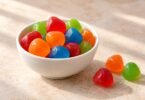
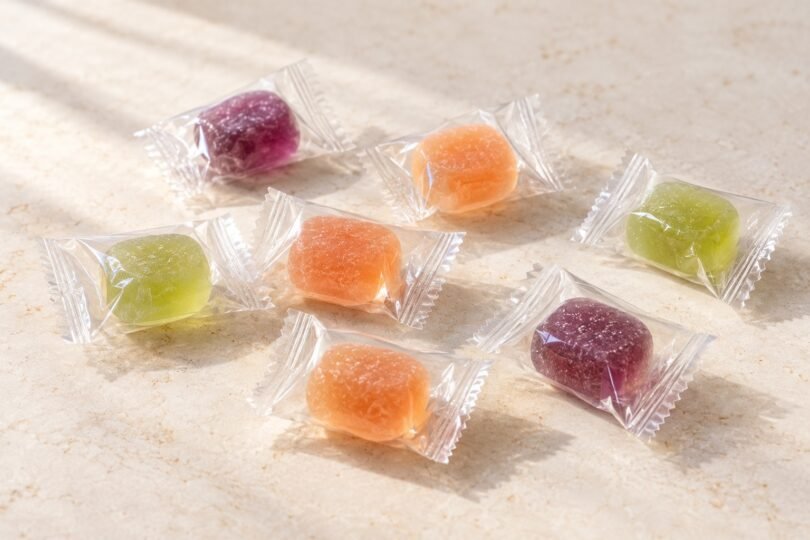
- Chewy gummy pieces: solid candies sold together in a bag, often shaped like fruit. My Gummy is an example. They are meant to be chewed and can still present a choking risk.
- Layered or filled gummies: pieces with contrasting outer and inner textures. Check whether a listing is for a gummy or for gel inside plastic fruit-shaped packaging; the photos and names can look similar.
- Jelly pouches and sticks: gel packaged in a pouch or tube. Some contain konjac, also called glucomannan. The ingredient list and package instructions matter; “jelly” alone does not identify the formula or how to eat it.
- Mini-cup jelly: small containers holding a firm, slippery gel. These require particular caution because the size, shape, texture and packaging can contribute to choking.
Three Korean-brand gummies to compare
These examples come from Orion’s Korean product pages. The weights and ingredient declarations below apply to the versions identified on those pages. They do not establish the contents of every overseas multipack or marketplace listing. No taste test or numerical ranking is claimed.
Orion My Gummy Grape, 66 g
If you want a straightforward grape gummy, look for 마이구미 and the grape flavor designation. Orion’s My Gummy page lists a 66 g version and explicitly says its displayed information is for grape. The maker’s imagery shows grape-cluster-shaped candies in a bag.
Label point: Orion declares milk and pork. Fruit flavor therefore does not mean dairy-free or free of animal-derived ingredients. A listing for ten 66 g bags would contain 660 g in total, but verify the seller’s selected quantity instead of assuming every “pack” is a multipack.
Orion My Gummy White Peach & Yellow Peach, 97 g
For two peach varieties in one bag, compare the product named 마이구미 백도&황도. Orion’s white and yellow peach product page identifies a 97 g version. The product artwork distinguishes the two varieties with pink and yellow heart-shaped gummies.
Label point: the maker declares milk, peach and pork. This 97 g mixed-peach product is a different listing from an older single-flavor 66 g peach bag; do not transfer ingredients, quantity or nutrition between them.
Orion Grape Almengi, 67 g
For another grape option, compare 포도알맹이, identified on Orion’s Grape Almengi page as a 67 g product. This is a separate product from My Gummy Grape, despite similar fruit imagery. Use the Korean product name as well as the English translation to distinguish listings.
Label point: Orion declares milk and pork for this version too. Check the bag’s complete ingredient list and any cross-contact statement before buying for a dietary restriction. The manufacturer’s short product summary is not a substitute for the full label.
Mini-cup jelly: what the FDA warning actually covers
FDA Import Alert 33-15 concerns firm mini-cup gel and jelly candies that present a choking risk. It explains that slippery, mouth-sized gels and packaging that encourages sucking can contribute to the hazard. Konjac-containing candies prompted earlier warnings, but the alert also addresses hazardous products made with other gelling agents, including carrageenan or agar. “Konjac-free” is not a safety guarantee.
That warning should not be turned into a claim that every food containing agar, carrageenan or konjac is dangerous. The product’s form and physical characteristics matter. Equally, changing from a mini-cup to a pouch does not establish that a particular product is suitable for a child or someone who has difficulty swallowing.
Do not buy jelly candy for bite-and-pop, suction or speed-eating challenges. Follow the actual package’s opening and eating instructions, including any age or choking warnings, and do not use supervision as a reason to ignore them.
For a concrete historical example, the FDA’s October 2020 Tropique recall concerned small jelly cups containing carrageenan. This illustrates why a seaweed-based formula alone does not settle the safety question; it is not a recall of the Orion gummies above.
What to check before ordering
- Country of manufacture: look for the actual origin statement on the selected package. A Korean brand, Korean writing, a Korean seller or an “Asian candy” category does not establish where that particular bag was made.
- Exact flavor and format: match the front of the bag, product name and description. Watch for changes between grape and green grape, single peach and mixed peach, gummies and jelly cups.
- Quantity: distinguish the weight of one bag from the number of bags in the order. Compare delivered cost per 100 g only after confirming both numbers.
- Full ingredients and allergen information: request a readable current back-label photo if the listing does not provide one. Check any importer’s label too. A “contains” declaration identifies allergens present as ingredients; a “may contain” statement concerns potential cross-contact. The absence of a “may contain” statement is not a guarantee against cross-contact. The FDA advises reading labels each time you buy. If the evidence is incomplete or conflicting, choose a different listing or ask the manufacturer before purchasing.
- Dietary requirements: do not infer vegan, vegetarian, halal or gluten-free status from fruit pictures, a clear appearance or the word “jelly.” Check the exact product’s ingredients and any applicable certification.
- Date, storage and seals: confirm the printed date’s meaning and the storage instructions. Avoid a seller that cannot explain the label or supply an intact, traceable package.
- Recall details: compare the brand, product, package size and lot or date code against the FDA recall notices and the manufacturer’s notices. A familiar brand or a retailer’s active listing is not proof that a specific lot is unaffected.
Common questions
Is jelly candy the same as a konjac snack?
No. “Jelly” can describe several candy textures and package types. Read the ingredients to establish whether a particular product contains konjac or glucomannan. A low-calorie or sugar-free claim also does not make a snack a meal replacement or establish a weight-loss benefit.
How do I recognize the right Korean product online?
Match the manufacturer, Korean product name, flavor, net weight and back label. For the examples here, the manufacturer links provide a starting point. Do not treat a translated title or an assortment photo as proof of what will arrive.
Which one should I start with?
For an adult who can comfortably chew gummies and whose dietary requirements match the label, compare one small bag of My Gummy Grape with the mixed white-and-yellow-peach version. Choose by flavor and verified labeling before committing to a bulk assortment. If the intended recipient is a young child, choose an age-appropriate alternative instead of these gummy candies.