The best shallow speaker is the one that fits the available space and the rest of the audio system. If you mean a shallow car subwoofer, three useful candidates are the JL Audio 13TW5v2-4, KICKER 46L7T104 and Skar Audio VD-12 D2. Their mounting depths differ substantially, so “shallow” alone is not a fit specification.
If you mean a replacement door speaker, start with a vehicle-specific fit check instead. A low-profile subwoofer requires an enclosure and amplifier arrangement; it is not a substitute for a full-range door speaker.
This is a specifications-based comparison. It does not claim listening tests, measured sound-pressure results or a universal winner for every vehicle.
Shallow subwoofers compared
| Exact model | Nominal size | Mounting depth | Impedance | Continuous or recommended power |
|---|---|---|---|---|
| JL Audio 13TW5v2-4 | 13.5 inches | 2.625 inches | Single 4-ohm | 600 W continuous handling |
| KICKER 46L7T104 | 10-inch square | 3.75 inches | Dual 4-ohm coils | 500 W RMS recommended amplifier power |
| Skar Audio VD-12 D2 | 12 inches | 4.92 inches | Dual 2-ohm coils | 500 W RMS handling |
These are bare drivers. Do not compare their depth with the complete height of a powered under-seat enclosure, or assume a nominal 10- or 12-inch size identifies the required opening.
JL Audio 13TW5v2-4 when mounting depth is the tightest constraint
The official JL Audio/Garmin product page identifies the 13TW5v2-4 as a 13.5-inch single-4-ohm driver. Its manufacturer’s manual specifies a 2.625-inch mounting depth, a 12.5-inch mounting-hole diameter and 600 watts of continuous power handling.

JL Audio 13TW5v2-4, TW5 Series 13.5" 4-Ohm Subwoofer, 600W
As an Amazon Associate we earn from qualifying purchases.
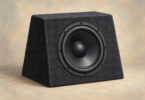
This is the shallowest bare driver in this shortlist, but it still needs considerable face area. Check the outline drawing, not just the nominal diameter. The manual recommends a 0.8-cubic-foot net sealed enclosure and specifically does not recommend a ported enclosure.
Choose it for a carefully planned sealed installation where very low depth matters. It makes little sense to buy it first and hope that an arbitrary truck box will match afterward. The single-4-ohm version is also different from the 13TW5v2-2; make sure the seller’s model and your amplifier plan agree.
KICKER 46L7T104 for a compact square-driver build
KICKER’s 46L7T104 specification identifies a 10-inch square L7T driver with dual 4-ohm voice coils, 3.75 inches of mounting depth and 500 watts RMS of recommended amplifier power. The stated square cutout is 9-5/16 inches.

KICKER permits sealed or ported designs for this model. Its current page lists a sealed range of 0.4 to 1.0 cubic feet and a vented range of 1.25 to 1.75 cubic feet, with port volume excluded from the vented specification. Use the current manufacturer drawing and enclosure requirements for the exact model when commissioning a box.
The square basket is the important practical catch. A round opening for a conventional 10-inch woofer is not an interchangeable fit. This option is worth considering when you can choose or build the enclosure around it, rather than when you need to reuse an unknown circular cutout.
Skar Audio VD-12 D2 when you have more depth available
The official Skar VD-12 page distinguishes the D2 dual-2-ohm version from the D4 dual-4-ohm version. The directly verified Skar marketplace listing gives the D2 a 4.92-inch mounting depth and 500-watt RMS rating; its 800-watt figure is peak power.

At nearly five inches deep, this model illustrates why a shallow-mount label is not enough. It can be a candidate where a traditional deep basket is impractical but more room remains than the JL or KICKER requires. It is not an automatic under-seat fit.
Confirm the enclosure requirements for the D2 and the final impedance your installer will present to the amplifier. Do not order the D4 just because its product photograph looks the same, and do not treat the headline 800-watt number as the amplifier-matching target.
Measure the whole installation
Write down the available space before comparing brands. At minimum, you need the driver’s mounting depth, mounting cutout, external frame dimensions, enclosure volume and front clearance. Also account for terminals, wiring and the surface facing the cone.
For an under-seat location, measurements must remain valid as the seat moves and with the seat occupied. Check nearby wiring, vents, brackets and vehicle safety systems. Have a competent installer assess any location that could interfere with the seat mechanism, restraint wiring or normal vehicle operation.
A useful distinction is driver depth versus enclosure depth. The driver’s published measurement does not include every wall, spacer, grille or clearance requirement in your installation. A box with an appealing external dimension can still be wrong inside.
Skar’s enclosure-selection guide identifies airspace, mounting depth, cutout size and enclosure style as separate checks. Internal bracing, the driver itself and ports can consume space. Ask whether a quoted volume is gross or net before treating it as a match.
Match the amplifier and voice-coil version
A dual-voice-coil driver provides configuration choices; it does not mean every amplifier can safely power every arrangement. Ask the installer to document the resulting load, the amplifier’s supported impedance and its RMS output at that load. A model name ending D2 or D4 is a consequential choice.
Use continuous/RMS specifications and the manufacturer’s recommended operating range as the starting point. Peak numbers are often prominent in product titles but do not describe the same thing. A large number alone also does not establish better sound, more useful bass or a better match for your listening needs.
Plan the signal path as well as the power. Factory amplifiers, built-in equalization and existing bass processing can affect an upgrade. A replacement driver cannot correct every problem elsewhere in the system. Include enclosure work, safe wiring and installation in the budget.
If you actually need shallow door speakers
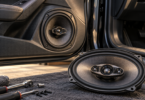
Door speakers need a different comparison. Measure available rear clearance, verify the mounting pattern and check front protrusion under the trim panel. The window mechanism must remain clear through its full travel.
KICKER’s CS-Series page lists shallow-design coaxial speakers in several sizes, including a 6.5-inch 46CSC654. That is a different product class from the subwoofers above. Choose using your vehicle, factory speaker impedance, available adapter and amplifier arrangement; the same nominal diameter does not guarantee a drop-in replacement.
Frequently asked questions
Which model is shallowest?
The JL Audio 13TW5v2-4 has the lowest published mounting depth here at 2.625 inches. It is also a larger nominal driver and needs its specified enclosure, so depth alone does not make it the best choice.
Can I use an existing truck box?
Only after checking cutout, net volume, depth and clearance against the exact driver. A box advertised for a particular vehicle is not automatically correct for every woofer of the same nominal size.
Can a shallow subwoofer play vocals?
A subwoofer serves the low-frequency part of the system. Retain suitable full-range or component speakers for the rest of the music; a shallow subwoofer is not a complete speaker-system replacement.
Do I need professional installation?
It is sensible when enclosure construction, amplifier matching or vehicle integration is unfamiliar. Secure the finished enclosure properly and keep listening levels reasonable. A loose enclosure is a safety hazard, and more output is not a reason to listen at harmful levels.
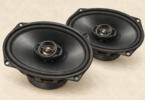
Image note: Examples from the product category; pictured models and variants may differ from the options discussed.