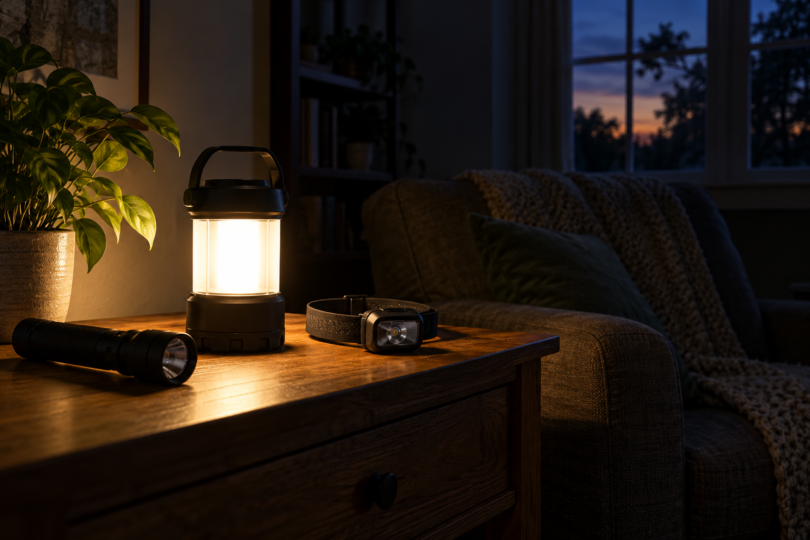

For a power outage, our most useful combination is a room lantern, a light that comes on automatically, and a headlamp for moving around with both hands free. The Streamlight Siege, GE 11281 and Black Diamond Spot 400 serve those different roles. Choose the gap in your household’s lighting plan before choosing the brightest number on a box.
This shortlist compares documented features and power arrangements. We have not run battery-drain, drop or room-illumination tests. Advertised output and runtime are manufacturer figures, and the lowest setting’s runtime does not describe performance at full brightness.
Three useful outage-lighting roles
| Product and role | Power source | Main limitation |
|---|---|---|
| Streamlight Siege 44931: shared room light | Three D alkaline batteries, sold separately | Bulky beside a headlamp; switch on manually |
| GE 11281: automatic nearby backup | Built-in rechargeable battery; charges in a wall outlet | 20-lumen emergency mode is for nearby guidance, not a room lantern |
| Black Diamond Spot 400: hands-free tasks | Three AAA batteries, or optional BD 1500 rechargeable pack | Focused personal light; rechargeable pack is separate |
Streamlight Siege 44931: best for a shared living space
The Siege is our room-lighting pick because its diffuser spreads light around a table or seating area. A handle and D-rings provide carrying and hanging options. It uses three D alkaline batteries, so you can restore power with spare cells without waiting for an outlet or charging bank.
Streamlight lists white-light settings of 540, 275 and 55 lumens, with corresponding runtimes of 30, 70 and 295 hours. Those figures are ratings, not a guarantee of constant brightness; the product page specifies the white-output figures with the cover removed. The diffuser is useful for close quarters, and the low setting trades brightness for endurance.
The tradeoff is weight and bulk: Streamlight lists nearly two pounds with batteries. Keep the lantern where it is easy to find and budget for the separately supplied D cells. It is a manually controlled battery lantern, so it will not detect a mains failure and turn itself on.
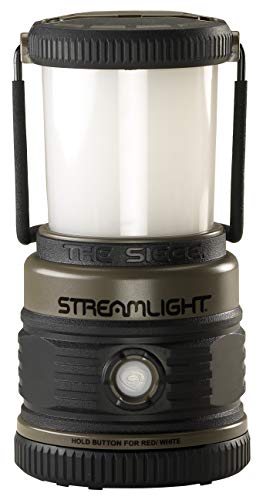
Streamlight 44931 Siege Lantern, Coyote, Single Unit
As an Amazon Associate we earn from qualifying purchases.
GE 11281: best for an automatic first light
The GE 11281 combines a dusk-to-dawn night light, an automatic power-failure light and a detachable flashlight. Jasco specifies 5 lumens for the normal night light and 20 lumens for emergency or flashlight use. That makes it a useful nearby marker when the lights go out, while a separate lantern handles longer periods in one room.
Its built-in battery charges while plugged in, and the prongs fold away for handheld use. Choose an accessible indoor outlet and check the light’s operation periodically using the instructions supplied with that exact unit. We do not give a battery-runtime estimate because the current manufacturer page does not establish one.
See GE 11281 details from Jasco.
Black Diamond Spot 400: best for hands-free tasks
A headlamp is convenient when carrying supplies or reading labels in a dark cupboard. The Spot 400 offers dimming, proximity and distance modes, red light, brightness memory and a lock function. Its dual-fuel design accepts three AAA batteries or the separately sold BD 1500 rechargeable battery.
On AAA batteries, Black Diamond lists 400 lumens and 2.5 hours on high, versus 6 lumens and 200 hours on low. Those are very different amounts of light. Buy it for adjustable personal illumination, not because the longest runtime implies days of full-power output. Check that you are buying Spot 400: a listing that selects Spot 450 is not the same model.
See the current Spot 400 from Black Diamond.
Build a lighting plan that survives the outage
Put a light where you can reach it before crossing a dark room, and keep a second light available if the first is flat or misplaced. A rechargeable model is convenient between outages; a replaceable-battery model is useful when charging opportunities disappear. Keep the correct spare cells with your emergency supplies and check them alongside the lights.
The American Red Cross recommends flashlights instead of candles. Keep outdoor cooking stoves out of the house, and do not use a gas stove to heat a room. An outage-lighting purchase should not introduce an open flame or indoor combustion hazard.
Keep away from flooded electrical equipment. A light’s water-resistance rating does not make a submerged outlet or flooded room safe. The Red Cross advises against using electrical equipment that may have been submerged and recommends a qualified inspection of the electrical system.
Questions about lights for power outages
What should I buy first?
For time spent together in one room, start with a battery lantern and the batteries it needs. If finding a light in the first moments is the bigger problem, add an automatic plug-in backup near your usual route. A headlamp fills the hands-free role.
Does every plug-in night light work when power fails?
No. Look specifically for a power-failure function and battery backup. The GE 11281 has both; its ordinary dusk-to-dawn sensor is a separate feature from outage activation.
Are rechargeable lights enough for a long outage?
Only if you have enough stored charge or a workable way to recharge them. The Siege accepts replacement D cells, while Spot 400 can use AAA cells or its compatible optional rechargeable pack. Avoid relying on a single charging route.
How should I compare runtime?
Compare the same brightness mode and battery configuration. The Siege’s 295-hour figure is for its low white setting, and Spot 400’s 200-hour AAA figure is for its 6-lumen setting. Neither means that maximum output lasts that long.
Are candles a sensible backup?
Choose battery lights. The Red Cross recommends flashlights rather than candles to reduce fire hazards during an outage. Keep spare batteries or a charged second light ready.