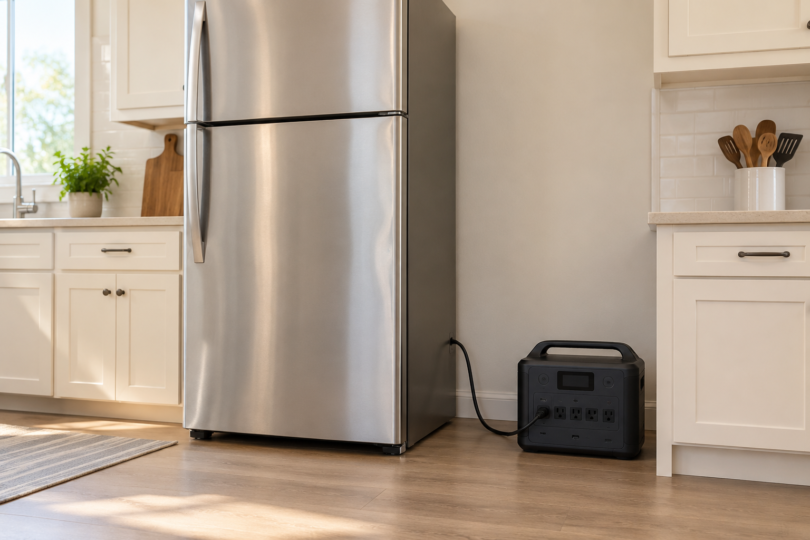

The best backup power supply for a refrigerator is one that can start its compressor, keep the AC outlet on between cooling cycles, and store enough energy for the outage you want to cover. For a larger battery and room to expand, start with the EcoFlow DELTA 2 Max. For a lighter unit to move between rooms, compare the Jackery Explorer 1000 v2. Both need to be matched to your refrigerator before you rely on them.
This comparison covers the US 120 V versions and a refrigerator plugged directly into the power station. A phone power bank, surge protector or small computer UPS is not an interchangeable substitute.
Two refrigerator backup power supplies to compare
| Power station | Nominal battery capacity | Rated AC output / listed surge | Best reason to choose it | Main trade-off |
|---|---|---|---|---|
| EcoFlow DELTA 2 Max | 2,048 Wh | 2,400 W / 4,800 W | More stored energy and optional extra batteries | About 23 kg; much heavier to move |
| Jackery Explorer 1000 v2 | 1,070 Wh | 1,500 W / 3,000 W | Lower carrying weight, about 10.8 kg | Less energy and less output headroom |
These are manufacturer specifications, not measured refrigerator runtimes. Surge output is temporary; neither number guarantees that a particular compressor will start.
1. EcoFlow DELTA 2 Max: best for more capacity and expansion
The DELTA 2 Max makes the stronger starting point when keeping the refrigerator powered takes priority over portability. Its 2,048 Wh battery holds nearly twice the nominal energy of the Jackery below. EcoFlow also supports up to two compatible extra batteries, sold separately, so you can add capacity without replacing the main station.
The US model EFD350 provides pure sine-wave AC through six outlets, with a combined 2,400 W rating and a listed 4,800 W surge. The outlets share that output budget. Adding a microwave or kettle can leave less capacity for the refrigerator’s next start, so dedicate the station to the fridge when dependable cooling is the goal.
- Choose this version: one US DELTA 2 Max power station, SKU EFDELTA2Max-US. Extra batteries and solar panels are separate purchases.
- Useful connections: 120 V AC outlets for a household refrigerator, plus USB-A, USB-C, a car outlet and DC5521 outputs for other compatible devices. A household fridge belongs on AC, not a USB or car-outlet adapter.
- Key setting: EcoFlow’s manual warns that intermittent loads can trigger AC timeout. Set AC timeout to “never” in the EcoFlow app and check the battery regularly.
- Important limit: the advertised X-Boost figure is not extra continuous inverter capacity. Size the refrigerator against the normal rating; the manual says X-Boost is mainly suited to heating devices and is incompatible with some voltage-sensitive appliances.
At approximately 23 kg, this is a substantial box to carry. It is the better of these two choices for a mostly stationary backup arrangement, provided your fridge’s running and starting requirements fit.
View the standalone US DELTA 2 Max at EcoFlow. For operating limits and timeout settings, use the DELTA 2 Max manual.
2. Jackery Explorer 1000 v2: best for easier carrying
The Explorer 1000 v2 is the more manageable choice if you need to lift the battery out of storage or move it to the kitchen during an outage. Jackery lists its weight at about 10.8 kg, with a 1,070 Wh LiFePO4 battery, 1,500 W rated output and 3,000 W surge peak.
The US JE-1000D version has three 120 V AC outlets. It offers less stored energy and less output headroom than the DELTA 2 Max, so it suits buyers who have checked their fridge’s startup demand and need a smaller backup. A light load does not automatically mean an all-night or all-day runtime.
- Choose this version: Black / Explorer 1000 v2 Portable Power Station, SKU 21-0001-000220, one station with its AC charging cable. Do not confuse it with Explorer 1000 Pro, 1000 Plus or HomePower 1000 v2.
- Useful connections: three AC outlets, two USB-C ports, USB-A and a 12 V car port. Solar panels are not included in this standalone selection.
- Key setting: the manual’s default energy-saving mode can turn outputs off after 12 hours at low load; its AC threshold is 25 W or less. Turn that mode off for an intermittent refrigerator load, following the manual, and monitor remaining charge.
- Important limit: 3,000 W is a surge figure, not a continuous operating allowance. Confirm compressor startup with the actual refrigerator before depending on this combination.
View the black standalone Explorer 1000 v2 at Jackery. The US JE-1000D manual provides the outlet ratings and energy-saving controls.
How to choose the right size for your refrigerator
- Check voltage and the plug. These selections are for US 120 V appliances. Match the refrigerator’s label and follow both appliance and power-station instructions.
- Separate running power from starting power. A compressor can need a brief burst when it starts. Ask the refrigerator manufacturer for starting requirements if they are not documented; a basic energy meter may miss that brief peak.
- Measure energy over complete cooling cycles. A suitable plug-in energy meter on normal mains power can show daily watt-hours. Include ordinary door openings and defrost cycles. The fridge’s label wattage alone cannot predict average consumption.
- Allow for losses and reserve. Nominal battery watt-hours are not all available at the AC outlet. Conversion losses, inverter standby draw, temperature, battery condition and other connected loads affect runtime.
For illustration only, an assumed 1,000 Wh battery with 80% usable energy and a constant average 100 W load gives 8 hours: 1,000 × 0.80 ÷ 100. This is a calculation using invented assumptions, not a test of either station or a promise for your refrigerator.
Set up backup power safely
Keep the battery station dry, uncovered and ventilated, away from heat and possible leaks. Both manuals specify charging at 32–113°F and discharging at 14–113°F; those limits do not make either unit rainproof. Use intact cables and follow the refrigerator manufacturer’s connection guidance. If an extension cord is necessary, it must be properly grounded and rated for the load.
Plug the refrigerator into the station’s output. Never connect a power station or generator output to a household wall outlet to energize house wiring. That is backfeeding. Have a qualified electrician specify and install any connection to household circuits; see CPSC’s generator and backfeeding guidance.
If you instead use a fuel-burning generator, operate it outdoors at least 20 feet from the home, with exhaust directed away from buildings. Never run one in a home, garage, basement or shed, even with doors open. CPSC’s generator safety advice explains the carbon-monoxide danger.
For automatic changeover, follow the specific manual and test the setup beforehand. Neither station is a zero-interruption supply. A household refrigerator backup recommendation is not a guarantee for life-support equipment or temperature-critical medication storage.
Protect the food, too
Keep an appliance thermometer in the refrigerator and aim for 40°F or below. Keep the door closed during an outage. CDC advises that an unopened refrigerator keeps food safe for up to four hours without power. A battery display showing “on” does not prove the food stayed cold.
For foods such as meat, fish, milk and eggs, FDA’s storm guidance says to discard perishables held at or above 40°F for two hours or more. If you cannot establish a safe temperature history, do not taste food to check it.
Which should you buy?
Choose the DELTA 2 Max for its larger battery, higher normal AC rating and expansion option. Choose the Explorer 1000 v2 when carrying weight matters and its smaller energy reserve fits your measured needs. Before buying either, confirm compressor startup compatibility and plan how you will recharge during an extended outage.