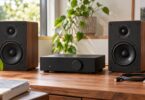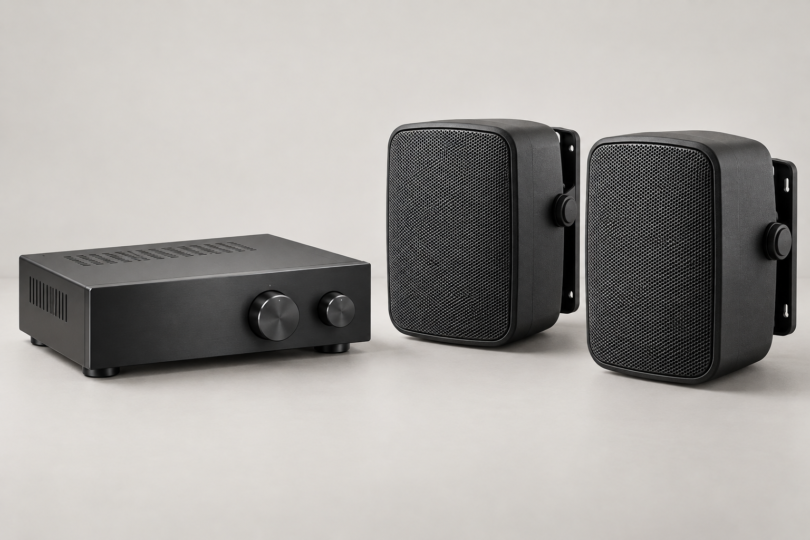

The best amplifier for outdoor speakers depends on how you want to play music and how many speakers you need to connect. For a single patio pair, the WiiM Amp is a practical streaming-first choice. The Sonos Amp makes sense when the patio belongs in an existing Sonos system. The OSD Audio XMP100 GEN2 suits an installation that needs physical A/B speaker switching and an external audio source.
Plan to keep all three amplifiers indoors in a dry, ventilated location. They can power suitable outdoor passive speakers through speaker wire, but their manuals do not permit exposure to rain or water. An outdoor speaker rating does not extend to the amplifier or its power connection. See the WiiM safety instructions, Sonos Amp guide and OSD installation manual.
Best amplifiers for outdoor speakers at a glance
| Amplifier | Best use | Manufacturer output specification | Connections that matter | Main limitation |
|---|---|---|---|---|
| WiiM Amp, original model | One patio listening area with app-based streaming | 2 × 60 W at 8 ohms; 2 × 120 W at 4 ohms | Wi-Fi, Ethernet, Bluetooth, AirPlay 2 receiving, HDMI ARC, optical and analog input; powered-subwoofer output | One stereo amplifier; no physical A/B speaker selector |
| Sonos Amp, black | Adding wired outdoor speakers to a Sonos home | 125 W per channel at 8 ohms; Sonos lists 250 W per channel at 4 ohms | Sonos streaming, AirPlay 2, HDMI ARC, analog input and powered-subwoofer output | Requires Sonos setup and a compatible speaker load; no Bluetooth audio input |
| OSD Audio XMP100 GEN2, XMP100BT-GEN2 | Switching between an indoor and outdoor speaker pair playing the same source | 2 × 50 W RMS at 8 ohms; 2 × 100 W RMS at 4 ohms; 1 × 200 W RMS bridged at 8 ohms | Bluetooth, USB music playback, main/interrupt analog inputs, A/B selector and trigger connections | A/B outputs do not provide independent music or volume for two zones |
These are manufacturer specifications, not results from a shared listening or bench test. Compare watts at the same impedance and operating mode; the OSD’s bridged figure describes one mono output, not stereo patio power. Specifications: WiiM Amp, Sonos output and setup, OSD XMP100 GEN2.
1. WiiM Amp: best for a straightforward streaming patio system
Choose the original WiiM Amp when you want to connect a pair of passive outdoor speakers and control music from your phone. Its network streaming, analog and optical inputs cover several sources without requiring a separate streamer. HDMI ARC is useful if a nearby television also feeds the system, while the subwoofer connection is for a powered subwoofer. The original Amp receives AirPlay 2; do not assume the differently named Amp Pro or Amp Ultra has the same features. Check WiiM’s exact model specifications.
- Why choose it: integrated streaming and several inputs reduce the number of separate boxes needed for one listening area.
- What to check: your preferred music service, the speaker load, and a reliable network connection where the amp will live.
- Limitation: adding speakers to its terminals does not create separately controlled zones. Buy a second amplifier if two areas need independent playback and volume.
The linked version is the original WiiM Amp in Space Gray, not the unamplified WiiM Ultra streamer or the Amp Ultra. Speakers and a powered subwoofer are separate purchases.

WiiM Amp Streaming Amplifier, Space Gray
As an Amazon Associate we earn from qualifying purchases.
2. Sonos Amp: best for an existing Sonos household
Sonos Amp is the natural shortlist choice when other rooms already use Sonos and you want the patio to join them. It supplies two amplified speaker channels and supports network playback, AirPlay 2, a line-level source and HDMI ARC. Its value is the shared Sonos system and control, so compare the total installation cost before buying it solely for occasional outdoor music. See Sonos Amp features.
- Why choose it: the outdoor pair can participate in Sonos room grouping.
- Useful option: Sonos provides dual-mono playback, which can suit a patio where listeners move around rather than sit between left and right speakers.
- Limitation: Sonos specifies compatible speaker power handling and prohibits loads below 4 ohms. Check the complete speaker pairing, not just the amp’s headline wattage.
Sonos supports two pairs of nominal 8-ohm speakers wired in parallel, but that does not establish compatibility for arbitrary four-speaker combinations. Its guide calls for speaker power ratings of at least 125 W for 8-ohm speakers and at least 200 W for 4-ohm speakers. Follow the Sonos connection and placement instructions for your installation.

Sonos Amp, Black
3. OSD Audio XMP100 GEN2: best for A/B speaker switching
The XMP100 GEN2 is useful when a phone, streamer or other source feeds the amplifier and you want front-panel switches for two speaker pairs. Its main and interrupt inputs, signal-sensing power and trigger connections are suited to a more traditional installed system. Bluetooth is built in; network music services need an appropriate external source. See OSD’s XMP100BT-GEN2 listing.
- Why choose it: select the indoor pair, outdoor pair or both with physical A/B buttons.
- Useful option: analog-source switching can simplify an installation with two source devices.
- Limitation: A and B share the stereo amplifier and main volume control. They are not four independent powered zones.
OSD specifies a minimum 4-ohm load in stereo or 8 ohms bridged. When running A and B together, use the manufacturer’s supported 8-ohm speaker pairs and check the combined load. Stay in stereo for a normal left/right patio pair; bridging changes the wiring and speaker requirements. The linked model is XMP100BT-GEN2, which must not be confused with older XMP100 specifications. Read the GEN2 manual.
How to choose the right amplifier for your setup
Start with passive speakers and the complete load
Check whether your speakers actually need a power amplifier. Passive speakers connect to amplifier speaker terminals; powered speakers already contain amplification and need an appropriate signal connection. For passive speakers, record their nominal impedance and the manufacturer’s recommended amplifier range before shopping.
Two nominal 8-ohm speakers in parallel present a nominal 4-ohm load to one channel. Two nominal 4-ohm speakers in parallel present 2 ohms. Real speaker impedance varies with frequency, so the arithmetic is a starting point, not permission to exceed a manufacturer’s supported wiring arrangement. A speaker selector or volume control must also be suitable for the system.
Decide whether you need one area or independent zones
For one patio pair, a stereo streaming amplifier is straightforward. For an indoor pair and outdoor pair playing together, the OSD’s A/B switching may be convenient. For different music or volume in separate areas, plan independent amplification and source control. Extra terminals alone do not create those capabilities.
Plan placement before buying
Choose a dry indoor location, leave the ventilation clearance specified in the manual and run suitable speaker cable to the outdoor speakers. Do not put an indoor amplifier in a sealed box and assume it has become weatherproof. For long cable runs, buried routes, wall penetrations or mains-power work, have the installation and cable selection checked by a qualified installer.
Frequently asked questions
Can these amplifiers stay outside under a covered patio?
Plan to keep them indoors. A roof does not eliminate wind-driven rain, splashes, condensation or temperature extremes. The WiiM, Sonos and OSD manuals require protection from water and adequate ventilation; none of these recommendations is an exposed outdoor amplifier.
How many watts do outdoor speakers need?
There is no single correct number. Match the speaker manufacturer’s amplifier recommendation and impedance, then consider listening distance and desired volume. Compare output at the same load and channel configuration instead of comparing a peak or bridged figure with a stereo rating.
Can one amplifier run four outdoor speakers?
Sometimes. The complete load must be supported by that exact amplifier. Sonos explicitly supports two pairs of nominal 8-ohm speakers in parallel, and OSD specifies 8-ohm pairs for simultaneous A/B use. Do not generalize that permission to four 4-ohm speakers or different wiring.
Does Bluetooth make the outdoor speakers wireless?
No. Bluetooth can carry audio from a compatible source to the WiiM or OSD amplifier, but passive outdoor speakers still need speaker wire from the amplifier. Sonos Amp does not offer Bluetooth audio input.
Which should I choose for a simple patio?
Start with WiiM Amp for integrated streaming, Sonos Amp for an existing Sonos system, or OSD XMP100 GEN2 for physical A/B switching. Make the final choice only after confirming the speakers, combined load and indoor installation location.