
The best subwoofer for a single-cab truck is the one that fits without sacrificing a safe driving position. Start with the KICKER Hideaway HS10 for a low-profile powered option, the Rockford Fosgate P300-10T for a powered truck enclosure, or the KICKER CompRT 48TCWRT102 when you can accommodate a separate amplifier.
None is a universal fit for every regular-cab pickup. Seat design, trim, factory audio equipment and the space behind or beneath the seat matter more than the truck’s badge or a subwoofer’s advertised diameter.
Research checked October 4, 2026. This comparison uses manufacturer specifications and manuals, not hands-on testing. We have not measured output, sound quality or fit in a particular truck. Confirm the exact product revision and installation requirements before buying.
Compare three single-cab subwoofer setups
| Option | Consider it when | Amplification | Main limitation |
|---|---|---|---|
| KICKER Hideaway HS10, model 51HS10 | You have a low, clear mounting space | Built-in, rated 180 watts RMS | A shallow enclosure still needs clearance and secure mounting |
| Rockford Fosgate P300-10T | A truck-style enclosure fits behind the seat | Built-in, rated 300 watts RMS | Check the complete enclosure drawing, including its deepest point |
| KICKER CompRT 48TCWRT102 | You want a thin loaded enclosure and a separately selected amplifier | External; manufacturer recommends 200–400 watts RMS in its manual | Budget space and money for the amplifier and installation |
Power ratings describe different parts of these systems. They are not a measured loudness ranking, and enclosure size alone does not tell you how any of them will sound in your cab.
1. KICKER Hideaway HS10: for a low-profile installation
The current HS10 product page identifies model 51HS10, a powered 10-inch unit rated at 180 watts RMS. It lists a 14-inch depth, 3-1/8-inch height and 9-7/8-inch width. A remote bass control is included, along with high- and low-level signal inputs.
This is the first option to investigate if vertical space is particularly tight and you would prefer not to find a second mounting location for an amplifier. Make a cardboard mock-up of the complete housing, then allow additional room for connectors, cables, ventilation and the mounting hardware.
Important fit check: do not assume every HS10 listing describes the same revision. Older stock and documentation may show different dimensions. Match the model number on the seller’s box to its manual. An under-seat position must stay clear when someone sits down and when the seat moves through its required range.
2. Rockford Fosgate P300-10T: for a powered truck enclosure
The P300-10T combines a 10-inch subwoofer with its amplifier in a truck-oriented enclosure. Rockford’s official powered-enclosure support page links the manual for this exact model. The manual rates it at 300 watts RMS and 600 watts peak.
It is a useful shortlist candidate when there is more room behind the seat than underneath it. Having the amplifier built in removes one component-matching decision, but you still need a suitable power connection and a compatible signal from the radio.
Important fit check: use the P300-10T outline drawing rather than dimensions from the similarly named P300-10. Check width, height, top depth and maximum bottom depth against the sloping seatback. Published specification tables can be confusing, so have an authorized installer confirm the current unit’s outside dimensions if clearance is close.
3. KICKER CompRT 48TCWRT102: for a separate-amplifier system
The 48TCWRT102 is a loaded 10-inch CompRT enclosure with a passive radiator and a single 2-ohm terminal. It is not a powered enclosure. KICKER’s enclosure manual specifies a 200–400-watt RMS recommended amplifier range for the TCWRT10.
Consider it if you already have an appropriate amplifier or want an installer to choose the amplifier separately. Its thin profile can help behind a seat, but the enclosure is about 23-1/4 inches wide. You need room for both components, their mounting and their cables.
Important fit check: verify the exact enclosure dimensions with the current unit. KICKER’s product page and manual have small dimensional inconsistencies, so they should not be treated as a machining template for a zero-clearance installation. The amplifier must support the enclosure’s 2-ohm load at the intended operating configuration.
Measure and budget before ordering
- Preserve seating: measure with the seat in every driving position you need, including recline and full intended travel. Do not compromise pedals, seat belts, airbags, seat wiring or access to essential controls.
- Measure the whole system: a driver’s mounting depth is not the depth of its finished box. For a custom enclosure, check required internal volume, driver displacement, rear clearance and any port requirements with the manufacturer.
- Match RMS and impedance: compare continuous/RMS ratings at the correct ohm load. Peak wattage is not a sensible target for continuous amplifier output. Never assume a bridged amplifier supports the same load as one channel.
- Price installation: include suitable wiring, protection, mounting, any required factory-radio interface and professional setup. A low enclosure price can leave substantial work unpriced.
Have a qualified car-audio installer handle fused power wiring, grounding, safe cable routing and secure mounting according to the vehicle and product manuals. KICKER’s technical guidance stresses ventilation, safe mounting and correct load matching. Gain should be set properly; it is not an extra volume control. Stop using a system that smells hot or sounds persistently distorted.
Frequently asked questions
Is a 10-inch subwoofer always better than an 8-inch?
No. Choose the complete enclosure and amplifier system around the available space and your listening goals. Driver diameter alone cannot establish bass quality or output.
Will a shallow subwoofer fit behind any single-cab seat?
No. Check the entire box, seatback angle, wiring space and safe seat movement. A truck-specific fit claim should name your model year, cab and seating configuration.
Do powered subwoofers need installation wiring?
Yes. An integrated amplifier still needs power, a suitable audio signal and secure mounting. Check what the exact package includes before ordering an installation kit.
Bottom line: shortlist the HS10 for low-profile space, the P300-10T for a powered truck box and the CompRT for a separately amplified setup. Let verified clearance and safe installation decide the winner.
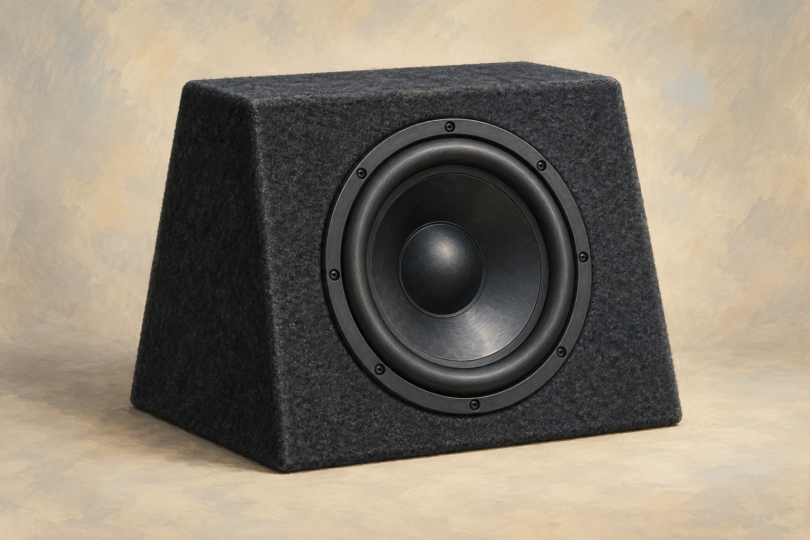
Image note: Generic subwoofer-enclosure illustration; actual truck clearance, wiring and product compatibility need separate verification.