

Historical research, June 2019: MIT researchers developed a method to help robots estimate where a person was in a familiar movement sequence. The advance addressed a practical problem in shared workspaces: a robot may predict the right path but still misjudge when a person will reach a particular point.
Why a robot could stop too early
In MIT’s account of the research, experiments with BMW used a rail-mounted robot to carry parts between stations while people moved nearby. The robot sometimes waited unnecessarily because its prediction software struggled with a person stopping or retracing a route.
Positions alone can be ambiguous. Someone standing still creates many observations in almost the same place; someone walking back can revisit positions recorded on the outward journey. Distinguishing those situations matters when estimating the timing of a possible crossing.
What BEST-PTA did
The 2019 paper by Przemyslaw A. Lasota and Julie A. Shah introduced BEST-PTA, short for Bayesian Estimator for Partial Trajectory Alignment. It matched an unfinished movement, observed as it happened, to a complete reference movement learned from examples.
The framework treated stopping segments and overlapping paths explicitly. Rather than returning only one best match, it calculated a distribution over possible correspondence points. That uncertainty information could then be used by a motion-prediction system.
What the tests established
The paper compared the approach with three baseline alignment methods across two human-motion datasets and reported better alignment performance. The researchers also demonstrated that improved alignment could benefit motion prediction. MIT described the example tasks as people crossing a robot’s path and reaching to position a bolt for a robot-assisted operation.
What the findings did not establish
This was evidence about a research method in the tested settings, not a guarantee that robots could predict every person’s next destination. Its reference trajectories represented recognizable patterns of movement. An unfamiliar action or environment would therefore require separate evaluation.
The significance was narrower and useful: better timing estimates could reduce unnecessary waiting while helping robots coordinate with nearby people. The study did not establish universal collision avoidance or document a current commercial deployment.
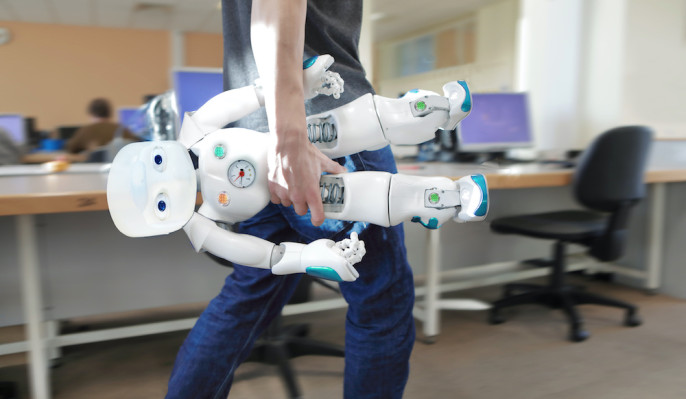
Image note: Illustrative factory robotics image accompanying an archive report on MIT’s 2019 human-motion prediction research; it does not show the MIT/BMW experiment.