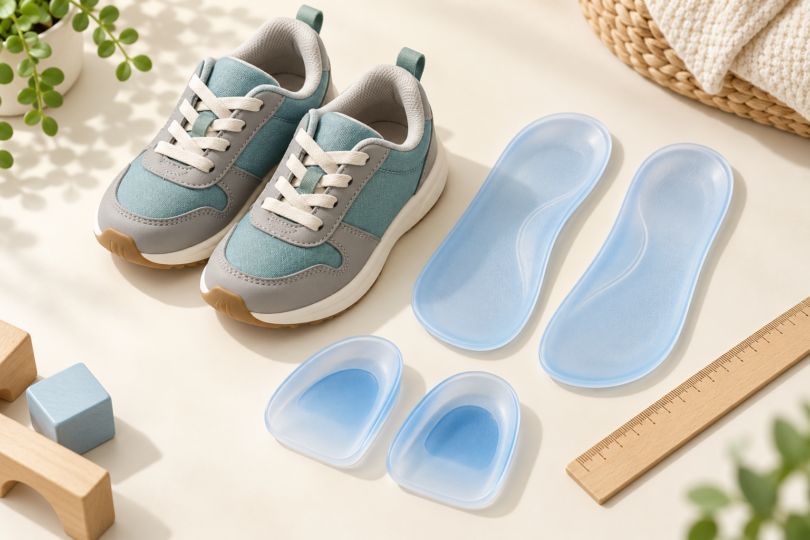

For full-length gel insoles for kids, start with KidSole Athletic Gel Sports if you want a contoured insert, or KidSole JellyFoam if you want a flatter gel-and-memory-foam design. Tuli’s Heavy Duty GEL Heel Cups are a separate heel-only option to discuss when a clinician recommends heel cushioning.
These choices are compared by manufacturer sizing, construction and fitting instructions. We have not tested them on children or measured their cushioning. The best choice depends on the child’s shoes and the reason for adding an insert; none is a universal answer to foot pain.
Before buying: does your child need an insert?
A low arch alone is not a reason to buy corrective insoles. AAOS guidance on flexible flatfoot says painless flexible flatfeet usually need no treatment. The Pediatric Orthopaedic Society of North America also explains that shoe inserts do not change the shape of a flexible flatfoot.
Ask your child’s pediatrician about persistent pain, stiffness, pressure sores or rubbing. A clinician can decide whether cushioning, an arch support or another approach is appropriate. Seek urgent medical help if a limping child cannot bear weight or has a fever and seems unwell; do not delay care while trying another insole. See the NHS guidance on limping in children.
Best gel inserts for kids: comparison
| Option | Construction and role | Published size choices | Best reason to consider it |
|---|---|---|---|
| KidSole Athletic Gel Sports | Full-length gel; contoured heel and slight arch reinforcement | 20 cm: US 11–1.5; 24 cm: US 2–6; 26 cm: US 6.5–8.5 | Contoured, trim-to-fit gel option |
| KidSole JellyFoam | Full-length gel base and memory-foam top; flat cushioning | 20 cm: US 11–1.5; 24 cm: US 2–6 | A flatter insert instead of a pronounced arch support |
| Tuli’s Heavy Duty GEL Heel Cups | Heel-only TuliGel cups; one pair | Small, Regular and Large; use the shoe-size-and-weight chart | Targeted heel cushioning in roomy lace-up shoes |
The KidSole ranges are manufacturer US shoe-size labels, not ages. Its 11–1.5 range crosses from little-kid numbering into the next size sequence. The listed centimetres identify the supplied insole size; compare the selected option with the actual shoe before cutting. None of these pages establishes a universal minimum age.
1. KidSole Athletic Gel Sports: for a contoured full-length insert
The Athletic Gel Sports insole has a gel construction, a shaped heel area and slight arch reinforcement. Guided lines show where to trim the forefoot. It is sold as one pair and is worth considering when a child-sized gel replacement is the goal.
Check shoe depth as well as length. A contoured insert that crowds the toes or pushes the heel out of the shoe is a poor fit. The card below is specifically the 24 cm, US kids’ 2–6 version; the 20 cm and 26 cm options are different selections. Do not interpret the product’s comfort language as proof that it corrects a foot condition.

KidSole Athletic Gel Sports Insoles, 24 cm, Kids US 2–6, One Pair
As an Amazon Associate we earn from qualifying purchases.
2. KidSole JellyFoam: for a flatter gel-and-foam insert
The Slim Gel + Memory Foam Hybrid, also called JellyFoam combines a gel base with a memory-foam cushioning layer. Choose it for its flat profile. The product page explicitly says it is not an arch-support insole, even though later generic sizing copy mentions arch support; this comparison follows the specific product description.
It comes as one pair with cutting guides. The linked Amazon selection is the 20 cm version labeled US 11–1.5; the manufacturer also lists 24 cm for US 2–6. Compare those choices before ordering. Trim only the forefoot as instructed, a little at a time, and check the fit before removing more material.

3. Tuli’s Heavy Duty GEL Heel Cups: a heel-only alternative
These Tuli’s gel heel cups occupy the rear of the shoe rather than extending under the toes. Medi-Dyne lists latex-free TuliGel material and supplies two cups. They are an option when heel cushioning is the specific goal, with enough space in a lace-up shoe. They do not replace a full-length insert or a prescribed orthosis.
Use the manufacturer’s combined weight and US shoe-size chart. For example, it lists Small for youth weighing 50–105 lb with shoe sizes 10.5Y–6Y; other weight-and-size combinations can require Regular. There is no single “kids size” that fits every child.
Wear the cups in both shoes, outside the socks, and check that they stay in place. Do not apply the full-length insoles’ trimming instructions to these cups: ask Medi-Dyne if the fit is wrong. Its guidance favors using either a heel cup or an orthotic; ask the prescribing clinician before combining them.
How to choose and fit an insert
Start with shoes that fit. AAOS shoe-fitting guidance recommends about half an inch between a child’s longest toe and the shoe tip, measuring both feet, and checking growing children’s fit regularly. An extra insert is not a reliable way to rescue an undersized shoe.
Check whether the original liner is removable and whether the shoe maker allows a replacement. Compare the new insert against it, then follow the exact insert’s cutting guides. Keep the heel and arch sections intact unless the manufacturer directs otherwise. Have the child try the shoes with their usual socks and walk before wearing them for a full day. These are practical fit checks, not a treatment plan.
Stop using an insert that causes pain or rubbing and reassess the fit. Persistent symptoms deserve an examination. A full-length gel cushion, a small heel cup and a clinician-selected orthosis have different roles; the word “orthotic” in a listing does not establish that an item is appropriate for your child.
Frequently asked questions
Will gel insoles fix flat feet?
Do not buy them expecting that result. Painless flexible flatfeet generally need no treatment, and inserts do not reshape them. A clinician may suggest an insert for symptoms after examining the child.
Are heel cups the same as gel insoles?
No. Heel cups cushion the heel area; full-length insoles extend through the shoe. The two KidSole selections cover the length of the shoe, while Tuli’s cups are a heel-only option. Match the type to the reason for use and available shoe space.
Can a gel insert treat Sever’s disease?
Heel pain needs the correct diagnosis. AAOS guidance on Sever’s disease describes clinician assessment and a treatment plan that can include limiting painful activity and heel pads. That does not establish that any product here will cure the condition or make continuing painful sport appropriate.
Can I choose by age or cut down adult insoles?
Use the child’s current shoe measurements and the manufacturer’s size range. The options here are sized by shoe size, with weight also used for Tuli’s. A smaller outline alone does not prove that an adult insert’s arch and heel contours will fit; choose a documented child-size option or ask a professional.