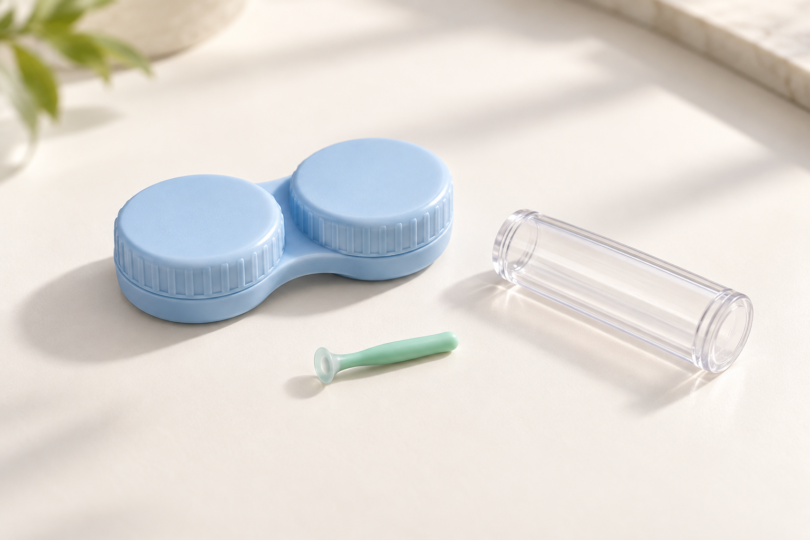

The best plunger for contact lenses depends on the lens and the job. Our three choices are the DMV Ultra for hard or rigid gas-permeable lens removal, the DMV Vented Scleral Cup for scleral lens insertion, and the DMV Soft Lens Handler for soft lenses. These devices are not interchangeable.
Before buying, have your contact-lens fitter confirm the exact tool and demonstrate its use with your prescribed lenses. A suction holder must contact the lens, never the bare eye. Scleral removal also needs its own technique: do not apply instructions for a small rigid lens to a larger scleral lens.
If you have eye pain, redness, light sensitivity, discharge or sudden blurred vision, CDC advises removing your contacts and calling your eye doctor immediately. Do not resume lens wear until your eye doctor advises it. If a lens will not come out, seek prompt professional help rather than repeatedly pulling with a tool.
Best contact-lens tools by lens type
We selected these tools by their documented purpose and manufacturer instructions. The recommendations are editorial comparisons, not hands-on tests or a claim that one device suits every wearer.
| Tool | Best fit in this guide | Important limit |
|---|---|---|
| DMV Ultra | Removal of hard/RGP lenses | Scleral use needs lens-specific training; not a soft-lens recommendation |
| DMV Vented Scleral Cup | Insertion of scleral lenses; also labeled for hybrid insertion | Insertion only; its air channel prevents suction |
| DMV Soft Lens Handler | Insertion and removal of soft lenses | No suction; do not use with hard, RGP, scleral or hybrid lenses |
1. DMV Ultra: best for hard/RGP lens removal
The Ultra is our starting point when your fitter recommends a suction remover for hard or rigid gas-permeable contacts. DMV labels it for both insertion and removal of those lenses. The removal cup and the shallow insertion dimple at the other end have different roles, so identify the correct end during training.
DMV also lists the Ultra for scleral lens removal. That does not make the removal technique universal: Moorfields Eye Hospital warns against attaching a suction holder to the center of a mini-scleral lens and pulling. Have your fitter teach the method for your lens. Choose the Soft Lens Handler below if your prescribed lenses are soft.
Read the Ultra instructions and ask DMV how to order the Ultra. Confirm the model and quantity you need; this recommendation does not establish a particular retailer multipack.
2. DMV Vented Scleral Cup: best for scleral insertion
Choose this option when your fitter wants an insertion aid for scleral or hybrid lenses. The air channel disables suction so the lens can release from the tool during insertion. Its device-specific instructions explicitly prohibit using it to remove a contact lens.
Check the full name when ordering: the Vented Scleral Cup and the standard Scleral Cup are separate products. For this recommendation, follow the Vented model’s leaflet and confirm its fit with your clinician. Do not substitute a similarly named cup because a retailer calls both products a plunger.
Read the Vented Scleral Cup instructions and ask DMV how to order the Vented Scleral Cup. You will need a separate removal method taught for your lenses.
3. DMV Soft Lens Handler: best option to discuss for soft lenses
For a soft-lens wearer who finds finger handling difficult, the Soft Lens Handler is the relevant choice in this shortlist. DMV describes it as an aid for people with long fingernails, rough hands or other handling difficulties. It uses gripper pads for removal and a smaller end for insertion; it does not remove a soft lens by suction.
The leaflet excludes hard, gas-permeable, scleral and hybrid lenses. Ask your fitter to show you the handling method before use. The device should not be slid across the eye’s surface, and its product category is not a reason to improvise with ordinary tweezers.
Read the Soft Lens Handler instructions and ask DMV how to order the Soft Lens Handler. Choose it only after confirming that a handling aid is appropriate for your soft lenses.
What to check before ordering
Match the exact product name, lens type and task first. Then confirm the quantity, total cost, delivery and return terms with the seller. DMV’s ordering page offers telephone and inquiry-form contact rather than a priced checkout, so these links are an ordering route, not a promise of stock or a quoted price.
Bring the proposed tool and its leaflet to your contact-lens appointment if you are uncertain. Being able to hold a tool is only part of choosing it; you also need a technique your fitter has checked. For handling, Moorfields recommends thoroughly washed and dried hands and a clean, flat work surface.
Tool cleaning and contact-lens care are separate routines. Follow the exact device leaflet, let the cleaned tool air-dry fully and store it in its case. The three DMV leaflets advise planned replacement every six months; ask your fitter about replacement if a tool is damaged sooner. Do not transfer a device-cleaning instruction to the lenses or your eyes.
A plunger is not a lens-care solution. Use the care system your eye-care professional recommends for your lens type; CDC notes that hard-lens and soft-lens care products differ and that saline does not disinfect lenses. Eyeglass sprays, household drain products and nasal-cleaning products have no place in this shortlist.
Never put unneutralized hydrogen peroxide lens solution in your eyes or use it to rinse lenses immediately before insertion. FDA warns that this can cause eye damage. A peroxide care system requires its specified neutralization process; it is not a substitute for an insertion or removal tool.
Frequently asked questions
Can one plunger work with every contact lens?
No. The Soft Lens Handler is restricted to soft lenses, while the Vented Scleral Cup is labeled for inserting hybrid and scleral lenses and must not be used for removal. Select the device with your fitter instead of treating “contact-lens plunger” as a universal specification.
Is a vented scleral cup also a remover?
No. Its air channel prevents suction, and DMV explicitly says not to use it for removal. Have your fitter select and teach a separate removal method.
Should I buy a large multipack?
Confirm the correct model and your replacement plan first. A low price per piece is poor value if the tool does not match your lenses or the task. Check the actual package quantity with the seller; no multipack size is assumed in these recommendations.