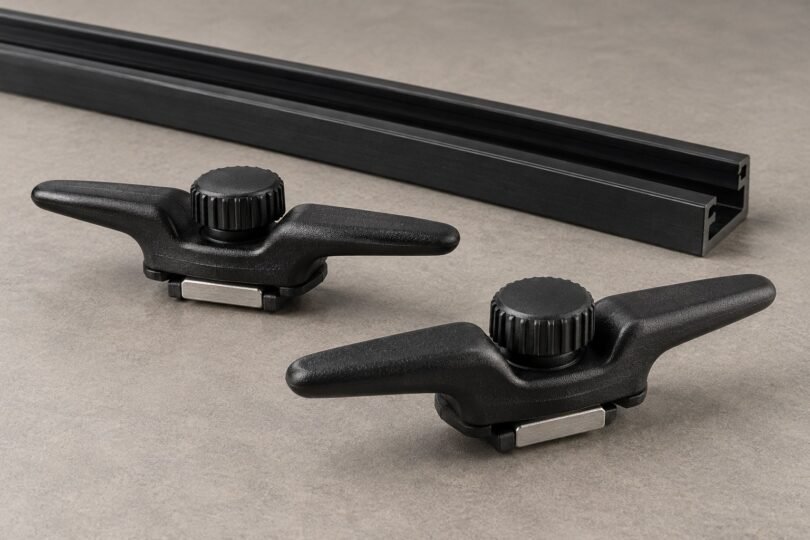

The right Tacoma bed rail cleat starts with the rail system on your truck, the accessory’s own load limit and the space available around your bed cover. For a replacement adjustable cleat, start by checking Toyota part PT278-35160 against your vehicle. For smaller attachment points, consider Toyota’s mini tie-downs with hooks, subject to their separate hook rating and cover restriction.
Before ordering, confirm the exact model year and bed equipment. A listing that mentions Tacoma, Tundra, Gladiator and Ram together does not establish that one accessory fits every rail system or carries the same load on every truck.
Which type of bed hardware do you need?
- Sliding bed rail cleat: a repositionable attachment point for the truck’s deck rail system. This is the category to shop when replacing a missing adjustable cleat.
- Mini tie-down with a hook: a smaller attachment point with distinct limits for its tie-down section and hook. Check which part you intend to load.
- T-slot nut, bolt or separate D-ring: hardware for a particular mounting assembly. Its dimensions and an individual component’s advertised strength do not establish the capacity of a completed Tacoma installation.
Ratchet straps, cargo nets, bike mounts, bed caps and tonneau covers serve other purposes. Choose those separately after identifying the correct attachment points. Cargo cleats should never be used as vehicle towing, recovery or lifting points.
Two Toyota accessories worth checking first
Toyota Bed Cleats, black: PT278-35160
Consider it for: replacing or adding a full-size adjustable cleat, after Toyota confirms compatibility with your Tacoma.
Toyota’s PT278-35160 product page identifies black nylon construction, approximate dimensions of 6 by 1 inches and a spring-loaded twist-lock mechanism. It requires a deck rail system, lists PT278-35112 as a previous version and states a maximum of 110 lb per cleat.
The useful reason to start here is the identifiable Toyota part number and published accessory specification. Confirm the number of cleats in the seller’s package before comparing prices; a product photo showing several pieces does not establish the quantity you will receive.
Watch for: listings that use a Toyota part number only as a replacement reference. An aftermarket product described as “replaces PT278-35160” is not automatically a Toyota Genuine part, and Toyota’s specifications do not validate that seller’s product.
Toyota Mini Tie-Downs With Hooks: PT278-00160
Consider them for: a compact attachment point when the vehicle and bed-cover checks both pass.
Toyota’s PT278-00160 product page describes a pair of black nylon mini tie-downs, approximately 2 by 1 inches each, that slide in the rails and use an internal tension spring. It states 110 lb per mini tie-down and a separate 50 lb limit for the hooks.
The important restriction: Toyota says this accessory requires the deck rail system and is not compatible with the factory tonneau cover. Do not buy it for that combination simply because a listing says it fits your truck’s year.
If you are attaching through the hook, use its lower hook limit. The stated total for a pair does not make either hook capable of carrying that combined load. Check your chosen package’s instructions instead of borrowing figures from a visually similar mini tie-down.
Why you may see both 110 lb and 220 lb ratings
Keep three questions separate: which accessory you have, what its own instructions allow, and what the vehicle’s rails allow. A higher figure elsewhere in a Toyota document does not increase the rating published for your particular accessory.
For example, Toyota describes PT278-0C010 as a die-cast aluminum cleat for the Tundra’s rail system, with a 220 lb maximum. That is a different product description from the black nylon PT278-35160 listing. It is not evidence that the Tundra part fits your Tacoma or that every replacement cleat is rated to 220 lb.
Follow all applicable limits. If the packaging, part number and published instructions disagree, have the manufacturer or Toyota dealer resolve the discrepancy before using the part. Do not select the largest number or add the advertised strengths of loose rings and bolts to calculate a truck-bed capacity.
A model-year example: the 2023 Tacoma
The 2023 U.S. Tacoma owner’s manual, pages 178 and 370, warns against cleat loads over 220 lb or angles over 45°, and limits total tensile load to 440 lb per rail. It allows at most three accessory locations on each short-bed side rail or four on each long-bed side rail, with support points spread along the rail.
These are 2023 vehicle instructions, not a universal rating for other model years or a higher rating for the 110 lb accessory above. Rail tensile load also is not the truck’s payload allowance.
Check fit before comparing multipacks
- Record your exact truck and equipment. Use the model year, bed configuration and installed rail system. Toyota’s parts pages offer a vehicle-fit check; ask a dealer to confirm the part number if the catalog leaves your configuration unclear.
- Identify what is already installed. Compare the existing cleat’s part markings and locking mechanism. A replacement needs more than a similar outline in a thumbnail.
- Check the entire rail space. A tonneau clamp, rack bracket, storage box or other accessory may occupy the position you want. Confirm compatibility with the relevant accessory maker before combining hardware.
- Read the selected option. Verify brand, part number, material, quantity and included locking hardware. A two-pack and four-pack may share reviews or photographs while being different purchase options.
- Obtain the installation instructions and rating. If the seller provides only “heavy duty” or a ring’s breaking-strength claim, that leaves the completed rail installation unresolved.
Buy the number of usable attachment points your setup needs. A larger multipack is not a reason to exceed the number of mounting locations permitted for your truck.
Installing the original-style cleat
For the 2023 Tacoma’s original-style cleat, pages 366–367, Toyota’s sequence is:
- Loosen and depress the thumbwheel to provide a 0.5-inch gap at the locking plate.
- Insert the plate, turn the cleat 90° and release the wheel.
- Slide it until the plate engages a rail detent.
- Tighten the wheel until the clutch ratchets; check that the cleat is securely locked.
Keep the tonneau cover’s closing and latching path clear. For other years or accessory designs, follow their own instructions. This procedure is not a torque specification for bolt-on hardware.
A cleat that will not seat or lock calls for a fit check. Do not drill, file or substitute hardware to make an uncertain product fit based on a generic marketplace suggestion.
Common buying questions
Are aftermarket aluminum cleats automatically stronger?
Material alone cannot establish a finished assembly’s capacity or compatibility. Look for instructions and a rating for the exact product, mounting hardware and intended vehicle. An aluminum body does not justify exceeding the rail’s limits.
Can I use the same cleats across Tacoma generations?
Confirm the exact part against the exact model year and rail system. A shared vehicle name, replacement-number list or old customer review is not enough to establish fit across generations. Use Toyota’s owner-manual selector for your truck’s instructions.
Can mini hooks replace full-size cleats?
Only when the specific application, fit and load requirements are satisfied. Their compact size is useful in some layouts, but the hook’s separate rating and any bed-cover restriction still apply. Choose by the attachment you will actually use, not by the quantity offered in a pack.