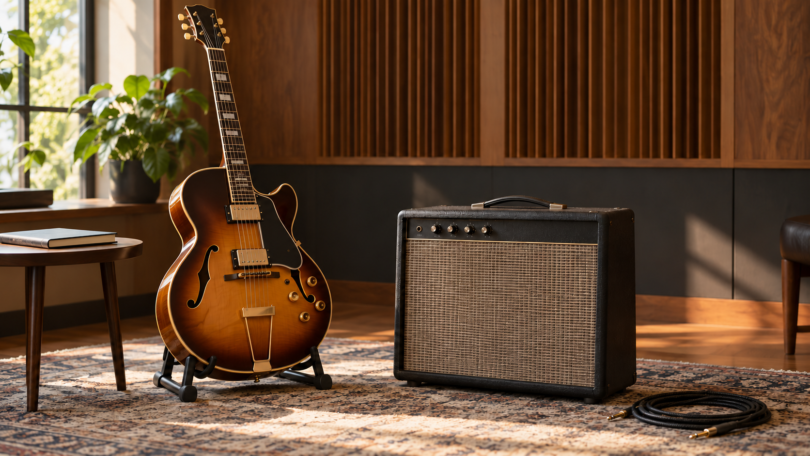

The best amp for jazz guitar depends on how you play: a clean pedal setup, a small combo with direct output for gigs, or a practice amp that also records over USB. Our shortlist is the Roland JC-40 for stereo clean tones, the Fender Tone Master Deluxe Reverb for a light Fender-style combo with an XLR output, and the BOSS Katana-50 Gen 3 for practice, effects and computer recording.
These are editorial choices based on manufacturer specifications and manuals. We have not conducted a hands-on comparison. Bring your own guitar to an audition if possible: pickup output, room acoustics, drummer volume and your tolerance for breakup matter more than a wattage ranking.
Best amps for jazz guitar at a glance
| Amp and exact version | Power, speakers and weight | Best reason to choose it | Main compromise |
|---|---|---|---|
| Roland JC-40 Jazz Chorus | 40W stereo; two 10-inch speakers; 15.8kg / 34lb 14oz | Stereo chorus, stereo inputs and an effects loop | Heaviest here; no USB recording |
| Fender Tone Master Deluxe Reverb, Black, 2274100000 | 100W digital power amp modeling 22W tube-amp performance; one 12-inch Jensen N-12K; 10.4kg / 23lb | Light carry, familiar controls and cabinet-simulated XLR output | No headphone jack or effects loop |
| BOSS Katana-50 Gen 3, KTN-50 3 | 50W; one custom 12-inch speaker; 11.6kg / 25lb 10oz | Low-power practice, onboard effects and USB-C recording | This standard 50 has no line output or effects loop |
Those power figures describe different designs. The Fender’s 100W power stage does not make it a four-times-louder version of a 22W Deluxe Reverb. It is designed to reproduce that amp’s response and headroom. None of these specifications guarantees clean volume over every drummer.
1. Roland JC-40: best for stereo clean tones and pedals
Choose the JC-40 when stereo chorus or a stereo effects pedal is central to your sound. Its two 10-inch speakers and independent power amps let the chorus spread through the room. The front L/MONO and R inputs accept a stereo source; they share the amp’s controls rather than acting as two separately adjustable instrument channels. Plug a single guitar into L/MONO.
For a straightforward jazz sound, start with distortion off, restrained reverb and the bright switch off, then adjust the three-band EQ for your guitar. These are starting suggestions, not a tested preset. A warm archtop may need less bass than expected, especially near a wall. The chorus can stay off when you want an unmodulated tone.
What works well: a mono send/stereo-return effects loop with series or parallel operation, plus L/MONO and R line outputs for a mixer or recorder. Those line outputs can operate while the internal speakers play. Headphones mute the speakers, but Roland specifically says the headphone presentation is not true stereo; it represents a centered listening position in front of the amp.
What to weigh up: at nearly 35lb, this is a meaningful step up in carrying weight from the other two. There is no USB audio interface, and remote switching requires a compatible optional footswitch. Pick it for its clean/stereo architecture, not because the word “Jazz” guarantees your preferred tone. The Roland JC-40 specifications and dealer route and JC-40 manual explain its connections.

Roland JC-40 Jazz Chorus, Black, 40 Watt
As an Amazon Associate we earn from qualifying purchases.
2. Fender Tone Master Deluxe Reverb: best for a light combo with direct output
The black Tone Master Deluxe Reverb is the choice here for players who want Fender-style controls, reverb and tremolo, with less carrying weight and a useful direct feed to the PA. This recommendation is the black 2274100000 version with a Jensen N-12K neodymium speaker. The Blonde version has different specifications, and the tube Deluxe Reverb is a different amplifier.
Fender specifies a 100W digital power amp into the built-in 8-ohm speaker, modeling the behavior of a 22W tube Deluxe. The rear output selector offers full output and five reduced settings, down to a labeled 0.2W equivalent. That helps set room loudness after choosing the front-panel response. For clean jazz, keep the channel volume below the breakup you hear with your own pickups; attenuation reduces loudness, not an already overdriven model’s distortion.
What works well: the balanced XLR output has a level control, ground-lift switch and selectable cabinet impulse responses. Mute silences the power amp while leaving XLR active, useful for recording or a quiet stage. The 23lb weight is the lowest in this comparison. A cover and two-button reverb/tremolo footswitch are included in the manufacturer’s package.
What to weigh up: there is no headphone jack, effects loop or midrange knob. The USB port is for firmware updates, not USB audio recording. Input 2 reduces sensitivity by 6dB, which can help with a high-output instrument, but this remains a model of a smaller tube combo rather than a promise of unlimited clean headroom. For a loud band, plan for PA support and audition at the volume you actually need. See the Fender product specifications and exact Tone Master Deluxe Reverb manual.

3. BOSS Katana-50 Gen 3: best for practice and USB recording
The standard Katana-50 Gen 3 suits a guitarist who wants one amp for clean chord practice, backing tracks, effects and recording without assembling a separate pedalboard. The exact model is KTN-50 3, with one 12-inch speaker and 50W rated output. It is distinct from the older MkII and from the Gen 3 50 EX.
Start with the Clean amp type, low gain and a little reverb, then shape bass, middle and treble for your instrument. Its six amp characters each have a variation, so there is room to explore fusion or driven sounds too. The power control includes standby, 0.5W, half and maximum settings. Master volume still matters: even the low-power setting can be too loud for a quiet room.
What works well: five effect categories, four stored tone settings across two banks, a backing-track auxiliary input and a headphone output that mutes the speaker. USB-C can send guitar audio to a computer; use a data cable and the supported BOSS driver/software for your system. Deeper editing uses BOSS Tone Studio for Katana Gen 3. Bluetooth playback and mobile editing require the separately sold BT-DUAL adaptor.
What to weigh up: this standard 50 lacks a dedicated line output, send/return loop and GA-FC connection. Do not borrow those features from another Katana model’s listing. A looper placed before the guitar input will have its recorded signal processed by the amp’s later settings. Power Amp In is an input for a preamp or modeler, not a speaker output. If you need an independent PA feed while hearing the combo speaker, choose the Fender or JC-40 here, or compare a different Katana model carefully. Check the exact BOSS Katana-50 Gen 3 product and dealer page and Gen 3 reference manual.
How to choose an amp for your jazz setup
Listen for clean headroom with your guitar. Play your hardest chord accents as well as single-note lines. A clean sound at apartment volume says little about the same amp alongside drums. Test your neck pickup, guitar volume and tone controls; reduce excessive bass before assuming you need a larger speaker. A hollow-body guitar may feed back as volume rises, so check position and distance from the amp during your audition.
Choose the connection you will use. For stereo pedals, the JC-40 has the clearest advantage. For a cabinet-simulated XLR feed, the Fender is more convenient. For computer recording and headphones, the Katana is the most complete fit here. A recording output is not an output for a passive speaker cabinet. These selected combos do not provide a user-facing extension-speaker output; do not rewire internal speakers or connect a passive cabinet to a headphone, line or Power Amp In jack.
Check the exact electrical version. The selected Fender SKU is sold as the North American 120V model; its manual specifies universal 100–240V operation and the product page lists 50–60Hz. Follow the voltage/frequency marking and use the correct grounded supplied power connection. The JC-40 and Katana manuals instead require the supply shown on the actual rear label and advise consulting Roland before overseas use. Do not assume they accept every country’s mains voltage or that a plug adaptor converts voltage. Their stated power consumption is 43W and 47W respectively; consumption is not speaker-output wattage.
Budget for the complete setup. Compare the amp plus any footswitch, BT-DUAL adaptor, data cable, headphones, carrying cover or PA connection you need. Keep ventilation clear, use a stable surface, turn levels down before connecting equipment and avoid prolonged loud listening. The Katana startup safety guide and Fender safety instructions give the model-specific precautions.
Which one should you buy?
Pick the JC-40 if clean stereo sound and external pedals matter most. Pick the black Tone Master Deluxe Reverb if a light carry and a direct PA output suit your gigs. Pick the Katana-50 Gen 3 if practice, effects and USB recording are your priorities. For an unmiked loud ensemble, none earns an automatic recommendation from its wattage alone: audition with the band or arrange PA support before buying.
Frequently asked questions
Do I need a tube amp for jazz guitar?
No. A clean sound you like at the volume you need matters more than the technology. These three choices use solid-state or digital designs. Try your own guitar and compare attack, EQ range and the point where the sound begins to break up.
How many watts does a jazz guitar amp need?
There is no single minimum. Headphones or low-power settings suit quiet practice, while an unamplified drummer can demand more clean headroom. Speaker efficiency, room size and PA support also matter. The Fender’s 100W power stage models 22W tube-amp performance, so these wattage figures are not a simple loudness ranking.
Can I use headphones with all three amps?
The JC-40 and Katana-50 Gen 3 have headphone outputs that mute their speakers. Roland says the JC-40 headphone sound is not true stereo. The Tone Master Deluxe Reverb has no headphone jack; silent monitoring needs suitable external audio equipment connected to its XLR output.
Does the Katana-50 Gen 3 have an effects loop or Bluetooth built in?
The standard KTN-50 3 has no send/return effects loop, dedicated line output or GA-FC jack. Wireless audio playback and mobile editing require the optional BT-DUAL adaptor. Check the exact model, because other Katana versions have different connections.
Can I use an imported amp with a plug adaptor?
Only if the actual amp’s electrical rating supports the local supply and the connection meets its grounding requirements. A plug adaptor does not convert voltage. The Tone Master Deluxe Reverb manual specifies 100–240V operation; the JC-40 and Katana require checking the rear label and consulting Roland before overseas use.