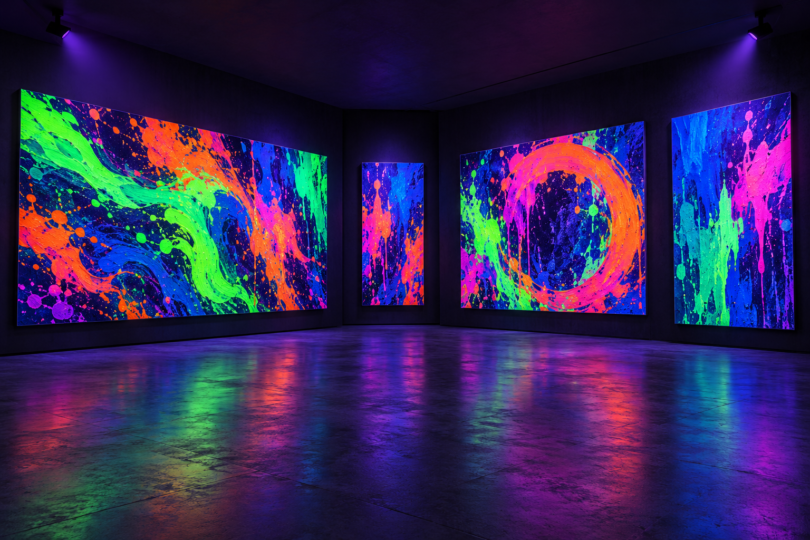

The best black light for a large area depends on what you need to illuminate: a broad display, a long wall or a more concentrated stage feature. For a professionally managed indoor setup, the CHAUVET DJ COREpar UV120 ILS is our most flexible pick because its removable lens changes the beam. The ADJ UV LED BAR20 IR suits a horizontal wall wash, while the ADJ UV COB Cannon offers a fixed, more concentrated beam.
These are professional entertainment fixtures. All three manuals specify professional use; the two ADJ manuals also identify their fixtures as Risk Group 3 for UV exposure. They are not casual home-party or body-paint recommendations. This comparison uses manufacturer specifications and manuals, not hands-on testing or measured room-coverage results.
Three blacklights compared
| Fixture and best fit | Maker wavelength | Published beam | Light source / electrical draw |
|---|---|---|---|
| CHAUVET DJ COREpar UV120 ILS: flexible professional indoor display | 390–400 nm | 44° without lens; 21° with included lens | 120W COB LED / 119W at 120V, 60Hz |
| ADJ UV LED BAR20 IR: professional indoor wall wash | 390–410 nm | 10° vertical × 40° horizontal | 20 × 1W LEDs / 30W |
| ADJ UV COB Cannon: professional stage feature | 395–405 nm | 33° | 100W COB LED / 120W maximum |
Electrical watts describe power consumption, not UV output or square feet covered. The ranges above also matter: the ADJ specifications extend into visible violet, so “blacklight” does not mean an invisible beam or a pure 365 nm source. CDC’s wavelength explanation places UVA at 315–400 nm. Match the light to the actual fluorescent material before committing to a full installation.
1. CHAUVET DJ COREpar UV120 ILS: best for changing the beam
Choose it for: professional indoor displays or mobile lighting work where one fixture needs different beam widths. The included magnetic Fresnel lens changes the beam from 44° to 21°. That flexibility is its clearest advantage over the two fixed-beam ADJ picks. The wider published 94° field angle without the lens is a separate specification; it is not a promise of equally bright illumination throughout that area.
The fixture has a 120W UV COB LED, 390–400 nm output, one- or five-channel DMX modes and ILS compatibility. Its housing can sit flat, and its adjustable bracket supports aiming and rigging. The IRC-6 remote and D-Fi USB wireless accessory are optional purchases. Confirm that a listing says COREpar UV120 ILS, since similarly named versions are not interchangeable evidence.
- Pros: two beam options, included lens and compatibility with an existing ILS setup.
- Tradeoffs: a wider beam distributes the light over a larger target; it does not prove better fluorescent brightness at a given distance. Wireless control adds an accessory.
Installation limits: professional use only, indoors and dry, with an ambient maximum of 40°C. The manual requires a grounded supply, ventilation clearance and a safety cable for overhead installation. Do not look into the operating source or connect it to a household dimmer. Power input is 100–240VAC, 50/60Hz; published draw is 119W at 120V or 118W at 230V. Its manual contains inconsistent power-linking counts, so have the supplier confirm the limit for the supplied regional unit before linking fixtures.
See the COREpar UV120 ILS manufacturer specifications and read its user manual.
2. ADJ UV LED BAR20 IR: best for a horizontal wall wash
Choose it for: a professional indoor installation that needs a long, shallow band of light. Its 10° vertical by 40° horizontal beam is useful when the target is wider than it is tall. For a tall wall or a room with targets in several directions, plan fixture placement and overlap rather than assuming one bar will cover everything.
The BAR20 IR uses twenty 1W LEDs, draws 30W and has a published 390–410 nm range. Its scissor yoke can support floor placement or hanging, and the included UC IR remote provides convenient control. DMX offers one-, two- or three-channel modes. The “IR” in the name refers to infrared remote control; the display light itself is the specified near-UV/violet output.
- Pros: defined rectangular beam, included remote and the lowest electrical draw in this shortlist.
- Tradeoffs: the narrow vertical spread is a poor match for a tall target from a close position. Lower power draw is not evidence of equivalent UV performance to the larger COB fixtures.
Installation limits: the manual restricts it to trained professionals and dry indoor locations. It specifies grounding and prohibits dimmer-pack power. Input is 100–240VAC; ADJ prints 47/63Hz, so check the supplied unit’s electrical label for the local circuit. The manual gives conflicting 40°C and 45°C ambient ceilings; do not plan above the stricter 40°C figure without manufacturer clarification. Its Risk Group 3 warnings require eye/skin protection and avoiding direct exposure. A listed separation distance is not a guarantee that exposure beyond it is safe.
See the ADJ UV LED BAR20 IR specifications and read its user manual.
3. ADJ UV COB Cannon: best for a focused professional stage feature
Choose it for: a defined scenic target where a professional lighting operator wants a fixed circular beam and DMX control. The manufacturer’s current product page and manual specify 33°. Some older descriptions say 56°; use the documentation supplied with the actual unit rather than designing a layout around a search snippet.
The UV COB Cannon has a 100W COB LED, 395–405 nm output and a maximum electrical draw of 120W. It supports manual, sound-active and DMX operation, with one-, two- or three-channel DMX modes. A dual yoke supports aiming. This is the UV COB Cannon, not the different 400W lamp-based UV Canon.
- Pros: fixed beam for a defined target, DMX control and selectable dimming curves.
- Tradeoffs: the fixed beam offers less flexibility than the COREpar’s removable lens. Neither its name nor its wattage establishes a whole-room coverage rating.
Installation limits: professional use only, with Risk Group 3 UV warnings. ADJ requires qualified installation, grounding, ventilation and a secondary safety attachment for overhead mounting. Input is 100–240VAC, 50/60Hz; do not connect a dimmer pack. The current manual conflicts on ambient ranges, stating −30 to 45°C in one section and −20 to 40°C in installation guidance. Confirm the unit’s limits with ADJ before temperature-critical use. We recommend this model only for a controlled indoor installation; an outdoor weather rating was not established.
See the ADJ UV COB Cannon specifications and read its current manual.
How to plan a large-area blacklight setup
Start with the targets. Measure the walls, artwork or scenic pieces you want to fluoresce, the available mounting positions and the throw distance. A wide beam and a narrow beam solve different problems. Have the supplier demonstrate your actual material under the proposed light with the venue’s normal ambient lighting. That check is more useful than an unsupported “covers 1,000 square feet” claim.
Plan distribution, power and control together. Several aiming positions may give more useful coverage than one source, but the number of fixtures cannot be selected responsibly from floor area alone. Include suitable brackets, clamps, safety cables, control equipment and power distribution in the budget. Power linking does not remove circuit limits; use the correct regional connectors and obtain clarification where the manual and product page disagree.
Keep decorative blacklights separate from germicidal UV-C. These recommendations concern fluorescence effects. They are not disinfection devices, and a UV-C sterilizing lamp is not a substitute. The FDA explains that UV-C can cause skin burns and eye injuries. Near-UV entertainment fixtures also need their own exposure precautions. Do not aim them at eyes or skin, recommend them for tanning, or infer safety from a wavelength label. Follow each manual and have a qualified operator assess the installation and audience exposure.
Which one should you choose?
Start with the COREpar UV120 ILS if changing beam width matters. Choose the BAR20 IR for a shallow horizontal wall wash, or the UV COB Cannon for a defined professional stage target. These are use-case recommendations, not a measured brightness ranking. For an ordinary home room, choose equipment explicitly documented for that setting rather than scaling down a professional fixture by guesswork.
Frequently asked questions
What is the best black light for a large area?
For a professional indoor setup, the COREpar UV120 ILS offers useful beam flexibility, the ADJ UV LED BAR20 IR suits a horizontal wall wash, and the ADJ UV COB Cannon suits a defined stage target. No single model has verified universal room coverage here.
How many blacklights do I need for my room?
Floor area alone is not enough. Fixture count depends on the targets, throw distance, beam shape, ambient light and fluorescent material. Ask for a demonstration or a lighting layout using your actual dimensions before buying multiple units.
Does a higher wattage mean a better blacklight?
No. Electrical draw, LED source rating and useful UV output are different measurements. Beam distribution and the material’s response also affect the result, so wattage alone cannot establish brightness or area coverage.
Can these blacklights be used outdoors?
The COREpar UV120 ILS and BAR20 IR manuals restrict them to indoor use. An outdoor rating was not established for the UV COB Cannon, so this shortlist recommends it only indoors. For outdoor work, select a fixture and connections with explicitly suitable environmental ratings.
Are decorative blacklights the same as UV-C sterilizing lamps?
No. These entertainment fixtures are intended for fluorescence effects, not disinfection. Do not substitute a germicidal UV-C lamp, look into an operating source or assume that a decorative blacklight is safe for direct eye or skin exposure.