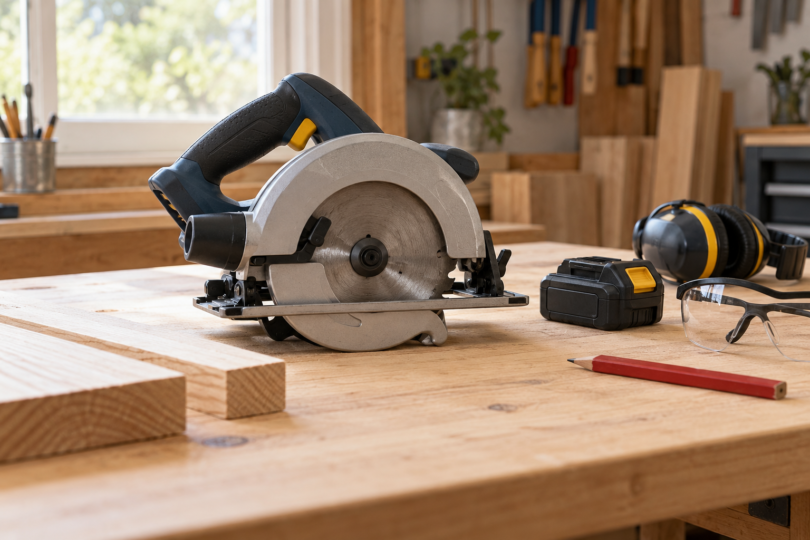

The best circular saw for women is the one that fits the user’s hands, strength, work position and projects. Gender does not determine the right blade size or power level. Start with a saw you can hold securely, reach the lock-off and trigger on without shifting your grip, and guide through the full cut while keeping the base supported.
These three choices cover different woodworking needs: a conventional cordless saw, a compact alternative and a corded model with greater cutting depth. The comparisons use manufacturer specifications and manuals; they are not hands-on test results.
Quick comparison
| Pick | Best fit | Cutting capacity | What to budget for |
|---|---|---|---|
| DEWALT DCS565B | General wood projects, especially with an existing compatible battery | 6-1/2-inch blade; 2-1/8 inches at 90°, 1-5/8 inches at 45° | Battery and charger sold separately |
| DEWALT DCS571B ATOMIC | A smaller blade and an elongated grip layout | 4-1/2-inch blade; maximum depth 39.5 mm in the current manual | Battery and charger sold separately |
| SKIL 5280-01 | Corded cutting with more depth and no battery purchase | 7-1/4-inch blade; 2-7/16 inches at 90°, 1-15/16 inches at 45° | Suitable power access and extension cord if needed |
Capacities are manufacturer ratings, not measured results. Blade diameter is not cutting depth, and the depth available decreases when the saw is tilted for a bevel cut.
1. DEWALT DCS565B: the versatile cordless choice
The DCS565B is the most useful starting point here for ordinary wood projects if its two-handle layout fits you. Its 6-1/2-inch blade has enough rated depth for common 1-1/2-inch-thick dimensional lumber at both 90° and 45°. DEWALT specifies a brushless motor, 4,950 RPM, a 0–50° bevel range, an LED worklight and an electric blade brake.
The practical advantage is the combination of conventional front and rear hand positions with cordless mobility. Check it with the battery you plan to use: a bare tool’s feel does not tell you how a larger battery will affect balance. The brake helps stop the blade after releasing the trigger, but you must still wait for a complete stop and check that the lower guard covers the blade before setting the saw down.
- Pros: useful wood-cutting depth; auxiliary handle; LED; electric brake; compatibility with DEWALT’s 20V MAX and FLEXVOLT batteries.
- Limits: battery and charger add to cost and working weight; no claim that its grip fits every hand; its manual limits it to wood cutting.
The B package includes the saw, DWA161218 blade, blade wrench and dust chute. It is not the DCS565P1 battery kit. The exact DCS565/DCS566 manual says not to cut metal, plastic, concrete, masonry or fiber cement. Follow that restriction even if a retailer or related-accessory carousel suggests another material.
2. DEWALT DCS571B ATOMIC: the compact-layout alternative
The DCS571B is worth comparing in person when a full-size saw feels awkward. Its 4-1/2-inch blade and elongated body give it a different reach and balance from the DCS565B. It has a removable auxiliary handle, a long finger trigger, an electronic brake and a dust port. A smaller blade does not automatically mean better control for your hands.
DEWALT describes cutting 2x material at 90° and 1x material at 45°. The current DCS571 manual gives a maximum cutting depth of 39.5 mm, about 1.55 inches. That is much less spare depth than the two larger saws, so measure your material and allow for the planned bevel before buying.
- Pros: compact blade format; auxiliary handle for control; electronic brake; rip fence and dust-port adapter in the B package.
- Limits: shallow capacity; battery and charger are separate; the long grip and rear battery can still feel awkward to some users.
Use the auxiliary handle and the hand positions in the manual. The supplied blade is for wood. Although the manual also lists fiber cement as an intended application, that requires the correct manufacturer-approved blade and dust precautions; the included wood blade is not a universal cutting accessory. The manual prohibits metal, plastic, concrete, masonry and wet-tile applications, and warns against abrasive wheels.
3. SKIL 5280-01: the corded choice for cutting depth
The SKIL 5280-01 suits a workspace with reliable power where battery ownership is not a priority. SKIL lists a 15-amp motor, 5,300 RPM, a 7-1/4-inch blade and an 8.7-pound tool weight. Its 51° bevel adjustment includes a stop at 45°. It has the greatest rated 90° cutting depth of these three picks.
Its contoured main handle, separate front handle and broad foot plate are useful features to assess during a fit check. The laser and dust blower can help you see the intended line, but neither guarantees a straight cut. The cord also needs a clear route so it cannot snag or enter the cutting path.
- Pros: no battery or charger to buy; deeper cuts; included 24-tooth carbide blade, wrench and carrying bag.
- Limits: 8.7 pounds may be tiring for some users; outlet and cord management matter; a laser does not replace careful alignment and support.
Follow the 5280 manual for blade fitting: a 7-1/4-inch blade with a 5/8-inch round arbor, rated for at least 5,300 RPM. Do not stare into the laser or direct it toward anyone. The manual says this tool is not designed for metal or masonry cut-off wheels.
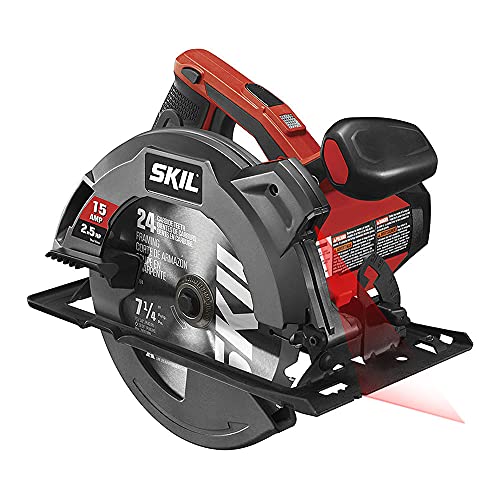
SKIL 5280-01 15-Amp 7-1/4-Inch Corded Circular Saw
As an Amazon Associate we earn from qualifying purchases.
How to choose a saw that feels manageable
Check reach before weight. With the tool unplugged or its battery removed, try the intended grip and locate the trigger lock, depth lever and bevel adjustment. You should not need to release a secure grip to reach the trigger. Then assess working balance with the intended battery fitted and the tool switched off. There is no single weight or handle size that fits all women.
Match the cut to the material. Measure actual thickness rather than relying only on nominal lumber sizes. Choose enough capacity for the bevel angle you need. Do not substitute a different blade diameter or arbor to gain depth; use the size and speed rating required by that saw’s manual.
Plan the whole setup. Include clamps, stable material supports, a suitable guide, eye and hearing protection, and the dust-control equipment specified for the work. A higher-capacity battery may add runtime and weight; a corded saw trades battery management for cable management. Compare complete usable setups, not bare-tool prices alone.
Safety checks before the first cut
Read the exact model manual before using any of these saws. Disconnect power before adjustments or blade changes. Check that the lower guard moves freely and closes promptly; never tie it open. Secure and support the workpiece as instructed, keep hands out of the blade path and below-workpiece cutting area, and position yourself to manage kickback. Never hold the workpiece in your hand or across your leg.
Use the manufacturer’s specified hand positions, a sharp suitable blade and the recommended protection. An electric brake, laser or small blade does not remove kickback risk. If you cannot hold and guide the saw securely through the intended cut, choose a different tool or get practical instruction before proceeding.
Which one should you buy?
Start with the DCS565B for versatile cordless wood cutting, especially if you already own suitable DEWALT batteries. Try the DCS571B when its compact layout solves a specific handling problem and its shallower capacity is enough. Choose the SKIL 5280-01 when a corded setup and greater depth matter more than minimizing the weight you carry. Personal grip fit and the planned cuts should decide between them.
Frequently asked questions
Do women need a special circular saw?
No. Choose by individual grip fit, trigger reach, working weight, balance and cutting requirements. Gender alone does not identify the right saw.
Is a smaller circular saw easier to control?
It can be for some users, but blade size alone does not determine control. Handle layout, battery position, work support and the required cutting depth also matter.
Do the DEWALT DCS565B and DCS571B include batteries?
No. Both B versions are tool-only packages with batteries and chargers sold separately. Check the exact kit number if you want a package with a battery.
Can these circular saws cut metal or masonry?
Do not treat these wood-oriented picks as general-purpose cut-off saws. The DEWALT manuals prohibit metal and masonry applications, and SKIL says the 5280 is not designed for metal or masonry cut-off wheels. Follow each exact manual and blade restriction.
Does an electric brake make the blade safe to touch immediately?
No. Keep clear until the blade has stopped completely, and check the lower guard before setting the saw down. Disconnect power before adjustments or blade handling; a blade may also be hot after use.