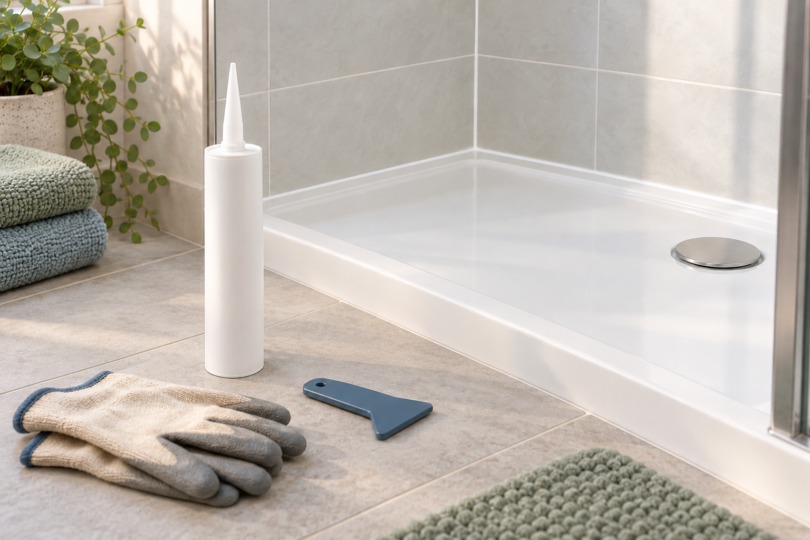

The best silicone sealant for a shower depends on the joint, the surfaces and how soon the shower needs to be used. GE Advanced Silicone 2 Kitchen & Bath is a useful all-round choice for compatible shower joints. DAP Silicone Max Kitchen & Bath in a small squeeze tube suits limited repairs. MAPEI Mapesil T Plus is the strongest fit here for coordinating a movement joint with MAPEI grout colors.
All three are 100% silicone sealants. Check the shower tray, enclosure and tile manufacturers’ requirements before choosing one, especially for unusual plastics, coated metal or natural stone.
Best shower silicone sealants at a glance
| Selected product | Best fit | Water exposure | Main limitation |
|---|---|---|---|
| GE Advanced Silicone 2 Kitchen & Bath, white, 10.1 fl oz cartridge, item 2812565 | General shower joints on compatible materials | 30 minutes only under GE’s specified bead, temperature and humidity conditions; otherwise 8 hours | Not for use under shower door tracks; not paintable |
| DAP Silicone Max Kitchen & Bath, gloss white, 2.8 fl oz squeeze tube, item 08795 | A small repair without a cartridge gun | 30 minutes at 73°F and 50% relative humidity | Acid-curing formula has important metal and plastic exclusions |
| MAPEI Mapesil T Plus, Warm Gray 5093, 10.1 US oz cartridge | Color-coordinated tile movement joints | Protect from water for at least 24 hours; some installations need longer | Porous stone can stain; full cure is much longer than initial water protection |
Water-ready time and full cure are different. The short intervals above do not mean the sealant has reached all of its final properties.
1. GE Advanced Silicone 2 Kitchen & Bath: best all-round choice
GE’s neutral-curing formula is a practical starting point for ordinary shower sealing work, provided the exact substrates and joint are approved. The manufacturer’s product page identifies the selected version as white, 10.1 fl oz, item 2812565. This is a cartridge for a caulking gun; the smaller squeeze tube is a separate size and item.
GE lists adhesion to many common bathroom materials, including ceramic and porcelain tile, glass, fiberglass, cultured marble and most metals and plastics. Its neutral cure and low-odor formulation make it worth considering where an acid-curing silicone’s metal restrictions would be inconvenient. That is still not blanket approval for every finish: GE requires manufacturer approval for galvanized surfaces or special coatings, and compatibility needs checking on the actual assembly.
The technical data sheet makes the 30-minute water-ready claim conditional on a bead no larger than 3/16 inch, temperature of at least 65°F and relative humidity of at least 50%. Otherwise, GE says to keep water off it for eight hours. It also says not to touch or clean the sealant for 24 hours, or until fully cured. Typical cure time is 24 hours at 73°F and 50% relative humidity, with temperature, humidity, substrate and bead depth affecting the result.
- Pros: Neutral-curing formula, broad documented bathroom uses and a detailed early-water-exposure allowance.
- Cons: Not paintable; the fast water-ready claim has conditions that may not match your bathroom.
- Fit limit: GE specifically excludes use under shower door tracks and continuous underwater contact. Do not select it for those jobs simply because the package says “Kitchen & Bath.”
Check GE Advanced Silicone 2 Kitchen & Bath and select the white 10.1 fl oz cartridge, item 2812565. Check the pack quantity and whether a caulking gun is sold separately.
2. DAP Silicone Max Kitchen & Bath: best small squeeze tube
The 2.8 fl oz gloss-white DAP Silicone Max, item 08795, is a convenient choice for a short joint or small repair when buying and handling a full cartridge would be unnecessary. The squeeze format does not need a cartridge gun. It still needs proper surface preparation and enough material to complete the joint continuously.
DAP identifies this as 100% silicone for interior kitchen, bath and plumbing applications, including showers and tubs. Its product page distinguishes the selected 2.8 fl oz tube from the larger 10.1 fl oz cartridges. The white tube’s UPC is 070798087958; avoid substituting a clear tube or a different DAP caulk based on brand alone.
The formula has a vinegar-like odor and uses an acid-curing silicone chemistry. The linked technical sheet says it is not recommended on or near brass, copper, copper alloys, zinc, iron, galvanized metals or other acid-sensitive surfaces. It also identifies adhesion and compatibility concerns with several plastics, including methyl methacrylate, polycarbonate, polypropylene, polyethylene and PTFE. Check an acrylic shower component’s manufacturer guidance instead of assuming every plastic is suitable.
At 73°F and 50% relative humidity, DAP specifies water resistance after 30 minutes and full cure after 24 hours. Low humidity may slow cure, and the sealant does not cure in totally confined spaces.
- Pros: Small squeeze tube, no cartridge gun required and clearly documented shower applications.
- Cons: Less material for a long joint; vinegar-like odor; not paintable.
- Fit limit: Its metal and plastic restrictions make it a less straightforward choice around mixed materials. It is also not intended for continuous underwater use.
Check DAP Silicone Max Kitchen & Bath and choose the 2.8 fl oz gloss-white tube, item 08795. The larger cartridge is a different purchase.
3. MAPEI Mapesil T Plus: best for color-coordinated tile joints
Mapesil T Plus is worth considering when the appearance of a tiled shower’s movement joints matters as much as a white seal around a tray. MAPEI makes it in colors coordinated with its grout palette, with a low-sheen finish for most colors. The selected version here is Warm Gray 5093 in a 10.1 US oz cartridge, not a tube of grout or an acrylic color-matched caulk.
The manufacturer lists showers, bathtubs, changes of plane and expansion or movement joints among its uses. Warm Gray falls under the product’s 25% movement classification; the different rating for Clear should not be transferred to this color.
Color coordination is helpful, but an exact visual match is not guaranteed. MAPEI warns that silicone and grout can differ slightly in color because their compositions differ. Compare a suitable sample with the finished grout. For natural stone, test first: Mapesil T Plus may stain porous materials.
Its technical sheet requires protection from water for at least 24 hours, and some installations need more time before the surface has adequate hardness. The same document lists 28 days for full cure, depending on temperature and humidity. Do not translate its separate pool-filling instructions into a shower cure time.
- Pros: Grout-color coordination, low sheen and explicit support for tile movement joints.
- Cons: Longer wait before water exposure than the conditional fast-water claims above; not paintable; a cartridge gun is needed.
- Fit limit: Test porous stone for staining and check adhesion where plasticizers or other contaminants may interfere. Apply within MAPEI’s stated 40–90°F range.
The selected listing is one Warm Gray 5093 cartridge, part 3BU509391. Check the color name and one-cartridge quantity before ordering; a cartridge gun and tooling accessories are separate.

MAPEI Mapesil T Plus 100% Silicone Sealant, Warm Gray 5093, 10.1 oz
As an Amazon Associate we earn from qualifying purchases.
What to check before buying shower silicone
Match the product to the joint
Silicone sealant forms a flexible joint. Grout fills the specified joints between tiles, while tile adhesive bonds tiles to the substrate. A silicone bead does not replace an incorrectly installed waterproofing system, repair a moving or damaged shower base, or automatically fix a leak behind the tiles.
“Caulk” is a broad shopping term, so read the chemistry on the label. A paintable acrylic or siliconized acrylic product is not the same formula as the 100% silicone products above. Use the sealant type and joint detail required by the shower and tile-system manufacturers.
Check every surface the bead will touch
A joint may meet tile, a plastic tray, coated metal and old residues in a small area. Approval for one material does not cover all of them. Read the exact formula’s exclusions, check the fixture manufacturer’s requirements and test compatibility where directed. For natural stone, look for staining as well as adhesion. For an enclosure or door track, follow its installation instructions, including drainage openings that must remain clear.
Choose the color, package and tools together
White is straightforward against a white tray; a coordinated color can make a tiled movement joint less conspicuous. Compare physical samples where appearance matters. Small squeeze tubes suit limited work, while cartridges use a caulking gun. Estimate the joint’s length, width and depth using the chosen product’s coverage guidance, and check the use-by date. A generic “one tube per shower” estimate is unreliable.
Prepare the joint and allow the specified cure
All three manufacturers call for clean, dry, sound surfaces. Remove old sealant and adhesion-blocking residue before resealing; applying a fresh layer over failed silicone is not the preparation described in their instructions. Use cleaning methods compatible with the substrate and product, and let the joint dry.
Read the label, technical sheet and safety data sheet before application. Provide the required ventilation and wear the specified gloves and eye protection. Tool within the product’s stated working time, follow its joint-size and backer-rod instructions, and keep water off it for the applicable interval. A skin on the surface does not prove full cure, and cool or dry conditions can change the schedule.
Which shower sealant should you choose?
Start with GE Advanced Silicone 2 for a compatible general shower joint, especially when neutral cure is useful. Choose the small DAP Silicone Max tube for limited work on approved substrates. Choose MAPEI Mapesil T Plus for a color-coordinated tile movement joint when you can allow its specified protection and cure times. Substrate approval and correct installation take priority over a fast-water-ready claim.
Frequently asked questions
Is silicone the same as caulk or grout?
No. Caulk is a broad term that covers different sealant chemistries. These three products are 100% silicone sealants for appropriate flexible joints. Grout and tile adhesive have different roles, and a bead of silicone does not replace a shower’s waterproofing system.
How long must shower silicone dry before getting wet?
Follow the exact product’s instructions. GE permits water after 30 minutes only with a bead no larger than 3/16 inch, at least 65°F and at least 50% relative humidity; otherwise it specifies eight hours. DAP’s 30-minute figure is at 73°F and 50% relative humidity. MAPEI requires at least 24 hours protected from water, with some installations needing longer. These are not all full-cure times.
Can I apply new silicone over old shower sealant?
The manufacturers’ preparation instructions require clean, dry, sound surfaces free of old sealant and other adhesion-blocking residue. Remove the failed material, use a compatible cleaning method and let the joint dry before applying the replacement product.
Will mold-resistant silicone keep a shower permanently mold-free?
No. Product protection does not make the whole shower mold-proof. Soap and other residue can support growth on the surface, so cleaning and suitable bathroom ventilation still matter. Repeated failure may also require checking for retained moisture, poor adhesion or an underlying leak.
Can I use any silicone on an acrylic tray or natural stone?
No. Check both the sealant instructions and the fixture or stone manufacturer’s requirements. DAP lists compatibility concerns with several plastics, and MAPEI warns that porous stone may stain. Test where directed, and obtain guidance for unlisted substrates or special coatings before application.